3
    Third GradePowered by ThirdGrade.com

    Daily lesson plan

    Day 4 · Thursday

    Week 33 · Synthesis: Area, Shapes, Research, Traits & Civic Action

    See what your state adds or places differently

    Suggested daily schedule
    8:30–8:45 AM15 minMorning Circle / Read-Aloud / Calendar
    8:45–10:00 AM75 minEnglish Language Arts
    10:00–11:00 AM60 minMathematics
    11:00–11:15 AM15 minSnack and Movement Break
    11:15–12:00 PM30–45 minScience (every day)
    12:00–12:45 PM30–45 minSocial Studies (every day)
    12:45–1:30 PM45 minLunch and Choice Time
    1:30–2:15 PM45 minSpecials: PE / Art / Music (rotating)
    2:15–2:45 PM30 minIndependent Reading & Journaling

    Social Studies

    Objective: I can make a step-by-step plan for one civic action and predict its results.

    Standards: D4.7.3-5, D4.8.3-5

    Builds on: Needs the facts and sources from Day 3. One-minute check: "Tell me your best fact and where it came from." (Answers vary. Look for a fact and its source.)

    Materials: Civic Action Project planner, Step 4 (or a notebook page titled Step 4), Calendar, A box (to hold the project materials), Notebook, Pencil

    1. Warm-Up · 5 min

      Spaced review from Week 22. Ask: "In a fair vote, how many votes does each person get?" (One. Every vote counts the same.) Then ask the big question: "What one action could make a difference for your issue?"

    2. Mini-Lesson · 10–15 min

      Say: "A good plan answers six questions." Count them on your fingers. "What will we do?" "What is our goal?" "When?" "Who will help?" "What do we need?" "How will we know it worked?" Show five kinds of action. Say: "You could write a polite letter to the department in charge. You could hold a cleanup with family. You could run a collection drive. You could make a poster for a library or school. You could do a kindness project." Model a plan. Say: "Action: collect cans for the food bank. Goal: 50 cans in one week. Helpers: Mom puts up flyers, and my brother carries the box. Materials: a box from home and a $3 poster board." Say: "Now I predict. I think we will collect 30 to 50 cans. Later we compare the prediction with what really happens." Say: "A goal needs a number so we can count it. 'Help the food bank' cannot be counted. '50 cans' can." Ask: "Which of the six questions does '50 cans' answer?" (What is our goal?) Ask: "Change 'help the animal shelter' into a goal you can count." (Sample: collect 20 old towels by Friday.) Ask: "Why predict before acting?" (So we can compare it with the real result and learn.) If stuck, say: "What could we count or show when we finish?"

    3. Activity / Source Work · 15–20 min

      Plan it. 1) Your child and the helpers talk over the action choices. Each person gives one idea and one reason. Agree on one action together. 2) On Step 4, your child writes the action and a goal with a number. 3) Write a date for each step on the calendar. 4) Name two helpers and give each a job. 5) List the materials and any costs. Put what you already have into the box. 6) Write one safety rule. Sample: "Always work with an adult, and never share our address online." 7) Your child writes a prediction: "I predict ___ because ___." 8) Check the plan with a two-column chart in the notebook: Six questions | Answered? Tick each one. Plans vary. Look for a goal you can count and a date on every step.

    4. Notebook Entry · 10 min

      Your child writes the plan as a numbered list of four to six steps. Then draw what success would look like. Sample: "1. Make a flyer Monday. 2. Put the box by the door Tuesday. 3. Count the cans each night. 4. Take the cans to the food bank Saturday."

    5. Exit Ticket · 5 min

      Your child answers from the written plan. Praise a goal with a number and jobs with names.

    Watch for: Setting a goal that cannot be counted, such as "make the park nicer."

    Try: Ask: "What could we count or show?" Rewrite the goal with a number and a date.

    Exit ticket:
    1. What is your action? What number is in your goal?
    2. Name two helpers and the job each one will do.
    3. What is your prediction? How will you find out if it was right?
    Show answers
    1. Answers vary. Look for: one clear action and a goal that can be counted, such as 40 cans or two bags of litter.
    2. Answers vary. Look for: two real people with specific jobs.
    3. Answers vary. Look for: an expected result and a way to check it, such as counting items or a reply to a letter.

    Support: Offer three ready plans: a cleanup, a collection drive or a letter. Your child picks one and fills in the dates and helpers.

    Extend: Your child plans two actions that work together, such as a poster and a collection box. Put the steps in order.

    Homework: Your child gathers the rest of the materials on the list and puts them in the box. Look for each listed item checked off.

    Practice page · Week 33, Day 4

    Social Studies

    I can make a step-by-step plan for one civic action and predict the result.

    Sofia's Plan

    What: collect warm hats for the family shelter. Goal: 30 hats. When: Monday to Friday next week. Who: Dad puts flyers on the bulletin board, and Sofia's sister decorates the box. Materials: a box from home and a $2 poster board. Safety: an adult is always with us, and we never share our address online. Prediction: we will collect 20 to 30 hats.

    Use Sofia's plan above.

    1. 1.

      What is Sofia's goal?

    2. 2.

      Name one helper and the helper's job.

    3. 3.

      Which goal can be counted?

      ○ Collect 30 hats.○ Make people happy.○ Help a lot.
    4. 4.

      Why does Sofia write a prediction before she acts?

    Plan It: write each step of your plan with a date and a helper.

    StepDateWho helps


    1. 5.

      My goal (a number):

    2. 6.

      My safety rule:

    Challenge: How will you know if your action worked?

    Materials: calendar · Civic Action Project planner
    Mathematics

    Objective: I can name quadrilaterals and draw ones that are not squares, rectangles or rhombuses.

    Standards: 3.G.A.1

    Builds on: Needs Week 33 Days 1 and 2: a quadrilateral is any polygon with 4 sides and 4 vertices. One-minute check: your child draws any quadrilateral and counts its sides (4).

    New words:
    • square corner – a corner that fits the corner of an index card exactly
    • rhombus – a quadrilateral with 4 equal sides

    Materials: 6 quadrilateral cards. Before the lesson, draw each on grid paper with the ruler and cut it out. Square: 4 by 4. Rectangle: 6 long and 2 tall. Rhombus: mark the middle of each side of a rectangle 6 long and 4 tall, then join the 4 marks. Roof shape: bottom side 6 long; top side 2 long, 3 rows higher and centered; join the ends. Kite: mark a top point; mark two side points 1 row lower, one 2 squares to the left and one 2 squares to the right; mark a bottom point 6 rows below the top point; join top to sides and sides to bottom. Lopsided shape: bottom side 6 long; mark a point 1 square right and 2 rows up from its left end, and a point 1 square left and 3 rows up from its right end; join the 4 points. Keep the cards for Week 34., Scissors (to cut out the cards), Ruler, Index card (to test square corners), Grid paper, Notebook, Pencil

    1. Warm-Up · 5 min

      Spaced review from Week 32 Day 2. A square has a perimeter of 12 units. Your child finds the length of each side (12 ÷ 4 = 3 units). Then practice ×6 facts with no clock. Ask 6 × 4, 6 × 6 and 6 × 9 (24, 36, 54).

    2. Mini-Lesson · 10–15 min

      Say: "Every quadrilateral has 4 sides and 4 vertices. Some have special names. We test two things: corners and sides." Show the test. Say: "A square corner fits the corner of an index card exactly." Work the square card fully. Fit the index card into each corner. Ask: "How many square corners?" (4) Measure each side with the ruler. (All 4 sides are equal.) Say: "It has 4 square corners and 4 equal sides. So this shape is a square." Test the rectangle card. Say: "It has 4 square corners, but its sides are 6, 2, 6 and 2. It is a rectangle." Test the rhombus card. Say: "It has 4 equal sides, but no square corners. A quadrilateral with 4 equal sides is a rhombus." Now your child does more. Your child tests the kite, roof and lopsided cards. (None has 4 square corners or 4 equal sides. All are still quadrilaterals.)

    3. Guided Practice · 10–15 min

      Your child tests every card with the index card and the ruler. 1) Sort the 6 cards into four groups. (1 square, 1 rectangle, 1 rhombus, 3 other quadrilaterals) 2) Turn the square card onto one corner. Ask: "Is it still a square?" (Yes. Its corners and sides did not change.) 3) Ask: "Does the square pass the rhombus test, 4 equal sides?" (Yes. A square is a special rhombus.) 4) On grid paper, your child draws a quadrilateral that is not a square, rectangle or rhombus. (Sample: bottom side 5, top side 2, slanted ends.) If stuck, say: "Check two things. Do all four corners fit the card? Are all four sides the same length?"

    4. Independent Practice · 15–20 min

      Your child draws with a ruler on grid paper, then tests corners and sides. 1) Draw a square with sides 3 units long. Count its square corners and equal sides. (4 and 4) 2) Draw a rectangle 5 units long and 2 units tall. Is it a square too? (No. Its sides are not all equal.) 3) Mark the middle of each side of a rectangle 4 long and 2 tall. Join the 4 marks. Name the new shape. (a rhombus; 4 equal sides) 4) Draw a quadrilateral with no square corners and no equal sides. (It has no special name.) 5) Draw a quadrilateral with exactly 2 square corners. (Sample: bottom side 5, left side straight up 3, top side 2.) 6) You turn the rhombus card on its side. Your child names it. (still a rhombus) 7) A kite has two sides of 2 feet and two sides of 4 feet. Can it be a rhombus? (No. Its sides are not all equal.) 8) A frame has sides of 4, 6, 4 and 6 inches. One corner does not fit the index card. Is it a rectangle? (No. A rectangle needs 4 square corners.)

    5. Exit Ticket · 5 min

      Read each question aloud; your child answers on grid paper and may use the ruler and the index card.

    Watch for: Believing a tilted square is no longer a square and calling it a diamond.

    Try: Turn the card slowly while your child retests one corner and one side. Turning a shape does not change its name.

    Fact fluency: ×6 facts

    Exit ticket:
    1. How do you test for a square corner?
    2. What two things do you test to name a quadrilateral?
    3. Draw a quadrilateral with exactly 1 square corner. Is it a square, a rectangle, a rhombus or none of these?
    Show answers
    1. Fit the corner of an index card into it. It must match exactly.
    2. Whether the corners are square and whether the sides are equal.
    3. None of these. The drawing has 4 sides and only one corner that fits the card.

    Support: Give your child a checklist for each card: 4 sides? 4 square corners? 4 equal sides? Your child ticks each line, then names the shape.

    Extend: Your child draws a quadrilateral with one corner pushed in, like an arrowhead. Is it still a quadrilateral? (Yes. It is closed and has 4 straight sides.)

    Homework: Your child sketches three quadrilaterals seen at home and labels each one square, rectangle, rhombus or other quadrilateral. Sample: a window is a rectangle; a floor tile is a square.

    Practice page · Week 33, Day 4

    Mathematics

    I can name quadrilaterals and draw ones that are not squares, rectangles or rhombuses.

    Look: special names

    1. Every quadrilateral has 4 sides and 4 vertices.
    2. Check corners with the corner of an index card.
    3. Measure sides with a ruler to see if they are equal.

    Write the most specific name.

    Word bank: square · rectangle · rhombus · quadrilateral

    1. 1.

      4 equal sides and 4 square corners

    2. 2.

      4 square corners, but the sides are not all equal

    3. 3.

      4 equal sides, but no square corners

    4. 4.

      4 sides of different lengths and no square corners

    Draw with a ruler. Check corners with the corner of a card.

    1. 5.

      Draw a quadrilateral that is not a square, rectangle or rhombus.

    2. 6.

      What does every quadrilateral have?

    Challenge: Why can a square also be called a rectangle and a rhombus?

    Materials: ruler · index card

    English Language Arts

    Objective: I can rehearse my talk and answer audience questions with details.

    Standards: SL.3.4, SL.3.6, SL.3.3

    Builds on: Needs the note cards, the visual aid and follow-up questions from Week 32. One-minute check: ask "What is a follow-up question?" (A question that digs deeper into what the speaker just said.)

    New words:
    • three-part answer – say the question again, answer it, and add a detail
    • rehearse – to practice a talk the way you will really give it

    Materials: Note cards, Visual aid, Clock, Writer's notebook, Pencil, A family member as audience

    1. Warm-Up · 5 min

      Word study (about 3 minutes). Use four words in meaning. Ask: "Which word names the dirt that plants grow in?" (soil) "Which word means to like doing something?" (enjoy) "Which word means to send a boat or rocket off?" (launch) "Point has two meanings. Name both." (A sharp tip, and to show with a finger.) Your child says one sentence with each word. Spaced review from Week 31. Ask: "Is adding a missing comma revising or editing?" (Editing.)

    2. Mini-Lesson · 10–15 min

      Say: "After a talk, listeners ask questions. A strong answer has three parts. Say the question again. Answer it. Add a detail from your research." Read aloud this "Fact Card: The Otters Come Back": Long ago, hunters killed sea otters for their thick fur. By 1911, only about 1,000 to 2,000 otters were left in the world. That year, several countries signed a treaty that stopped the hunt. Slowly, the otters came back. Today, more than 100,000 sea otters live along the coasts of the northern Pacific Ocean. Model with the card. Say: "A listener asks, Why did people hunt sea otters? I answer: Why did people hunt sea otters? They wanted the fur. Otter fur is very thick." Your child counts the three parts on fingers. Then teach the honest answer: "Good question. My sources did not say, but I can look it up." Say: "Always answer in complete sentences, never just yes or no."

    3. Guided Practice · 10–15 min

      Use the fact card. 1) Ask: "How many otters were left by 1911?" (How many otters were left by 1911? Only about 1,000 to 2,000 were. Hunters had taken the rest.) 2) Ask: "What stopped the hunt?" (What stopped the hunt? A treaty did. Several countries signed it in 1911.) 3) Ask: "How long does a sea otter live?" (The card does not say. Your child gives the honest answer.) 4) Together, predict three questions about your child's own topic and write them in the notebook. Your child answers each with three parts. Then watch one full run of the talk. Give one glow (a strength) and one grow (a next step). If stuck, say: "Say my question back to me. Now answer it. Now add one fact."

    4. Independent Practice · 15–20 min

      Your child rehearses with the cards, the visual aid and the clock. 1) Give the full talk twice more. Write down each time in the notebook. 2) After the last run, a family member asks two questions. 3) Your child answers each with three parts. Look for: a talk of 3 to 5 minutes and the visual shown at the star. Each answer uses a fact from the report.

    5. Exit Ticket · 5 min

      Ask the three questions. Your child stands to answer question 1 as if facing an audience.

    Watch for: Answering a question with "yes," "no" or "I don't know" and then stopping.

    Try: After every short answer, say: "Tell me one fact that goes with that." Your child adds it in a complete sentence.

    Exit ticket:
    1. I ask: 'What was the most surprising thing you learned?' Give a three-part answer.
    2. Which question we predicted was hardest? Answer it again with a detail.
    3. Tell one glow and one grow from your rehearsal today.
    Show answers
    1. Answers vary. Look for: the question said again, an answer, and one detail from the report.
    2. Answers vary. Look for: all three parts, or the honest answer if the sources did not say.
    3. Answers vary. Look for: one real strength and one change your child can make.

    Support: Your child keeps a question card. It lists three likely questions with one key-word answer for each.

    Extend: Your child prepares one extra fact to share only if a listener asks about it.

    Homework: Give your talk one last time for a family member. Answer one surprise question with a three-part answer.

    Practice page · Week 33, Day 4

    English Language Arts

    I can answer audience questions with details.

    Look: a three-part answer

    1. Repeat the question.
    2. Answer it.
    3. Add a detail from your research.

    Fact Card: Honeybees

    Honeybees dance to tell other bees where flowers are. A waggle dance shows which way to fly. A bee in winter stays in the hive and huddles with others to keep warm.

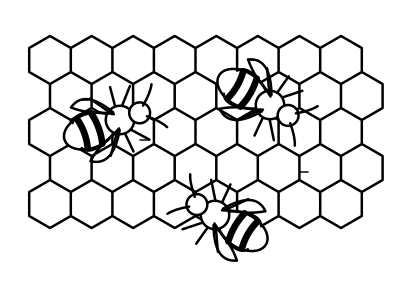
    Three honeybees crawl on a honeycomb made of six-sided wax cells.

    Use the fact card above.

    1. 1.

      Question: 'How do bees tell each other where flowers are?' Write a three-part answer.

    2. 2.

      Question: 'What do bees do in winter?' Write a three-part answer.

    3. 3.

      Someone asks a question you cannot answer. What can you say?

    4. 4.

      Write one question an audience might ask about your topic.

    Circle the word that is spelled correctly.

    1. 5.

      Which is correct?

      ○ point○ poynt
    2. 6.

      Which is correct?

      ○ enjoi○ enjoy

    Challenge: Give your talk once. Write one glow (something strong) and one grow (something to improve).

    Science

    Objective: I can use fossils as evidence of what environments were like long ago.

    Standards: 3-LS4-1

    Builds on: Needs Day 2 on sediment layers and Week 11, where each living thing needs a certain habitat. One-minute check: ask, "Could coral live in a desert? Why not?" (No. Coral needs warm, shallow sea water.)

    New words:
    • rock layer – a flat band of rock that formed from sediment, with newer layers on top of older ones

    Materials: World map or globe, 3 sheets of plain paper (model rock layers), Colored pencils, Science notebook and pencil

    1. Day 164 — Fossils and Past Environments — Wonder Warm-Up · 5 min

      Spaced review from Week 20. Ask: "What is climate?" (The usual weather pattern of a place over many years.) Then the wonder. Ask: "Suppose you found seashells inside the rock on a mountaintop. What would you think?"

    2. Mini-Lesson · 10–15 min

      Say: "Each kind of living thing needs a certain environment. So a fossil is a clue about the place where it lived." Say: "Fossil seashells are found in rock high on mountains. That rock formed under a sea long ago. Later the land was slowly pushed up." Say: "Fossil leaves and tree trunks are found in Antarctica. Today ice covers it. Long ago it was much warmer and had forests." Say: "Earth's surface changes very slowly, over millions of years." Now lay down the 3 sheets one at a time in a stack. Say: "Sediment settles in layers. The first layer ends up on the bottom." Your child labels the bottom sheet "oldest" and the top sheet "youngest." Say: "So fossils in lower rock layers are usually older than fossils above them." Ask: "A leaf fossil lies two layers above a coral fossil. Which living thing lived there later?" (The plant with the leaf.) Ask: "Fossil leaves of warm-weather trees are found where winters are long and snowy. What was that place like long ago?" (Warmer.) If stuck, say: "What does this living thing need? So what was the place like?"

    3. Investigation / Hands-On · 15–20 min

      Past and Present Chart. 1) Read three cases. Your child finds each place on the map or globe. Case 1: sea animal fossils in rock high in the Himalaya mountains of Asia. Case 2: fossil forests in Antarctica. Case 3: stone logs of giant trees in the dry desert of Arizona. 2) Your child fills in a table: Place | Fossils found | Past environment | Environment today. (Himalayas: a sea; high, cold mountains. Antarctica: a warmer forest; ice. Arizona: a wet forest; dry desert.) 3) For each row they say: "My evidence is ___." 4) Layer story. With colored pencils, your child draws one fossil on each sheet. A trilobite goes on the bottom, a fern in the middle and a mammoth tooth on top. Say: "Woolly mammoths lived on cold grasslands." Your child tells the story from the bottom up. (A sea. Then damp land with ferns. Then cold grassland.) Look for a past environment that matches what each living thing needed. Say: "Scientists check many fossils before they decide."

    4. Science Notebook Entry · 10 min

      In the notebook, your child chooses one place and draws it twice, labeled "Long Ago" and "Today." Under the drawings they finish the frame: "Long ago this place was ___. My evidence is ___." Sample: "Long ago this place was a forest. My evidence is the stone logs in the desert."

    5. Wrap-Up & Exit Ticket · 5 min

      Ask the three exit questions aloud; your child answers aloud or in writing. Praise each answer that uses the word evidence.

    Watch for: Thinking sea animals climbed the mountain, or that people carried the shells up.

    Try: Say that the shells are inside the rock itself. The rock formed under the sea, and then the land rose very slowly.

    Exit ticket:
    1. A farm field far from any ocean has fossil coral in its rock. What once covered that land?
    2. Fossil tree stumps are found on an Arctic island where no trees grow today. What does that suggest about the past?
    3. Why can a living thing's needs tell us what a place was like long ago?
    Show answers
    1. A warm, shallow sea.
    2. The island was once warm enough for forests.
    3. Each kind needs a certain environment. Its fossil is evidence that the place once had that environment.

    Support: Do the Antarctica case together. Your child does the Arizona case alone with the hint, "What do big trees need?"

    Extend: Your child draws a three-layer cliff with one fossil in each layer. A family member reads the story from bottom to top.

    Homework: Ask a family member, "What might our town have been like long ago?" Draw one idea and the fossil that would be evidence. Look for: the fossil fits the environment.

    Practice page · Week 33, Day 4

    Science

    I can use fossils as evidence of what places were like long ago.

    Rocks Remember

    Fossils are clues about the past. If scientists find fossils of sea animals in rock on dry land, they know that land was once under water. If they find fossils of plants that need warm weather in a cold place, they know that place was once warmer. Places on Earth change over very long times.

    Past and Present Chart. Fill in each place you studied.

    PlaceFossils foundPast environmentEnvironment today


    Use the fossils as evidence.

    1. 1.

      Fossil corals are found in rock in Indiana, far from any ocean. What does this tell us?

    2. 2.

      Whale fossils are found in a desert in Egypt. What was this place like long ago?

    3. 3.

      A shell fossil is in a low rock layer. A leaf fossil is in a layer above it. Which fossil is probably older? Why?

    Challenge: Fossils of warm-weather plants are found in a very cold place. What does this tell us?

    Materials: world map or globe · fossil pictures