Week 33 · Day 4 Practice Pages
Practice page · Week 33, Day 4
Mathematics
I can name quadrilaterals and draw ones that are not squares, rectangles or rhombuses.
Look: special names
- Every quadrilateral has 4 sides and 4 vertices.
- Check corners with the corner of an index card.
- Measure sides with a ruler to see if they are equal.
Write the most specific name.
Word bank: square · rectangle · rhombus · quadrilateral
- 1.
4 equal sides and 4 square corners
- 2.
4 square corners, but the sides are not all equal
- 3.
4 equal sides, but no square corners
- 4.
4 sides of different lengths and no square corners
Draw with a ruler. Check corners with the corner of a card.
- 5.
Draw a quadrilateral that is not a square, rectangle or rhombus.
- 6.
What does every quadrilateral have?
Challenge: Why can a square also be called a rectangle and a rhombus?
Materials: ruler · index card
Practice page · Week 33, Day 4
English Language Arts
I can answer audience questions with details.
Look: a three-part answer
- Repeat the question.
- Answer it.
- Add a detail from your research.
Fact Card: Honeybees
Honeybees dance to tell other bees where flowers are. A waggle dance shows which way to fly. A bee in winter stays in the hive and huddles with others to keep warm.
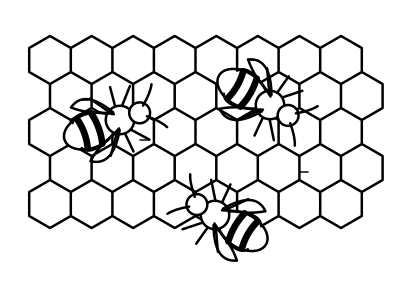
Use the fact card above.
- 1.
Question: 'How do bees tell each other where flowers are?' Write a three-part answer.
- 2.
Question: 'What do bees do in winter?' Write a three-part answer.
- 3.
Someone asks a question you cannot answer. What can you say?
- 4.
Write one question an audience might ask about your topic.
Circle the word that is spelled correctly.
- 5.
Which is correct?
○ point○ poynt - 6.
Which is correct?
○ enjoi○ enjoy
Challenge: Give your talk once. Write one glow (something strong) and one grow (something to improve).
Practice page · Week 33, Day 4
Science
I can use fossils as evidence of what places were like long ago.
Rocks Remember
Fossils are clues about the past. If scientists find fossils of sea animals in rock on dry land, they know that land was once under water. If they find fossils of plants that need warm weather in a cold place, they know that place was once warmer. Places on Earth change over very long times.
Past and Present Chart. Fill in each place you studied.
| Place | Fossils found | Past environment | Environment today |
|---|---|---|---|
Use the fossils as evidence.
- 1.
Fossil corals are found in rock in Indiana, far from any ocean. What does this tell us?
- 2.
Whale fossils are found in a desert in Egypt. What was this place like long ago?
- 3.
A shell fossil is in a low rock layer. A leaf fossil is in a layer above it. Which fossil is probably older? Why?
Challenge: Fossils of warm-weather plants are found in a very cold place. What does this tell us?
Materials: world map or globe · fossil pictures
Practice page · Week 33, Day 4
Social Studies
I can make a step-by-step plan for one civic action and predict the result.
Sofia's Plan
What: collect warm hats for the family shelter. Goal: 30 hats. When: Monday to Friday next week. Who: Dad puts flyers on the bulletin board, and Sofia's sister decorates the box. Materials: a box from home and a $2 poster board. Safety: an adult is always with us, and we never share our address online. Prediction: we will collect 20 to 30 hats.
Use Sofia's plan above.
- 1.
What is Sofia's goal?
- 2.
Name one helper and the helper's job.
- 3.
Which goal can be counted?
○ Collect 30 hats.○ Make people happy.○ Help a lot. - 4.
Why does Sofia write a prediction before she acts?
Plan It: write each step of your plan with a date and a helper.
| Step | Date | Who helps |
|---|---|---|
- 5.
My goal (a number):
- 6.
My safety rule:
Challenge: How will you know if your action worked?
Materials: calendar · Civic Action Project planner