Builds on: Needs Weeks 6 to 8: the Native nation of your area, the Week 7 T-charts and the Week 8 founding card. One-minute check: ask, "When was our town founded?" (The year on the founding card.)
Materials: Notebook, Long paper strip (cut a sheet the long way and tape the halves end to end), Tape, Markers, This unit's T-charts and founding card, Pencil
Day 43 — Q1 Review: Native Nations, Explorers, and Settlers — Big Question Warm-Up · 5 min
Ask three review questions from Weeks 6 and 7 before opening any notes. "Who lived here first?" (The Native nation or nations from Week 6, by name.) "Who came next?" (Explorers and settlers from Europe, and enslaved Africans who were forced to come.) "What happened when they met?" (Both cooperation and conflict.) Then ask the big question: "How can one strip of paper tell our area's story fairly?"
Mini-Lesson · 10–15 min
Today is review. Go through six ideas with one question each. Ask: "Name a nation whose homeland includes our area. Does it live here or nearby today?" (The name from Week 6. Yes, it is a living nation.) "Why did Haudenosaunee builders cover longhouses with bark?" (Their forests gave them bark.) "Name one reason settlers came, and one group forced to come." (Sample: land to farm; enslaved Africans.) "A treaty is a written agreement between whom?" (nations) Now show how to give two points of view. Hold up the Week 7 T-chart. Say: "One event, two views." Model one: "A settler family plows a new field. The settlers say it will feed them. A Native family says it was their planting ground." Then your child tries. Say: "Settlers build a town beside a river. Give two views." (Sample: Settlers have water and a mill. A Native nation loses a place it has always used.) Last, your child reads the founding year from the founding card. If stuck, say: "Say first, next, then, today, and point along the strip."
Activity / Source Work · 15–20 min
Build a four-step history timeline on the strip. 1) Tape the strip flat. Your child draws a long line with a marker and makes four marks. 2) Step 1, far left: write the Native nation's name and "lives here." Draw an arrow under the whole line to today. 3) Step 2: "Europeans arrive. There is cooperation and conflict." 4) Step 3: "Settlers found our community," with the year. 5) Step 4: "Our community today." 6) Your child adds one fact under each step from the notebook. 7) At Step 2 or 3, add one sentence giving the Native nation's point of view. Use a fact from your Week 6 or Week 7 notes, not a guess. 8) Under Step 3, write what the Native nation was doing or facing in those same years. If your sources do not say, write "find out." 9) Check together. Look for: the events are in order, and Step 1 uses present-tense words such as "lives."
Notebook Entry · 10 min
Your child copies the timeline into the notebook with one fact at each step. Then write it as four sentences with these frames: "First ____. Next ____. Then ____. Today ____." Sample ending: "Today the nation and our town are both here."
Wrap-Up & Exit Ticket · 5 min
Read the exit questions aloud; your child may look at the strip. Praise present-tense words about the Native nation.
Watch for: Putting the town's founding before the Native nation, or ending the nation's story in the past.
Try: Start at the far left with the nation's name. Draw the arrow to today before adding anything else.
Exit ticket:
Retell our area's history in four sentences. Use first, next, then and today.
Which step on your timeline has an arrow that runs all the way to today? Why?
Pick one event on your timeline. Tell two points of view about it.
Show answers
Answers vary. Look for: the Native nation first, Europeans arriving, the founding year, and today, in order.
Step 1, the Native nation. It is a living nation today.
Answers vary. Look for: two different views of one event, each with a reason.
Support: Write the four step labels on the strip yourself. Your child says one fact for each step, then writes it.
Extend: Make a national strip beside the local one: 1830, Indian Removal Act; 1838 to 1839, Trail of Tears. Ask what was happening in your town then.
Homework: Retell the four-step timeline to a family member with the words first, next, then and today. Look for: the right order, and "lives here" for the Native nation.
Practice page · Week 9, Day 3
Social Studies
I can put the history of my area in order and give more than one view.
Fill in the 4-step history timeline with one fact at each step.
Step
Event
One fact
1.
Step 1: Native nations live here (and still do):
2.
Step 2: Europeans arrive:
3.
Step 3: Settlers found our town:
4.
Step 4: Our town today:
Answer each question.
5.
Give one settler view and one Native view of a new town.
6.
What is a treaty?
7.
Did everyone who came to North America choose to come?
○ Yes○ No
Challenge:Why does Step 1 say "and still do"?
Materials: long paper strip
Mathematics
Objective: I can show multiplication with equal groups and arrays and write two equations for an array.
Standards: 3.OA.A.1, 3.OA.A.3, 3.OA.B.5
Builds on: Review of Week 4 equal groups and arrays. One-minute check: say "3 rows of 5." Your child draws it and writes the multiplication (3 × 5 = 15).
New words:
equation – a number sentence with an equals sign, such as 3 × 5 = 15
Materials: 30 counters (dried beans, coins or buttons), Sheet of plain paper, Grid paper, Crayons, Notebook, Pencil
Warm-Up · 5 min
Spaced review from Week 3. Write 700 − 256. Your child solves it (444). Then ask 3 × 7 and 6 × 7, then 3 × 8 and 6 × 8 (21, 42, 24, 48). Ask: "What do you notice?" (Each ×6 product is double the ×3 product.)
Mini-Lesson · 10–15 min
Say: "Today we review equal groups and arrays." On the plain paper, build 6 rows of 4 beans. Ask: "How many rows? How many in each row?" (6; 4) Write 6 × 4 = 24. Slowly turn the paper a quarter turn. Ask: "How many rows now? How many in each?" (4; 6) Write 4 × 6 = 24. Ask: "Did we add or take away any beans?" (No.) Say: "One array gives two equations. Turning it does not change the total." Now your child does more. Your child outlines 3 rows of 7 on grid paper and colors it. Ask: "What two equations match your array?" (3 × 7 = 21 and 7 × 3 = 21)
Guided Practice · 10–15 min
1) Your child draws 5 rows of 6. Then your child writes two equations (5 × 6 = 30 and 6 × 5 = 30). 2) Your child draws 2 groups of 8 as circles with dots and writes the equation (2 × 8 = 16). 3) A room has 4 rows of 9 chairs. How many chairs in all? (4 × 9 = 36) If stuck, say: "How many groups or rows? How many in each one? Write the number of groups first."
Independent Practice · 15–20 min
1) Draw an array for 2 × 9. Write two equations (2 × 9 = 18 and 9 × 2 = 18). 2) Draw an array for 6 × 8. Write two equations (6 × 8 = 48 and 8 × 6 = 48). 3) Draw 3 groups of 6 as circles with dots (3 × 6 = 18). 4) Write 8 + 8 + 8 + 8 + 8 as multiplication (5 × 8 = 40). 5) You draw 4 rows of 4. Ask: "Does turning it give a new equation?" (No. Both are 4 × 4 = 16.) 6) Tariq has 9 packs of 3 cards. How many cards in all? (27) 7) Elena plants 8 rows of 5 seeds. How many seeds in all? (40) 8) Each jump rope is 7 feet long. Four ropes lie end to end. Write 4 × 7 = ? and solve. (28 feet)
Exit Ticket · 5 min
Put the beans away. Read each question aloud; your child answers on grid paper.
Watch for: Thinking the turned array has a different total, and counting it again from one.
Try: Your child builds the array on paper and turns it by hand. Ask: "Did any bean come or go?" Then write both equations.
Fact fluency: ×3 and ×6 facts
Exit ticket:
Draw an array for 7 × 5. How many in all?
Write two multiplication equations for that array.
Kofi has 3 boxes with 8 markers in each. How many markers in all?
Show answers
35 (drawing shows 7 rows of 5)
7 × 5 = 35 and 5 × 7 = 35
24
Support: Build every array with beans before drawing it. Keep to 5 rows or fewer, such as 2 rows of 5 and 3 rows of 4.
Extend: Give your child 24 beans. Ask for every array that uses all of them with no more than 10 rows or columns. Answers: 3 × 8 = 24, 8 × 3 = 24, 4 × 6 = 24 and 6 × 4 = 24.
Homework: Find one array at home, such as a muffin pan. Draw it and write two equations. Sample: 3 rows of 4 gives 3 × 4 = 12 and 4 × 3 = 12.
Practice page · Week 9, Day 3
Mathematics
I can show multiplication with equal groups and arrays and write two equations for an array.
Look: an array with 3 rows of 8
3 rows of 8 shows 3 × 8 = 24.
Turn it a quarter turn: 8 rows of 3 shows 8 × 3 = 24.
One array, two equations, same total.
Draw each array. Write two equations.
1.
2 rows of 7
2.
4 rows of 6
3.
5 rows of 9
Solve.
4.
Kemal puts 4 stamps on each of 8 cards. How many stamps?
5.
A box of crayons has 3 rows of 6 crayons. How many crayons?
6.
Freya has 7 jars with 5 buttons in each. How many buttons?
Challenge:Draw every array you can make with 24 counters.
Materials: Counters (optional)
English Language Arts
Objective: I can review text features, main idea, word meanings and steps in a process.
Standards: RI.3.2, RI.3.3, RI.3.4, RI.3.5, RI.3.7
Builds on: Needs Weeks 6 and 7: text features, main idea and context clues. One-minute check: ask, "Why does a writer put a word in bold?" (It is an important word to learn.)
Materials: The 'From Seed to Sprout' passage (in the lesson), printed or copied onto paper, A dried bean, A paper towel and a small bag or jar (homework), Reader's notebook, Highlighter, Pencil, Your child's own nonfiction book
Warm-Up · 5 min
Word study, plurals. Dictate: "The puppies hid their toys in boxes." Your child writes it, and you check it together. Ask: "Which plural changed y to i? Which kept its y? Why?" (Puppies changed. Toys kept its y because a vowel comes before it.) Spaced review from Week 8. Ask: "What is the job of a conclusion?" (It tells the opinion again in different words.)
Mini-Lesson · 10–15 min
Hold up the dried bean. Say: "This looks lifeless. Let's read what is hiding inside." Read aloud. Title: From Seed to Sprout. 'A seed may look asleep, but it holds a tiny plant inside. When the seed soaks up water, it swells and its coat splits open. This start of growth is called germination. First, a root pushes down into the soil. Next, a shoot grows up toward the light. Finally, the first leaves open, and the young plant begins to make its own food from sunlight.' Caption: 'A bean seed sprouts a root before a shoot.' Say: "In a book, germination would be in bold." Mark the text together. Circle the title, box germination and star the caption. Think aloud: "What is the whole passage about? A seed holds a tiny plant that starts to grow when it gets water. That is the main idea." Your child highlights the sentence that helps most.
Guided Practice · 10–15 min
1) Ask: "What does germination mean? Which words helped?" (A seed starting to grow. Clues: soaks up water, swells, coat splits open, "start of growth.") 2) Ask: "Which words tell the order of the steps?" (First, next and finally.) Your child numbers the steps in the margin. 3) Draw a four-step diagram together with arrows: seed soaks up water, root grows down, shoot grows up, leaves open. 4) Ask: "What does the caption add?" (It tells what the picture shows: the root comes before the shoot.) 5) Ask: "Why does the seed coat split?" (The seed soaks up water and swells.) If stuck, say: "Reread the sentence before the boxed word. What is happening to the seed?"
Independent Practice · 15–20 min
Your child uses their own nonfiction book. 1) Find three text features on one page or section. Name each one and tell what it is for. 2) Write the main idea of that page or section in one sentence. 3) List three details that support it. 4) Choose one new word and write its meaning with the clue words that helped. Look for: details that fit the main idea, and a meaning taken from nearby words, not a guess.
Exit Ticket · 5 min
Read each question aloud. Your child answers in the notebook and may look back at the passage.
Watch for: Mixing up the order of the steps, since both the root and the shoot grow.
Try: Point to "First" and "Next." Your child numbers the steps in the margin before answering.
Exit ticket:
Which step comes right after the root pushes down? Which word signals it?
What does 'coat' mean in this passage? Which words helped you?
Name one text feature in 'From Seed to Sprout' and tell what it is for.
Show answers
A shoot grows up toward the light. The signal word is 'Next.'
The outer covering of a seed. Clue: 'its coat splits open' when the seed swells.
Any one: the title tells the topic; the bold word marks an important word; the caption explains the picture.
Support: Mark the title, bold word and caption for your child. Your child explains what each one does.
Extend: Your child writes a one-paragraph summary of the passage with the main idea and every step in order.
Homework: Wrap the dried bean in a damp paper towel inside the bag or jar. Your child checks it daily and writes what appears first. Look for: the root, usually within a week.
Practice page · Week 9, Day 3
English Language Arts
I can review text features, main idea, word meanings and steps in a process.
Hatching Day
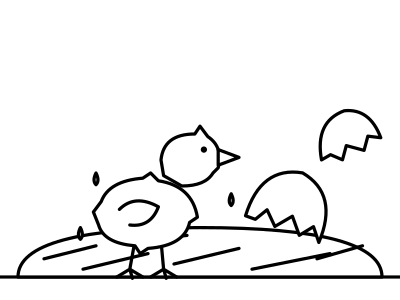
A hen lays an egg and sits on it to keep it warm. Inside, a chick grows for about 21 days. When it is ready, the chick pecks a small hole in the shell. This first crack is called pipping. First, the chick breaks a hole. Next, it turns and chips a ring around the shell. Finally, it pushes the shell apart and tumbles out, wet and tired.
A chick dries into a fluffy ball a few hours after hatching.
Mark the text, then answer.
1.
Circle the title, box the bold word and star the caption.
2.
What is the main idea?
3.
What does "pipping" mean? Which words helped?
4.
Draw a three-step diagram of hatching with arrows.
5.
What does the caption tell you?
Change y to i and add -es.
6.
puppy → ____
7.
berry → ____
8.
story → ____
Challenge:Write the hatching steps with first, next and finally in your own words.
Science
Objective: I can use motion patterns to predict and describe how I solved a design problem with magnets.
Builds on: Needs Week 6 (motion patterns) and Week 7 (the magnet latch project). One-minute check: ask, "In a pendulum, what is one full swing?" (Out and back to the start.)
Materials: Pendulum: string about 24 inches long, a washer or key ring as the weight, tape and a ruler, Timer, Shoebox cabinet with its magnet latch, Science notebook (Weeks 6 and 7), Printed Quarter 1 Review: Science (Assessments page) and pencil
Day 43 — Q1 Review: Patterns and Engineering Design — Wonder Warm-Up · 5 min
Spaced review from Week 7. Your child names the 5 engineering steps in order. (Define the problem, plan, build, test, improve.) Then ask: "What was one criterion for your latch?" (Sample: it stays shut through 5 gentle shakes.) Ask: "How can a pattern help us tell what happens next?"
Mini-Lesson · 10–15 min
Say: "A motion pattern is a movement that repeats in a way we can predict." Tape the pendulum to a table edge. Measure 18 inches from the edge to the middle of the weight. Pull the weight a hand's width to the side and let go. Your child counts full swings for 30 seconds while you watch the timer. Do it twice. Expect about 22 each time. Ask: "What do you predict for a third count? Why?" (About the same, because the pattern repeats.) Test it. Say: "A shorter string swings faster. A bouncing ball bounces lower each time." Now hold up the shoebox. Say: "Criteria are what a design must do. Constraints are limits. We test to find failure points, then we improve." Ask: "Was 'at most 2 magnets' a criterion or a constraint?" (A constraint.) "What did you improve after testing?" (Answers vary. Look for one change.) If stuck, say: "Find that page in your notebook and read me one sentence."
Investigation / Hands-On · 15–20 min
Give the Quarter 1 Review: Science now. It is on the Assessments page and takes 20 to 30 minutes. It may run into notebook time. 1) Put the pendulum, the shoebox and the notebook out of sight. Your child needs only a pencil. 2) Your child works alone. You may read any question, table or answer choice aloud, as often as needed. 3) Do not explain science words or give hints. 4) It is not timed, and breaks between sections are fine. 5) Score it later with the notes under each section. Those notes name the weeks to revisit. If you give the review on another day, use this time differently. Rerun the latch shake test and compare with Week 7.
Science Notebook Entry · 10 min
Your child finishes the review first. Then they write three sentences: "A pattern I can predict is ___. One criterion for my latch was ___. One constraint was ___." Sample: "A pattern I can predict is a pendulum's swing count. One criterion was that it opens with one finger. One constraint was only 2 magnets." If time is short, your child says the three sentences aloud instead.
Wrap-Up & Exit Ticket · 5 min
Read the three exit questions aloud; your child answers aloud or on paper. Praise steady effort on the review, not the score.
Watch for: Describing engineering as only "build it," and skipping defining the problem and testing.
Try: Your child points to the notebook page for each of the five steps and reads one sentence from it.
Exit ticket:
A rocking chair rocks 12 times in 20 seconds, and then 12 times again. About how many times will it rock in the next 20 seconds? Why can you predict that?
Your latch falls open in the shake test. What is the next engineering step, and what would you do?
New problem: a magnet hook must hold a dish towel on the fridge. Give one criterion and one constraint for it.
Show answers
About 12. The motion repeats in a pattern, so the next count should be about the same.
Improve. Change one thing, such as moving the steel part closer, and test again.
Answers vary. Look for: a criterion such as "holds the towel without sliding," and a constraint such as "use only 1 magnet."
Support: Read every review question aloud and give a short break after each section. Your child may say long answers while you write them.
Extend: After the review, your child shortens the string to 12 inches and predicts more or fewer swings. Then they test it. Expect more, about 27.
Homework: Your child explains the five engineering steps to a family member, with one example from the latch for each. Look for: all five, in order.
Practice page · Week 9, Day 3
Science
I can use motion patterns to predict and describe how I solved a design problem with magnets.
Count pendulum swings in 30 seconds twice. Predict the third count, then test.
Trial
Swings in 30 seconds
1.
My prediction for Trial 3:
2.
A ball bounces 45, 30 and 20 inches. Will the next bounce be higher or lower than 20?
3.
Which swings faster?
○ a pendulum with a short string○ a pendulum with a long string
Engineering page: write one example from your magnet latch for each step.
4.
Define the problem:
5.
Test:
6.
Improve:
Materials: a pendulum · the shoebox cabinet with the magnet latch · a timer