Builds on: Needs Day 3: growing settlements wanted more land, and Native nations lost land. One-minute check: ask, "Why did growing towns lead to conflict?" (Settlers wanted land where Native nations lived.)
New words:
treaty – a written agreement between nations
removal – forcing people to leave their homes and move far away
petition – a letter that many people sign to ask leaders for something
Materials: Notebook, U.S. map, Yarn, 1 piece about as long as your hand, Tape, Pencil
Day 34 — Treaties, Conflict, and Removal — Big Question Warm-Up · 5 min
Review from Day 3. Ask: "Name two ways settlements grew." (Any two: building, government, trade, more people.) Then ask the big question: "Two groups both want the same land. What are fair ways to solve it?" Say: "Today is about promises between nations. Some of it is sad."
Mini-Lesson · 10–15 min
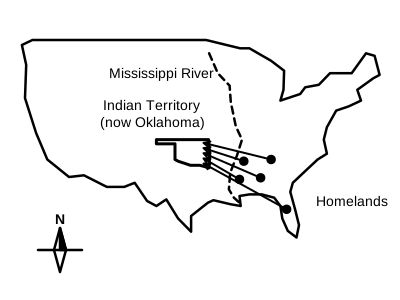
Say: "A treaty is a written agreement between nations. The United States signed hundreds of treaties with Native nations. Many promised land to a nation, and many were broken." Find Georgia on the map. Say: "The Cherokee homeland was here and in nearby states. The Cherokee Nation had farms, schools, a written language and its own government." Say: "In 1829 news spread of gold on Cherokee land. Settlers also wanted cotton farms there. In 1830 a law, the Indian Removal Act, pushed Native nations in the Southeast to move west." Say: "In 1832 the Supreme Court, the country's highest court, said Georgia could not make laws for Cherokee land. Georgia ignored the ruling, and the president did not make Georgia obey. In 1835 a small group who were not the nation's leaders signed a treaty giving up the land. Principal Chief John Ross and most Cherokee people said no." Say: "In 1838 and 1839 the U.S. Army forced about 16,000 Cherokee people to leave. Most walked. Thousands died. This is called the Trail of Tears. The Muscogee (Creek), Choctaw, Chickasaw and Seminole nations were forced west too." Ask: "Finish this: a treaty is ____." (a written agreement between nations) "Did most Cherokee people agree to the 1835 treaty?" (No.) If stuck, say: "A treaty is a promise on paper between nations."
Activity / Source Work · 15–20 min
1) Tape yarn from northern Georgia to northeastern Oklahoma. 2) Read this source aloud. It was written for this lesson. "The Cherokee did not go quietly. They printed a newspaper, went to court and sent leaders to Washington. In 1838 more than 15,000 Cherokee people signed a petition asking Congress to cancel the removal treaty. Congress did not cancel it. Some other Americans also said the treaties must be kept." 3) Ask: "What evidence shows most Cherokee people opposed removal?" (More than 15,000 signed the petition.) 4) Draw a three-row chart in the notebook for the question "Who should live on this land?" Row 1, many settlers and U.S. leaders: "We want this land for farms and gold." Row 2, the Cherokee Nation: "This is our homeland, and treaties promised it to us." Row 3, Americans against removal: "Treaties are promises and must be kept." 5) Your child says each view in one fair sentence and tells what that group wanted or valued. Say: "We can explain a view without agreeing with it. Forcing people from their homes was wrong."
Notebook Entry · 10 min
Your child finishes these frames: "A treaty is ____. The Trail of Tears happened because ____. Today the Cherokee Nation ____." Sample: "The Trail of Tears happened because settlers and leaders wanted Cherokee land and broke promises."
Wrap-Up & Exit Ticket · 5 min
Leave a minute for your child's questions, then read the exit questions aloud. Praise fair wording and present-tense words about the Cherokee today.
Watch for: Thinking everyone back then agreed with removal, or that the Cherokee story ended in 1839.
Try: Point to Row 3 and ask, "Who disagreed, and why?" Then reread the last notebook frame.
Exit ticket:
Two nations sign a paper that says where each will live. What is the paper called, and what must both sides do?
Name two peaceful ways Cherokee people tried to stop the removal.
Where is the Cherokee Nation's capital today? Why is it so far from Georgia?
Show answers
A treaty. Both sides must keep the promises in it.
Any two: a petition, going to court, printing a newspaper, sending leaders to Washington.
Tahlequah, Oklahoma. The nation was forced west on the Trail of Tears. The Eastern Band of Cherokee Indians lives in North Carolina today.
Support: Teach three things only: what a treaty is, the yarn route, and where Cherokee nations are today.
Extend: Your child writes a short letter to a lawmaker of 1838, giving two reasons to keep the treaties.
Homework: Tell a family member what a treaty is and why both sides must keep it. Look for: the words "between nations."
Practice page · Week 7, Day 4
Social Studies
I can explain what a treaty is and give more than one view of Indian Removal.
Removal from the Southeast
In 1830 a U.S. law called the Indian Removal Act pushed Native nations in the Southeast to move west of the Mississippi River. The Cherokee, Muscogee (Creek), Choctaw, Chickasaw and Seminole nations were all forced to leave homelands. Many had signed treaties that promised them their land. Many U.S. leaders wanted the land for farms. Other Americans said the treaties should be kept. Thousands of Native people died on the long journeys.
Write what each group might say about the question "Who should live on this land?"
Group
Their view
1.
U.S. leaders who wanted removal:
2.
A Native nation:
3.
Americans who spoke against removal:
Answer each question.
4.
What is a treaty?
5.
The Cherokee call their forced walk west the ____.
6.
Where is the Cherokee Nation's capital today?
Challenge:Name one nation besides the Cherokee that was forced to move west.
Materials: U.S. map · yarn
Mathematics
Objective: I can choose a strategy to solve mixed ×3, ×4 and ×6 facts.
Standards: 3.OA.C.7, 3.OA.B.5
Builds on: Needs Days 1 to 3: double plus one more group, double-double, and the ×5 fact plus one more group. One-minute check: ask 3 × 5 (15), 4 × 5 (20) and 6 × 5 (30).
Materials: Fact cards made on Days 1 to 3, Grid paper, Crayons, Notebook, Pencil
Warm-Up · 5 min
Spaced review from Week 3. Your child solves 700 − 345 (355). Then count by 4s to 40 and by 6s to 60 together.
Mini-Lesson · 10–15 min
Say: "Look at the factors first. Find one you have a strategy for." Write 3 × 9, 4 × 9 and 6 × 9 in a column. Point to 3 × 9. Ask: "Which strategy fits?" (Double plus one more group. 18 + 9 = 27.) Write 3 × 9 = 27. Point to 4 × 9. Ask again. (Double-double. Double 9 is 18. Double 18 is 36.) Write 4 × 9 = 36. Point to 6 × 9. Ask again. (The ×5 fact plus one more group. 45 + 9 = 54.) Write 6 × 9 = 54. Next, write 6 × 4. Say: "Some facts fit two strategies." Say: "As a ×6 fact, I think 5 × 4 = 20, then 20 + 4 = 24." Say: "Turned, it is 4 × 6. Double 6 is 12. Double 12 is 24." Ask: "Did both ways agree?" (Yes. 24.) Now your child does more. Write 3 × 7, 4 × 7 and 6 × 7. Your child names each strategy and writes the products (21, 28, 42).
Guided Practice · 10–15 min
Mix the fact cards. Your child names the strategy before the product. 1) 4 × 8 (double 8 is 16; double 16 is 32). 2) 6 × 8 (40 + 8 = 48). 3) 8 × 3. Turn it to 3 × 8 (16 + 8 = 24). 4) Ask: "Jo says 6 × 8 is 32. Is that right?" (No. 32 is the product of 4 × 8. 6 × 8 = 48.) If stuck, say: "Which factor is 3, 4 or 6? Say its strategy, then do one step." Then go through the other cards with no timer. Your child sorts them into "know it" and "still building" piles. For each still-building card, your child says the strategy aloud.
Independent Practice · 15–20 min
Your child writes the strategy steps and the product. 1) 3 × 6 (12 + 6 = 18). 2) 4 × 4 (double 4 is 8; double 8 is 16). 3) 6 × 6 (30 + 6 = 36). 4) 4 × 5 (20). 5) 7 × 3 (21). 6) Your child colors 6 rows of 3 on grid paper and splits it. (5 × 3 = 15; 15 + 3 = 18) 7) Nia packs 4 boxes with 9 muffins in each box. How many muffins? (4 × 9 = 36) 8) Ben has 6 shelves with 7 books on each shelf. How many books? (6 × 7 = 42) Check each answer by drawing or by using a second strategy.
Exit Ticket · 5 min
Put the cards away. Read each question aloud; your child writes the answers.
Watch for: Mixing up ×4 and ×6 products, such as saying 6 × 8 is 32.
Try: Your child says the ×5 fact first. Say: "5 × 8 = 40, so 6 × 8 must be more than 40."
Fact fluency: ×3, ×4 and ×6 facts
Exit ticket:
What is 8 × 4? Name your strategy.
What is 3 × 6?
Which ×3, ×4 or ×6 fact is hardest for you? Which strategy helps?
Show answers
32; double-double (double 8 is 16, double 16 is 32)
18
Answers vary. Look for: a named fact and a strategy that matches its table.
Support: Sort the cards by table. Practice one table with its strategy for a few minutes before mixing the piles.
Extend: Write 6 × 8 = 48. Ask: "Find it a third way. Start with 6 × 4." (6 × 4 = 24 and 24 + 24 = 48.) Ask: "Why does that work?" (Each row of 8 is two 4s. So the array is two arrays of 6 × 4.)
Homework: Practice the still-building pile for 10 minutes with no timer. Say the strategy for each card. Sample: 6 × 9, 45 and 9 more, 54.
Practice page · Week 7, Day 4
Mathematics
I can choose a strategy to solve mixed ×3, ×4 and ×6 facts.
Look: pick a strategy
×3: double plus one group. 7 × 3 is 14 and 7, 21.
×4: double-double. 7 × 4 is 14, then 28.
×6: the ×5 fact plus one group. 7 × 6 is 35 and 7, 42.
Multiply.
1.
4 × 8 = ____
2.
3 × 7 = ____
3.
6 × 5 = ____
4.
9 × 4 = ____
5.
3 × 3 = ____
6.
8 × 6 = ____
Solve.
7.
Tomas sets up 6 rows of 4 chairs. How many chairs?
8.
Nia buys 3 bags of 9 limes. How many limes?
Challenge:6 × 4 can be solved as a ×4 fact or a ×6 fact. Show both ways.
Materials: Multiplication chart (optional)
English Language Arts
Objective: I can explain how a detail supports the main idea and how one event causes another.
Standards: RI.3.2, RI.3.8, RI.3.3, L.3.1.I
Builds on: Needs Day 3: naming the job a detail does. One-minute check: ask, "Which kind of detail tells why?" (A reason.)
New words:
cause – why something happens
effect – what happens because of the cause
simple sentence – one complete thought
compound sentence – two complete thoughts joined by a comma and a word like and, but or so
complex sentence – a complete thought with an added part that begins with because, when or if
Materials: The 'A Beaver Pond' paragraph (in the lesson), printed or copied onto paper, Reader's notebook, Pencil, Highlighter, Your child's own nonfiction book (homework)
Warm-Up · 5 min
Word study, open syllables. Ask: "Which word means making no sound?" (silent) "Which word names a person who is learning?" (student) "Which number means none at all?" (zero) Your child says one sentence with spider. Spaced review from Week 3. Ask: "Which marks go around an author's exact words?" (Quotation marks.)
Mini-Lesson · 10–15 min
Read aloud. Title: A Beaver Pond. 'A beaver pond helps many other animals. The dam slows the stream, so the water spreads out and grows deep. Fish swim in the deep water. Because fish live there, herons come to hunt. Ducks nest in the tall grass at the edge. When summer is dry, the pond still holds water for deer. Beavers have orange front teeth.' Say: "A strong detail helps prove the main idea. Use this stem: This detail supports the main idea because ___." Model: "The duck detail supports the main idea because it shows one animal the pond helps." Then say: "A cause makes something happen. An effect is the thing that happens. The word so points to the effect." Highlight the second sentence. Write: Cause: the dam slows the stream. Effect: the water spreads out and grows deep.
Guided Practice · 10–15 min
1) Ask: "Which sentence does not belong with the main idea? Why?" (Beavers have orange front teeth. It is true, but it is not about helping animals.) 2) Read: "Because fish live there, herons come to hunt." Ask: "Which part is the cause? Which part is the effect?" (Cause: fish live there. Effect: herons come to hunt.) 3) Write S, C and X. Say: "A simple sentence is one complete thought, like 'Fish swim in the deep water.' A compound sentence joins two complete thoughts with and, but or so. A complex sentence adds a part that begins with because, when or if." Your child labels the dam sentence and the heron sentence. (C, X) Say: "Put a comma after the because part when it starts the sentence." 4) Ask: "What type is the sentence about summer?" (X. It starts with when.) If stuck, say: "Which happened first? That is the cause."
Independent Practice · 15–20 min
Your child works in the notebook. 1) Write a "supports the main idea because" sentence for the fish detail and for the deer detail. (Sample: The deer detail supports the main idea because deer get water from the pond.) 2) Write one cause and effect from the paragraph as "Because ___, ___." (Sample: Because the dam slows the stream, the water grows deep.) 3) Rewrite the same idea with so. (The dam slows the stream, so the water grows deep.) 4) Write one simple sentence about beavers and label it S. Check for a comma after the because part and a comma before so. Look for explanations in your child's own words.
Exit Ticket · 5 min
Read each question aloud. Your child answers in the notebook and may look back at the paragraph.
Watch for: Mixing up the cause and the effect.
Try: Ask: "Which happened first?" Then your child says it as "___ made ___ happen."
Exit ticket:
What is the difference between a cause and an effect?
Simple, compound or complex? 'Ducks nest in the tall grass at the edge.' How do you know?
Finish in your own words: 'Herons come to hunt' supports the main idea because ___.
Show answers
A cause makes something happen. An effect is the thing that happens.
Simple. It has one complete thought and no joining word.
Answers vary. Look for: herons find food at the pond, so the pond helps them.
Support: Say three details aloud, one at a time. Your child answers "shows the pond helping" or "does not fit" before writing.
Extend: Your child writes one cause and effect three ways: with so, with because first, and with because in the middle.
Homework: Read a nonfiction book for 15 minutes. Your child writes one cause and its effect in a sentence with because. Look for: the because part tells why.
Practice page · Week 7, Day 4
English Language Arts
I can explain how a detail supports the main idea and find causes, effects and sentence types.
Look: sentence types
Simple (S): one complete thought. Trees grow.
Compound (C): two thoughts joined with and, but or so. It rained, so we stayed in.
Complex (X): a part with because, when or if plus a complete thought. When it rains, we stay in.
Why Leaves Change Color
In fall, many trees get ready for winter. The days get shorter, so trees make less of the green coloring in their leaves. When the green fades, yellow and orange colors that were hiding in the leaves show through. Because frozen ground holds little water, trees drop their leaves to save water for winter. Squirrels bury acorns in the fall too.
Answer about the paragraph.
1.
Which sentence does NOT support the main idea?
2.
Cause: the days get shorter. Effect: ____
3.
Finish: "Trees drop their leaves" supports the main idea because ____.
4.
S, C or X? The days get shorter, so trees make less green.
○ S○ C○ X
5.
S, C or X? When the green fades, yellow colors show.
○ S○ C○ X
6.
S, C or X? Trees drop their leaves.
○ S○ C○ X
Split each word after the open syllable.
7.
spider
8.
student
Challenge:Rewrite with because: It snowed, so school closed.
Science
Objective: I can run fair tests on my latch, find where it fails and make it better.
Standards: 3-PS2-4, 3-5-ETS1-3
Builds on: Needs the Day 3 prototype and fair tests from Weeks 3 and 6. One-minute check: ask, "What makes a test fair?" (Change one thing. Keep everything else the same.)
Materials: Prototype shoebox cabinet, About 20 steel paper clips, all the same size, Masking tape, 1 spare magnet, if you have one (for the demonstration), 3 thin cardboard squares (extension only), Science notebook and pencil
Day 34 — Test and Improve — Wonder Warm-Up · 5 min
Spaced review from Week 4. Ask: "Which pulls harder on a paper clip: a magnet 1 inch away or 4 inches away?" (1 inch away. The pull is stronger up close.) Then your child predicts: "How many paper clips can hang on your door before it falls open?" Write the prediction down.
Mini-Lesson · 10–15 min
Say: "Today is steps four and five: test and improve. Engineers test against the criteria. They look for the failure point. You met that word with the marble run. It is the moment a design stops working. A failure is information, not a mistake." Show one. Hang paper clips in a chain from a magnet, one at a time, until the chain drops. Count them. Say: "The chain dropped at ___ clips. That was its failure point." With no spare magnet, just describe this. Explain the three tests below. Say: "We do each test the same way every time." Ask: "Why shake 5 times in every test, not 2 times and then 10?" (To keep the test fair, so we can compare.) "A shelf holds 3 books and breaks at 4. At what number did it fail?" (4 books. That is its failure point.) "How many things do we change before we test again?" (One.) If stuck, say: "What did we do the first time? Do exactly that again."
Investigation / Hands-On · 15–20 min
Change: one part of the latch. Keep the same: the box, the hook spot, the clips and the shaking. Measure: the clip count. 1) Shake test. Turn the box door-side down and shake gently 5 times. Record: stayed shut, yes or no. 2) Open test. Can one finger open it? Open and shut it 5 times. Does it work every time? 3) Strength test. Bend one clip into a hook and tape it to the door near the latch. Hold the box door-side down past a table edge. Your child adds clips to the hook one at a time until the door drops. Record the count. If it holds all the clips, write "more than 19." 4) Your child writes one improvement, then makes it. Ideas: line the steel up better, add a second washer, or use thinner tape. 5) Repeat all three tests. Chart: Test | Version 1 | Version 2, with rows for shake, open and strength. Version 2 often holds more, but not always. Say: "Real results vary. If it did not help, that is information too." Safety: small magnets are dangerous if swallowed. Keep them away from little children, phones and bank cards.
Science Notebook Entry · 10 min
Your child copies the chart into the notebook and writes: "My latch failed when ___. I improved it by ___. Version 2 held ___ clips." Sample: "My latch failed when I hung 5 clips. I improved it by moving the washer under the magnet. Version 2 held 9 clips."
Wrap-Up & Exit Ticket · 5 min
Read the three exit questions aloud; your child answers on paper. Praise before-and-after numbers used as evidence.
Watch for: Changing two things at once, then not knowing which change helped.
Try: Your child writes the one change on paper before touching the latch. Any second idea waits for Version 3.
Exit ticket:
A paper bridge holds 8 coins. It falls when the 9th coin is added. What is its failure point?
What one improvement did you make to your latch?
How do your numbers show whether the improvement helped?
Show answers
9 coins (or: when the 9th coin was added).
Answers vary. Look for: one specific change, such as "I added a second washer."
Answers vary. Look for: both clip counts compared, such as "It held 5 before and 9 after, so it helped."
Support: Run only the shake test and the strength test. Count the clips aloud together, and you write the numbers.
Extend: New fair test: slip one thin cardboard square at a time between magnet and steel. Record the clip count for 0, 1, 2 and 3 squares.
Homework: Your child tells a family member the latch's failure point and the fix. Look for: two numbers, one from Version 1 and one from Version 2.
Practice page · Week 7, Day 4
Science
I can run fair tests on my latch, find where it fails and make it better.
Run each test on Version 1, make one change, then test Version 2.
Test
Version 1
Version 2
1.
Shake test: did it stay shut after 5 gentle shakes?
2.
Open test: could you open it with one finger?
3.
Strength test: how many paper clips did it hold before it dropped open?
Answer the questions.
4.
What is a failure point?
5.
My improvement was ____. I know it helped because ____.
Challenge:Version 1 held 7 clips. Version 2 held 12 clips. How many more did Version 2 hold?
Materials: the prototype shoebox cabinet · about 20 paper clips · a timer