3
    Third GradePowered by ThirdGrade.com

    Daily lesson plan

    Day 2 · Tuesday

    Week 6 · Foundations: Place Value, Stories, Forces & Communities

    See what your state adds or places differently

    Suggested daily schedule
    8:30–8:45 AM15 minMorning Circle / Read-Aloud / Calendar
    8:45–10:00 AM75 minEnglish Language Arts
    10:00–11:00 AM60 minMathematics
    11:00–11:15 AM15 minSnack and Movement Break
    11:15–12:00 PM30–45 minScience (every day)
    12:00–12:45 PM30–45 minSocial Studies (every day)
    12:45–1:30 PM45 minLunch and Choice Time
    1:30–2:15 PM45 minSpecials: PE / Art / Music (rotating)
    2:15–2:45 PM30 minIndependent Reading & Journaling

    Social Studies

    Objective: I can describe how different Native nations met their needs for food, clothing, and shelter using the land around them.

    Standards: D2.His.2.3-5, D2.Geo.4.3-5

    Builds on: Needs Week 4 natural resources and climate, and yesterday's lesson. One-minute check: ask, "Name one natural resource and one thing made from it." (Sample: trees, a wooden spoon.)

    New words:
    • longhouse – a long home with a wooden frame covered in bark, shared by several families
    • tipi – a cone-shaped home of poles and a cover, made to move easily
    • bison – a large, shaggy animal of the grasslands, sometimes called buffalo
    • source – anything that gives us information, such as a book, a map, a photo or a letter

    Materials: Notebook, Pencil, A U.S. map, Colored pencils, Prep notes on a Native nation of your area: its own name, where its government is and one fact about today. Use the nation's own website or a library book; a librarian can help.

    1. Day 27 — How Native Nations Used the Land — Big Question Warm-Up · 5 min

      Spaced review from Week 4. Ask: "What is a natural resource?" (Something useful that comes from nature.) Then ask the day's wonder: "Long ago there were no stores. Where did people get food, clothing and a home?" (From the land around them.)

    2. Mini-Lesson · 10–15 min

      Say: "Each Native nation used the resources of its own region with great skill. So homes and foods were different from place to place." Point to the Northeast on the map. Say: "The Haudenosaunee homelands are here, in a land of forests. Long ago, Haudenosaunee people built longhouses. A longhouse had a wooden frame covered with bark. Several families lived in one. They grew corn, beans and squash together, and many still do. They call these crops the Three Sisters." Point to the Great Plains. Say: "The Lakota homelands are here, on wide grasslands with few trees. Great herds of bison lived there. Lakota families made tipis from poles and bison hides. A tipi could be packed up to follow the herds." Say: "Today Haudenosaunee and Lakota people live in houses like yours. Longhouses and tipis are still used for gatherings." Ask: "Why bark in the Northeast?" (There were many trees.) "Why hides on the Plains?" (There were many bison and few trees.) If stuck, say: "What grows or lives in that place?"

    3. Activity / Source Work · 15–20 min

      Source work. Say: "A source is anything that gives us information, such as a book, a map or a letter." Read this source aloud. "Hopi people live on high, dry land in what is now Arizona. Long ago they built homes of stone and clay, and many families still live in those villages. Hopi farmers plant corn deep in the soil to reach water. Tlingit and Haida people live along the rainy Northwest coast. They built large houses from cedar planks and caught salmon. Cedar and salmon are still important to them today." 1) In the notebook, draw a chart with five columns: Nation, Region, Home long ago, Food, Resource used. 2) Your child fills four rows. Use the Mini-Lesson for two and the source for two. Expect these answers. Haudenosaunee: Northeast, longhouse, the Three Sisters, bark and wood. Lakota: Great Plains, tipi, bison, hides and poles. Hopi: Southwest, stone and clay home, corn, stone and clay. Tlingit and Haida: Northwest coast, plank house, salmon, cedar. 3) Ask: "Which words show Hopi people are here today?" ("Hopi people live" and "still live.") 4) Your child colors each region on the U.S. map with colored pencils.

    4. Notebook Entry · 10 min

      In the notebook, your child writes this frame in pencil for two nations. "Long ago, the ____ used ____ from their land to build ____." Sample: "Long ago, the Tlingit used cedar from their land to build plank houses." Then add one sentence about today that starts "Today."

    5. Wrap-Up & Exit Ticket · 5 min

      Read the three exit questions aloud. Praise answers that link a home or food to a resource of that region.

    Watch for: Thinking all Native people lived in tipis.

    Try: Point to each of the four regions and ask, "What grows or lives here?" Then name the home that fits.

    Exit ticket:
    1. A nation's homelands have thick forests and no bison. Which would be easier to use for homes there, bark or bison hides?
    2. Why was a home that packs up quickly useful for families who hunted bison?
    3. Pick one nation from today. Name one thing that is the same as long ago and one thing that has changed.
    Show answers
    1. Bark, because forests have many trees.
    2. The bison herds moved, and the families followed them.
    3. Answers vary. Same: growing corn, fishing for salmon or living in their homelands. Changed: modern houses, cars or schools.

    Support: Fill in only the Haudenosaunee and Lakota rows. Your child draws each home beside its row.

    Extend: Your child adds a fifth row for the nation in your prep notes. Use a library book or the nation's own website.

    Homework: Your child explains one home from today's chart to a family member and tells what it was made from. Look for the nation's name and the resource.

    Practice page · Week 6, Day 2

    Social Studies

    I can explain how Native nations used their land for food and shelter.

    Homes From the Land

    Seminole families in the Florida wetlands built chickees: homes with cypress poles and roofs of palmetto leaves, open on the sides to let breezes through. Nez Perce families on the Columbia Plateau fished for salmon, dug camas roots and built lodges covered with tule reed mats. Ojibwe families near the Great Lakes built wiigiwaams (wigwams) covered with birch bark. Today the Seminole Tribe of Florida still builds chickees.
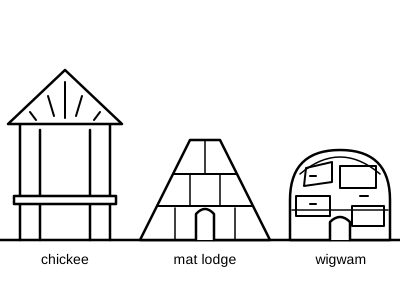
    Three traditional homes stand side by side: a Seminole chickee with a palmetto-leaf roof, a Nez Perce lodge covered with reed mats and an Ojibwe wigwam covered with birch bark.

    Fill in the chart from the reading.

    NationRegionShelterResource used


    1. 1.

      Seminole shelter and resources:

    2. 2.

      Nez Perce shelter and foods:

    3. 3.

      Ojibwe shelter and resource:

    4. 4.

      Why are chickees open on the sides?

    Answer each question.

    1. 5.

      Why were Native homes different in different regions?

    2. 6.

      The ____ used ____ from their land to build ____.

    Challenge: Is the chickee only part of the past? How do you know?

    Materials: U.S. map
    Mathematics

    Objective: I can use place value to know my ×10 facts.

    Standards: 3.OA.C.7, 3.NBT.A.3

    Builds on: Needs Grade 2 place value: 10 ones make 1 ten, and counting by 10s. One-minute check: ask how many tens are in 60 (6) and in 90 (9).

    New words:
    • 10 times as many – 10 groups of the same amount

    Materials: 10 dimes, Place-value chart drawn on paper (a tens column and a ones column), 10 index cards or paper slips, Notebook, Pencil

    1. Warm-Up · 5 min

      Spaced review from Week 1. Your child rounds 348 to the nearest 10 (350). Then ask two facts from Day 1: 2 × 6 (12) and 8 × 2 (16). Count by 10s to 100 together.

    2. Mini-Lesson · 10–15 min

      Say: "Today we multiply by 10 using tens." Write 3 × 10. Ask: "What does this tell us to build?" (3 groups of 10.) Draw 3 sticks. Say: "Each stick is one ten." Count them: 10, 20, 30. Write 3 × 10 = 30. Say: "3 groups of ten is 3 tens. 3 tens is 30." Write 3 in the tens column and 0 in the ones column. Ask: "Why is there a 0 in the ones place?" (There are 3 tens and no extra ones.) Next, write 10 × 3. Say: "This is 10 groups of 3. It is the same array turned, so it is 30 too." Point to the chart. Say: "10 × 3 is 10 times as many as 3. The 3 ones became 3 tens. The digit 3 shifted one place to the left." Now your child does more. Your child draws 7 sticks, counts by 10s and writes 7 × 10 = 70. Your child writes 7 in the tens column and says, "7 tens is 70." Then your child writes 10 × 7 = 70.

    3. Guided Practice · 10–15 min

      Your child says each fact in tens. 1) 4 × 10 (4 tens is 40). 2) 10 × 9 (9 tens is 90). 3) Lay out 6 dimes. Ask: "Each dime is 10 cents. How many cents?" (6 × 10 = 60) 4) 10 × 10 (10 tens is 100). Count all ten dimes by 10s to check. If stuck, say: "Draw one stick for each ten. Now count the sticks by 10s."

    4. Independent Practice · 15–20 min

      Your child writes each product and says it in tens. 1) 2 × 10 (20). 2) 5 × 10 (50). 3) 10 × 8 (80). 4) 10 × 1 (10). 5) 9 × 10 = ? Draw sticks to show it. (90) 6) You draw 8 sticks. Your child writes the multiplication sentence (8 × 10 = 80). 7) A pack holds 10 pencils. Ana buys 4 packs. How many pencils? (4 × 10 = 40) 8) 6 children each hold up 10 fingers. How many fingers in all? (6 × 10 = 60) Last, your child makes fact cards for the ×10 facts. Sort them into "know it" and "still building" piles. Use no timer.

    5. Exit Ticket · 5 min

      Put the dimes and chart away. Read each question aloud; your child writes the answers.

    Watch for: Adding 10 instead of making tens, such as writing 16 for 6 × 10.

    Try: Lay out 6 dimes. Your child touches each dime and counts: 10, 20, 30, 40, 50, 60. Say: "6 tens, not 6 and 10."

    Fact fluency: ×10 facts

    Exit ticket:
    1. What is 10 × 6?
    2. What is 9 × 10? Say it in tens.
    3. Explain why 5 × 10 is 50. Use the word tens.
    Show answers
    1. 60
    2. 90; 9 tens is 90
    3. 5 × 10 means 5 tens, and 5 tens is 50.

    Support: Use only 1 × 10 to 5 × 10. Your child slides one dime for each group and counts by 10s aloud.

    Extend: Ask: "What is 3 × 20? Think in tens." (3 groups of 2 tens make 6 tens, so 3 × 20 = 60.) Then your child tries 2 × 40 and draws the sticks (8 tens, so 2 × 40 = 80).

    Homework: Find things in groups of 10 at home, such as dimes or toes. Write 3 multiplication sentences that match. Sample: 4 dimes, 4 × 10 = 40 cents.

    Practice page · Week 6, Day 2

    Mathematics

    I can use place value to know my ×10 facts.

    Look: 5 × 10

    1. Multiplying by 10 makes groups of ten.
    2. 5 × 10 is 5 tens.
    3. 5 tens is 50: 5 in the tens place and 0 in the ones place.

    Multiply.

    1. 1.

      2 × 10 = ____

    2. 2.

      10 × 9 = ____

    3. 3.

      4 × 10 = ____

    4. 4.

      10 × 6 = ____

    5. 5.

      10 × 3 = ____

    6. 6.

      1 × 10 = ____

    Solve.

    1. 7.

      Mr. Diaz buys 7 boxes of 10 pencils. How many pencils?

    2. 8.

      Draw ten rods to show 3 × 10.

    Challenge: Explain why 9 × 10 is 90 using the word tens.

    Materials: Base-ten blocks (optional)

    English Language Arts

    Objective: I can use headings, captions and bold words to find information and figure out word meanings.

    Standards: RI.3.5, RI.3.4, RI.3.1, L.3.4.A

    Builds on: Needs yesterday's lesson on informational text. One-minute check: ask, "Name two clues that a book is informational." (Any two: true facts, headings, captions, bold words, photos, an index.)

    New words:
    • text feature – a part of a page, like a heading or a caption, that helps you find and understand information
    • heading – a short title over one section that tells its topic
    • caption – the words beside a picture that explain it
    • bold word – an important word printed in dark, thick letters

    Materials: Your child's own nonfiction book or children's magazine, Five sticky notes or paper slips, Reader's notebook, Pencil

    1. Warm-Up · 5 min

      Word study, Unit 1 review. Write slide, boat, corn, turn, candle, maple. Your child underlines the vowel pattern or splits the word. (slide: i and silent e. boat: oa. corn: or. turn: ur. can|dle. ma|ple.) Read the words together. Spaced review, Week 4. Ask: "What is a moral?" (The lesson a fable teaches.)

    2. Mini-Lesson · 10–15 min

      Say: "Text features help readers find information fast. A heading tells the topic of a section. A caption explains a picture. A bold word is important vocabulary." Read aloud this page. Words in capital letters stand for bold print. [The Saguaro Cactus. Heading: Storing Water. The saguaro grows in the Sonoran Desert. Its tall stem is covered in folds called PLEATS. After a rainstorm, wide, shallow roots soak up water quickly. The pleats stretch out like an accordion as the stem fills. Heading: A Desert Apartment. Gila woodpeckers peck nest holes in the stem. The cactus seals each hole with a hard shell called a BOOT. Later, tiny elf owls may move in. Caption: A Gila woodpecker peeks out of its nest hole.] Think aloud: "PLEATS is bold, so it matters. I reread the sentence around it. It says the stem is covered in folds called pleats. So pleats are folds in the stem." Point to each heading and the caption, and name its job.

    3. Guided Practice · 10–15 min

      Your child points to the sentence that proves each answer. 1) Ask: "What does BOOT mean here? Which words told you?" (A hard shell the cactus makes around a nest hole. "A hard shell called a boot.") 2) Ask: "You want to know how a saguaro gets water. Which heading helps?" (Storing Water.) 3) Ask: "What does the caption add?" (It tells what the picture shows: a woodpecker in its nest hole.) 4) Ask: "Why is the second heading 'A Desert Apartment'?" (Different animals live in holes in one cactus, like neighbors in a building.) If stuck, say: "Put your finger on the bold word. Read the whole sentence around it."

    4. Independent Practice · 15–20 min

      Your child works in their own nonfiction book or magazine. 1) Mark two headings, one caption and two bold words with sticky notes. 2) In the reader's notebook, write what the section under each heading is about. 3) For each bold word, write its meaning from the sentences around it. 4) Write one question the caption answers. Look for: meanings that fit the sentence; headings matched to their topics. Check meanings in the book's glossary if it has one. If the book has no bold words, your child picks two new topic words.

    5. Exit Ticket · 5 min

      Read each question aloud. Your child answers in full sentences with the saguaro page open.

    Watch for: Skipping the headings and captions and reading only the main paragraphs.

    Try: Use one routine on every page today: heading first, picture and caption second, then the paragraph.

    Exit ticket:
    1. Under which heading would you look to learn which animals live in a saguaro?
    2. The page says the pleats "stretch out like an accordion." What happens to the stem as it fills with water?
    3. What is the job of a caption?
    Show answers
    1. A Desert Apartment.
    2. It gets wider, because the folds open up to hold the water.
    3. It explains what a picture shows.

    Support: Mark the features with sticky notes ahead of time. Your child names each one and tells its job.

    Extend: Your child writes a new heading and a caption for a page in their book that has none.

    Homework: Read nonfiction for 15–20 minutes. Then find two text features on a cereal box, recipe or magazine at home. Tell what each one does.

    Practice page · Week 6, Day 2

    English Language Arts

    I can use headings, captions and bold words to find facts and word meanings.

    Penguins Keep Warm

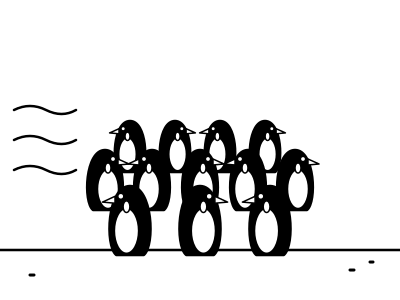
    Built for the Cold: Emperor penguins live in Antarctica, the coldest continent on Earth. Under their skin is a thick layer of fat called blubber. Blubber holds in body heat. Huddling Together: In winter storms, thousands of penguins stand close in a tight group called a huddle. They take turns moving to the warm middle.

    A crowd of emperor penguins stands pressed together in a tight huddle on the snow while icy wind blows.
    Penguins in a huddle block the icy wind.

    Use the text features to answer.

    1. 1.

      Draw a box around each heading.

    2. 2.

      Underline the caption.

    3. 3.

      What does "blubber" mean? Which words told you?

    4. 4.

      What does "huddle" mean?

    5. 5.

      Which heading would you read to learn how penguins share warmth?

      ○ Built for the Cold○ Huddling Together
    6. 6.

      What does the caption tell you?

    Circle the word with a consonant-le syllable.

    1. 7.

      maple, sleep, turn

    2. 8.

      rain, candle, cube

    Challenge: Find a bold word in a nonfiction book. Write its meaning from the sentence around it.

    Science

    Objective: I can run a fair test to find out what changes how fast a pendulum swings.

    Standards: 3-PS2-2

    Builds on: Needs Day 1 (counting full swings for 30 seconds) and Week 3 Day 4 (a fair test changes one thing). One-minute check: ask, "About how many full swings did our 24-inch pendulum make in 30 seconds?" (About 19, or your own count.)

    New words:
    • variable – anything in a test that could change, such as length or weight
    • data – the numbers and notes you collect in a test

    Materials: String, about 30 inches long, 3 metal washers of the same size (or 3 matching keys), Tape, A table or counter edge, Ruler or tape measure, Timer or a clock with a second hand, Science notebook and pencil

    1. Day 27 — Pendulum Fair Test — Wonder Warm-Up · 5 min

      Spaced review from Week 4. Ask: "Is gravity a contact force or a non-contact force?" (Non-contact.) Then hold up yesterday's pendulum. Ask: "What could we change to make it swing faster or slower?" List your child's ideas. (Sample: the string length, the weight, how far we pull it back.)

    2. Mini-Lesson · 10–15 min

      Say: "Each thing we could change is called a variable. Our pendulum has three: string length, weight, and how far we pull it back." Ask: "Suppose I shorten the string and add weight together, and the count changes. What caused it?" (We cannot tell.) Say: "So in a fair test, we change one variable and keep the others the same." Show it. Hold up a 24-inch pendulum with 1 washer. Say: "To test length, I change only the string." Ask: "What stays the same?" (The weight and the pull-back.) Say: "To test weight, I change only the washers." Ask: "What stays the same now?" (The string length and the pull-back.) Your child writes a prediction: "Which will change the number of swings: a shorter string, a heavier weight, both or neither?" Do not give the answer yet. If stuck, say: "Point to the one thing that is different. Everything else must match."

    3. Investigation / Hands-On · 15–20 min

      Safety: keep faces back from the swinging weight. 1) Draw a chart: Test, String length, Washers, Trial 1, Trial 2 (full swings in 30 seconds). Say: "The numbers we collect are called data." 2) Test A: 24 inches, 1 washer. Pull back one hand-width and let go. Count full swings for 30 seconds, twice. 3) Test B: 12 inches, 1 washer. Use the same pull and do two trials. 4) Test C: 24 inches, 3 washers taped flat together. Use the same pull and do two trials. Always measure from the table edge to the middle of the weight. Expect about 19 swings for A, about 27 for B and about 19 for C. A shorter string usually gives more swings. More weight usually changes the count very little. A difference of one swing can come from counting. If results differ, say: "Real results vary. Look for the pattern." Ask: "Which variable changed the count?" (The string length.)

    4. Science Notebook Entry · 10 min

      Under the chart, your child finishes two frames. "When I changed ___, the number of swings ___." "When I changed ___, the number of swings stayed about the same." Sample: "When I changed the string length, the number of swings went up. When I changed the weight, the number stayed about the same."

    5. Wrap-Up & Exit Ticket · 5 min

      Ask the three exit questions aloud. Praise your child for trusting the data, even where the prediction was different.

    Watch for: Predicting that a heavier weight swings faster, then doubting the data.

    Try: Repeat Tests A and C once more, counting together. Say, "The data came out the same twice. Scientists trust data they can repeat."

    Exit ticket:
    1. What was the only difference between Test A and Test B? Why did everything else have to match?
    2. Predict: will a 6-inch string make more or fewer full swings in 30 seconds than a 12-inch string?
    3. Ava counted 19 swings with 1 washer and 20 swings with 3 washers. What should she conclude about weight?
    Show answers
    1. The string length. Everything else matched so we could tell that the string length caused the change.
    2. More. A shorter string swings faster.
    3. Weight made almost no difference. The counts are about the same; one swing apart can come from counting.

    Support: Run Tests A and B only, and count aloud together. Your child points to the one variable that changed.

    Extend: Test 4 lengths: 6, 12, 18 and 24 inches. Your child describes the pattern. (The shorter the string, the more swings.)

    Homework: Tell a family member which change made the pendulum swing faster, and show it with a string and a key. Listen for: a shorter string gives more swings; weight barely matters.

    Practice page · Week 6, Day 2

    Science

    I can run a fair test to find out what changes how fast a pendulum swings.

    Count full swings in 30 seconds. Change only one thing in each test.

    TestString lengthWeightTrial 1Trial 2


    1. 1.

      Test A: long string, 1 washer. Test B: short string, 1 washer. Which made more swings?

    2. 2.

      Test C: long string, 3 washers. Did the count change much from Test A?

    Answer the questions.

    1. 3.

      What is a fair test?

    2. 4.

      A shorter string makes a pendulum swing ____.

      ○ faster○ slower
    3. 5.

      Finish: When I changed ____, the number of swings changed.

    Challenge: Yuki wants a pendulum that swings slower. What should she change?

    Materials: string · 3 washers · tape · a timer · a ruler

    Standards-matched clips that reinforce today's objectives.

    Social Studies

    Native American History for Kids | An insightful look into the history of the Native Americans

    Learn Bright

    Supports: I can describe how different Native nations met their needs for food, clothing, and shelter using the land around them.

    D2.His.2.3-5
    D2.Geo.4.3-5
    Watch on YouTube