3
    Third GradePowered by ThirdGrade.com

    Daily lesson plan

    Day 1 · Monday

    Week 5 · Foundations: Place Value, Stories, Forces & Communities

    See what your state adds or places differently

    Suggested daily schedule
    8:30–8:45 AM15 minMorning Circle / Read-Aloud / Calendar
    8:45–10:00 AM75 minEnglish Language Arts
    10:00–11:00 AM60 minMathematics
    11:00–11:15 AM15 minSnack and Movement Break
    11:15–12:00 PM30–45 minScience (every day)
    12:00–12:45 PM30–45 minSocial Studies (every day)
    12:45–1:30 PM45 minLunch and Choice Time
    1:30–2:15 PM45 minSpecials: PE / Art / Music (rotating)
    2:15–2:45 PM30 minIndependent Reading & Journaling

    Social Studies

    Objective: I can use a map key, the compass rose, and a scale without help.

    Standards: D2.Geo.2.3-5, D2.Geo.3.3-5

    Builds on: Needs the Week 3 lessons on map keys, directions and scale. One-minute check: ask, "What do we call the map symbol that shows north, south, east and west?" (A compass rose.)

    Materials: 1 sheet of plain paper, Ruler marked in inches, Pencil, Crayons, 4 sticky notes, Notebook

    1. Day 21 — Flex: Reteach Map Skills — Big Question Warm-Up · 5 min

      Before you start, draw the Pine County map on the plain paper. Put a compass rose in a corner with N at the top. Write the scale: 1 inch = 10 miles. Draw a house in the middle for Home. Draw a book 3 inches east of Home and a tree 1 inch north. Draw a blue crayon oval 4 inches west and a barn 2 inches south. Add a key: book is library, tree is park, blue oval is lake, barn is farm. Spaced review from Week 3. "Which way is east on this map?" (Right.) "What does the book stand for?" (Library.) "How far is 2 inches on this scale?" (20 miles.) Today's big question: "Could you read this map with no help at all?"

    2. Mini-Lesson · 10–15 min

      Reteach directions and the key. Write N, S, E and W on the sticky notes. Stick each on the matching wall. The sun rises in the east, so use that to choose. Say: "North is at the top of most maps. East is on the right. South is at the bottom. West is on the left." Your child points to each wall as you name it. Say: "Before I look for anything, I read the key. Where is the park? The key says the tree is the park. I see the tree. It is above Home, so the park is north of Home." Ask: "What does the barn stand for?" (The farm.) "What direction is the farm from Home?" (South.) "What direction is Home from the lake?" (East.) If stuck, say: "Put your finger on the starting place. Which way does it move to reach the other place?"

    3. Activity / Source Work · 15–20 min

      Scale work. 1) Show the ruler. Find the zero line and mark it with a pencil dot. 2) Say: "Zero goes on the middle of the first symbol." 3) Your child measures from Home to each place. 4) Your child fills in a chart with three columns: Place, Inches, Real miles. 5) Your child counts by tens for each inch. Expect these results. Park: 1 inch, 10 miles. Farm: 2 inches, 20 miles. Library: 3 inches, 30 miles. Lake: 4 inches, 40 miles. 6) Change the scale. Say: "Now let 1 inch = 20 miles. Count by twenties." Ask: "How far is the farm now?" (40 miles: 20, 40.) 7) Ask one two-step question. "You drive from the park to Home, then on to the farm. How far?" (30 miles.) If a measure is a little off, round to the nearest inch.

    4. Notebook Entry · 10 min

      In the notebook, your child writes My Map Rules with one example each. "1. Read the key first. 2. North is at the top. 3. Each inch on the scale stands for ____ miles." Sample example: "The tree means park. The park is north of Home. The park is 10 miles away."

    5. Wrap-Up & Exit Ticket · 5 min

      Read the three exit questions aloud. Your child may use the ruler but not your help. If one is missed, repeat that step in tomorrow's warm-up. Praise answers that include a direction word or the word miles.

    Watch for: Reading the scale correctly but measuring from the end of the ruler instead of the zero line.

    Try: Mark the zero line with a dot. Your child lines it up three times before measuring anything.

    Exit ticket:
    1. A map has north at the top. The pool is drawn to the left of the school. What direction is the pool from the school?
    2. Why must the zero line of the ruler sit on the first place you measure from?
    3. A scale says 1 inch = 20 miles. A road on the map is 3 inches long. How long is the real road?
    Show answers
    1. West.
    2. So the measurement starts in the right spot. If it does not, the distance comes out wrong.
    3. 60 miles. Count by twenties: 20, 40, 60.

    Support: Practice only directions today with the wall notes and the map. Save the ruler and scale for tomorrow's warm-up.

    Extend: Your child adds two new places to the Pine County map and writes three distance questions for you to solve.

    Homework: Your child draws a map of one room at home with a key and a compass rose. Look for at least three symbols, each one in the key.

    Practice page · Week 5, Day 1

    Social Studies

    I can use a map key, the compass rose and a scale without help.

    Map of Birch Town

    Scale: 1 inch = 20 miles. Key: a book means library. A tree means park. A cross means hospital. The library is to the right of the park. The hospital is below the park. On the map, the park is 2 inches from the library and 3 inches from the hospital.
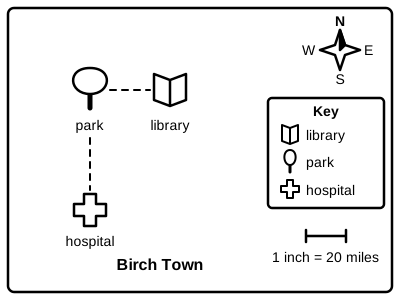
    A map of Birch Town shows a park, a library to its right and a hospital below it, with a key, a compass rose and a scale bar.

    Use the map to answer.

    1. 1.

      What does the cross symbol mean?

    2. 2.

      What direction is the library from the park?

    3. 3.

      What direction is the hospital from the park?

    4. 4.

      How many real miles is the park from the library?

    5. 5.

      How many real miles is the park from the hospital?

    Write your map rules.

    1. 6.

      My Map Rules: (1) Read the ____ first. (2) ____ is up. (3) Each inch stands for ____ miles.

    Challenge: On most maps, which side is west?

    Materials: ruler · sticky notes labeled N, S, E, W

    Mathematics

    Objective: I can fix my mistakes when adding and subtracting with regrouping.

    Standards: 3.NBT.A.2

    Builds on: Needs Week 2 Days 3 and 4 and Week 3 Days 3 and 4: regrouping to add and to subtract. One-minute check: your child solves 53 − 27 (26) and tells where the trade happened.

    Materials: 3 index cards (before the lesson, copy these with their wrong answers: 603 − 248 with 445, 456 + 278 with 624, 524 − 176 with 452), Grid paper, Colored pencil, Notebook, Pencil

    1. Warm-Up · 5 min

      Spaced review. Your child solves 268 + 125 from Week 2 (393) and 562 − 138 from Week 3 (424). Then make 100. Say a number; your child says its partner to 100. Use 60 (40), 35 (65), 82 (18), 49 (51).

    2. Mini-Lesson · 10–15 min

      Say: "Today you are the teacher. You will find mistakes and fix them." Write 347 + 285 in columns with the wrong answer 522. Say: "This answer is wrong. Let's find out why." Estimate first: 350 + 290 = 640. Ask: "Is 522 close to 640?" (No.) Rework it with the colored pencil. Ones: 7 + 5 = 12. Write 2 and a small 1 above the tens. Tens: 4 + 8 + 1 = 13. Write 3 and a small 1 above the hundreds. Hundreds: 3 + 2 + 1 = 6. The sum is 632. Ask: "What was the mistake?" (Both small 1s were left out.) Now your child does more. Show the first card: 603 − 248 with the wrong answer 445. Your child checks by adding: 445 + 248 = 693. Ask: "Is that 603?" (No.) Your child reworks it and names the mistake. (5 hundreds, 9 tens, 13 ones; 355. Smaller digits were taken from bigger ones.)

    3. Guided Practice · 10–15 min

      Use the other two cards, then write the third problem. Your child finds each mistake and fixes it. 1) 456 + 278 with the wrong answer 624. (The small 1s were left out; 734) 2) 524 − 176 with the wrong answer 452. (Smaller digits were taken from bigger ones; 348) 3) Write 700 − 236 with the wrong answer 474. (After both trades the tens are 9, not 10; 464) If stuck, say: "Check with an estimate or by adding. Then rework one column at a time. Which column is different?"

    4. Independent Practice · 15–20 min

      Your child solves each, then checks subtraction by adding and addition with an estimate. 1) 538 + 276 (814). 2) 709 − 352 (357). 3) 465 + 389 (854). 4) 800 − 463 (337). 5) 624 − 187 (437). 6) Draw squares, sticks and dots for 304 − 158. Show the trades (146). 7) A library has 415 picture books and 398 chapter books. How many books in all? (813) 8) A hall has 900 chairs. 645 are taken. How many are empty? (255) Your child reworks any problem that does not check.

    5. Exit Ticket · 5 min

      Put the cards away; your child answers on grid paper and checks question 2 by adding.

    Watch for: Treating 0 tens as 10 tens without taking 1 from the hundreds, so the answer comes out too big.

    Try: Your child writes the regrouped top number before subtracting. For 600, write 5, 9 and 10 above the digits.

    Fact fluency: Making 100 (pairs that add to 100)

    Exit ticket:
    1. Solve 486 + 357.
    2. Solve 600 − 274.
    3. What mistake do you need to watch for most when regrouping?
    Show answers
    1. 843
    2. 326
    3. Answers vary. Look for: a named step, such as adding the small 1 or trading from the hundreds when there are 0 tens.

    Support: Use 2-digit error hunts first. Show 52 − 28 with the wrong answer 36. Your child draws sticks and dots and fixes it (24).

    Extend: Your child makes two error-hunt cards with a hidden mistake for you to find. The right answers go on the back.

    Homework: Solve 3 problems and check each. 357 + 468 (825), 900 − 615 (285), 742 − 386 (356).

    Practice page · Week 5, Day 1

    Mathematics

    I can fix my mistakes when adding and subtracting with regrouping.

    Look: find the mistake

    1. Kim added 458 + 267 and got 625. Check the ones: 8 + 7 = 15. Write 5, regroup 1.
    2. Tens: 5 and 6 and 1 make 12. Write 2, regroup 1. Hundreds: 4 and 2 and 1 make 7.
    3. The right sum is 725. Kim forgot to regroup a ten into the hundreds.

    Ty made a mistake on each one. Write the right answer.

    1. 1.

      376 + 248. Ty got 514.

    2. 2.

      602 − 375. Ty got 373.

    3. 3.

      549 + 186. Ty got 625.

    Solve and check.

    1. 4.

      527 + 395 = ____

    2. 5.

      800 − 436 = ____

    3. 6.

      713 − 258 = ____

    4. 7.

      Owen had 905 marbles. He gave 368 to his cousin. How many marbles does Owen have now?

    Challenge: Which mistake do you need to watch for most? Write a tip for yourself.

    Materials: Base-ten blocks (optional)

    English Language Arts

    Objective: I can tell the difference between what happens in a story and its central message.

    Standards: RL.3.2, RL.3.1, L.3.1.C

    Builds on: Needs Week 4 Day 2, stating the moral of a fable. One-minute check: ask, "What is the moral of 'The Ant and the Grasshopper'?" (Get ready today for what you will need later.) If your child retells events instead, today's lesson is the fix.

    New words:
    • abstract noun – a noun that names an idea or a feeling you cannot see or touch, like courage

    Materials: Six index cards or paper slips, Reader's notebook, Pencil, Your child's own book

    1. Warm-Up · 5 min

      Word study, flex review of Weeks 1–4. Write hop, cape, paint, snow, shark, table. Say: "Each word shows a pattern we know." Your child reads each word and names its pattern. (hop: closed, short vowel. cape: silent e. paint and snow: vowel team. shark: r-controlled. table: consonant-le.) Spaced review, Week 4. Ask: "What does a myth explain?" (Something in nature.)

    2. Mini-Lesson · 10–15 min

      Say: "What happens in a story is its events. The central message is the lesson we learn from them." Read aloud the fable "Fox and the Cracked Jug": [Fox borrowed Heron's blue water jug. On the path home he slipped, and the jug cracked from top to bottom. Fox hid it under a bush. "The wind must have blown it away," he told Heron. All night Fox tossed and turned. At sunrise he carried the broken jug to Heron's door. "I cracked it, and then I lied," he said. "I am sorry." Heron looked at the jug, then at Fox. "A jug can be mended," she said. "I am glad you told me." Together they patched it with river clay.] Think aloud and write: "What happens: Fox breaks the jug, lies, and then tells the truth. Message: Telling the truth takes courage, and it keeps a friendship strong." Say: "Truth, courage and friendship are abstract nouns. They name ideas or feelings. You can touch a jug. You cannot touch courage. Some abstract nouns are built with endings: sad, sadness; brave, bravery; friend, friendship." Your child circles the three abstract nouns in the message.

    3. Guided Practice · 10–15 min

      Write six index cards: "Fox slips on the path." "Honesty brings peace." "Fox hides the jug." "Forgiveness mends a friendship." "Heron and Fox patch the jug." "Courage means owning up." 1) Your child sorts them into What Happens and Message. (Events: slips, hides, patch. Messages: the other three.) 2) Ask: "How can you spot a message card?" (It names no character. It is true for anyone.) 3) Ask: "Which words show that the lie bothered Fox?" ("All night Fox tossed and turned.") 4) Your child circles one abstract noun on each message card. (honesty or peace; forgiveness or friendship; courage) If stuck, say: "Does this card tell what a character did? Or what all of us should learn?"

    4. Independent Practice · 15–20 min

      Your child writes in the reader's notebook. 1) For "Stone Soup," write one What Happens sentence and one Message sentence. 2) Do the same for "The Boy Who Cried Wolf." 3) Do the same for their own book or a favorite story. 4) Circle one abstract noun in any message. Look for: event sentences that name characters; message sentences that fit anyone and could start with "People should." Sample: "What happens: A traveler gets a village to add food to his soup. Message: Generosity helps a whole village."

    5. Exit Ticket · 5 min

      Read each question aloud. Your child answers in the notebook in full sentences. The fox fable may stay open.

    Watch for: Writing an event as the message, such as "Fox told the truth."

    Try: Ask, "What should we learn from Fox?" Help your child turn the event into a lesson with no character names.

    Exit ticket:
    1. Write one event from the fox fable. Tell why it is not the message.
    2. Heron says, "I am glad you told me." How do her words help show the message?
    3. Use the abstract noun "honesty" in a sentence about Fox.
    Show answers
    1. Answers vary. Sample: Fox hid the jug. That is something a character did. It is not a lesson for everyone.
    2. Answers vary. Look for: Heron cares more about the truth than about the jug, so telling the truth keeps the friendship.
    3. Answers vary. Sample: Fox showed honesty when he told Heron what really happened.

    Support: Sort only four cards, two of each kind. Read each one aloud and ask, "Did someone in the story do this?"

    Extend: Your child writes a new ending in which Fox keeps lying. Then they name the message that ending would teach.

    Homework: Read your own book for 15–20 minutes. Then tell a family member the fox fable in three sentences and say its message. Look for events first, then a lesson for anyone.

    Practice page · Week 5, Day 1

    English Language Arts

    I can tell what happens in a story from its central message and use abstract nouns.

    Look: abstract nouns

    1. Some nouns you can see or touch: leaf, owl.
    2. Abstract nouns are ideas or feelings: kindness, friendship.
    3. Add -ness, -ship or -hood: kind → kindness, friend → friendship, child → childhood.

    Owl's Umbrella Leaf

    Owl found the biggest leaf in the forest. When rain came, she held it over her own head. "Find your own leaf!" she told Hedgehog and Wren. The wind grew stronger. Whoosh! It tore the leaf from Owl's claws. Hedgehog and Wren pulled her under a fallen log, where they all stayed dry together. When the next storm came, Owl's new leaf covered three heads instead of one.

    Is it an event or a message? Circle one.

    1. 1.

      The wind tore the leaf away.

      ○ event○ message
    2. 2.

      Sharing keeps everyone safer.

      ○ event○ message
    3. 3.

      Hedgehog and Wren pulled Owl under a log.

      ○ event○ message
    4. 4.

      Write the central message in your own words.

    5. 5.

      Add a suffix to make an abstract noun: kind → ____

    6. 6.

      Add a suffix to make an abstract noun: friend → ____

    Write the syllable type for each word.

    1. 7.

      paint

      ○ closed or silent e○ vowel team○ r-controlled○ consonant-le
    2. 8.

      shark

      ○ closed or silent e○ vowel team○ r-controlled○ consonant-le

    Challenge: Circle the abstract noun: Owl learned about friendship.

    Science

    Objective: I can use arrows to show whether forces are balanced or unbalanced and predict what will happen.

    Standards: 3-PS2-1

    Builds on: Needs Week 2 Day 3, the penny tug-of-war, and Week 2's balanced and unbalanced forces. One-minute check: ask, "Two equal pulls in opposite directions: balanced or unbalanced?" (Balanced.)

    Materials: Toy car, 2 strings, each about 3 feet long, 2 paper cups, each with a string handle taped on, 25 pennies, Tape, Paper and scissors (to cut 3 short and 3 long arrows), A hardcover book, Science notebook and pencil

    1. Flex Day 1 — Catch-Up: Balanced vs. Unbalanced — Wonder Warm-Up · 5 min

      Spaced review from Week 2. Ask: "One child pulls a wagon, and it starts to roll. Balanced or unbalanced forces?" (Unbalanced. Its motion changed.) Then set the book on the table. Ask: "This book is not moving. Are there any forces on it right now?" Take your child's idea. Say: "Today arrows will help us decide."

    2. Mini-Lesson · 10–15 min

      Say: "A force arrow shows a push or a pull. It points the way the force goes. A longer arrow means a stronger force." Draw the book on the table with one arrow pointing down. Ask: "What pulls the book down?" (Gravity.) "Why doesn't it fall through the table?" (The table pushes up on it.) Draw an up arrow the same length. Say: "Equal arrows in opposite directions mean balanced forces. Balanced does not mean no forces. It means the motion does not change." Now draw a still ball with one long arrow to the right, for a kick. Ask: "Balanced or unbalanced? What will the ball do?" (Unbalanced. It starts moving right.) Ask: "A still chair has a long arrow left and a short arrow right. Which way does it start to move?" (Left, toward the stronger force.) If stuck, say: "Find the longer arrow. The motion changes that way."

    3. Investigation / Hands-On · 15–20 min

      Safety: keep feet clear of the hanging cups. 1) Tape a string to each end of the car. Set the car in the middle of the table. 2) Run each string over an opposite table edge and tie on a cup. 3) Plan three rounds. Round A: 8 pennies in each cup. Round B: 8 pennies and 15 pennies. Round C: an empty cup and 8 pennies. 4) Before each round, hold the car still. Your child lays a paper arrow beside each string, short or long, pointing toward that cup. 5) Let go. Record in a chart: Round, Pennies left, Pennies right, Arrows, What the car did. Change only the pennies. Keep the same car, cups and start spot. Expect the car to stay still in Round A. Expect it to roll toward 15 in Round B and toward 8 in Round C. The empty cup still pulls a little, so it gets a short arrow. If the car sticks in Round B, say: "Real results vary. Friction is holding it. Add pennies one at a time." Ask: "Did your arrows match what happened?"

    4. Science Notebook Entry · 10 min

      Your child draws the car three times, once for each round, with its two arrows. Under each drawing, write balanced or unbalanced and what the car did. Sample for Round B: a short arrow toward 8 and a long arrow toward 15. "Unbalanced. The car rolled toward the 15 pennies."

    5. Wrap-Up & Exit Ticket · 5 min

      Ask the three exit questions; your child may draw arrows to answer. Praise any answer that says a still object still has forces on it.

    Watch for: Saying a still object has no forces on it.

    Try: Your child rests a hand flat on the table, and you set the book on it. Ask, "Do you feel the book pressing down? Your hand pushes up just as hard."

    Exit ticket:
    1. A cat sleeps on a couch without moving. Name the force pulling the cat down and the thing pushing up on it.
    2. You push on a door, and a friend pushes back from the other side. The door does not move. What do you know about the two pushes?
    3. A toy boat has a short arrow pointing left and a long arrow pointing right. Are the forces balanced or unbalanced? Which way does its motion change?
    Show answers
    1. Gravity pulls down. The couch pushes up just as hard, so the forces are balanced.
    2. They are equal in strength and opposite in direction, so the forces are balanced.
    3. Unbalanced. Its motion changes to the right, toward the longer arrow.

    Support: Run only Rounds A and C. Place the arrows together with your child before each one.

    Extend: Start with 8 pennies in each cup. Your child predicts how many extra pennies will move the car, then adds one at a time. Ask why one is not enough. (Friction resists the start.)

    Homework: Draw one balanced and one unbalanced situation from home, with force arrows. Look for equal opposite arrows on the still object and unequal arrows where motion changes.

    Practice page · Week 5, Day 1

    Science

    I can use arrows to show whether forces are balanced or unbalanced and predict what will happen.

    Penny tug-of-war again. Lay paper arrows to predict, then test each round.

    RoundLeftRightMy arrows (short or long)What the car did


    1. 1.

      Round A: 6 pennies and 6 pennies. Balanced or unbalanced?

    2. 2.

      Round B: 6 pennies left and 14 pennies right. Which way will it move?

    3. 3.

      Round C: 0 pennies left and 6 pennies right. Which way will it move?

    Answer the questions.

    1. 4.

      A lamp sits still on a desk. Are there forces on it? Explain.

    2. 5.

      What do two equal arrows pointing opposite ways mean?

    Challenge: Draw arrows for Round B.

    Materials: a toy car with two strings · paper cups and pennies · paper arrows

    Standards-matched clips that reinforce today's objectives.

    English Language Arts

    Understanding theme | Reading | Khan Academy

    Khan Academy

    Supports: I can tell the difference between what happens in a story and its central message.

    RL.3.2
    Watch on YouTube
    Social Studies

    Map Skills 1: Neighborhood Map With Compass Rose - Using a Compass on a Neighborhood Map

    Miacademy Learning Channel

    Supports: I can use a map key, the compass rose, and a scale without help.

    D2.Geo.2.3-5
    D2.Geo.3.3-5
    Watch on YouTube