Objective: I can choose a focus for my year-end community project that uses what I learned this year.
Standards: D4.6.3-5, D2.Civ.6.3-5, D2.Eco.8.3-5
Builds on: Needs the civic action project from Weeks 33 and 34 and the Week 32 noticing walk. One-minute check: ask, "Name one need you noticed in our community." (Answers vary. Sample: a playground with no shade.)
New words:
showcase – a time to show finished work to other people
external benefit – something good that reaches people who did not pay for it or plan it
external cost – a problem that lands on people who did not cause it
Materials: Notebook, Social studies notebook pages from the whole year, Noticing list from Week 32, 6 sticky notes (or small paper slips), Pencil
Warm-Up · 5 min
Spaced review from Week 28. Ask: "Which workers help bring bread to our table?" (Sample: a farmer, a baker, a truck driver and a store worker.) Then ask the big question: "If you could improve one small thing in our community, what would it be?"
Mini-Lesson · 10–15 min
Say: "Your year-end project is a Community Showcase. A showcase is a time to show finished work to others." Say: "You will propose one improvement, using all four parts of social studies." Draw four boxes in the notebook and label them. Geography: a map of where the need is. History: a then-and-now fact about the place. Economics: a cost plan, a list of prices with a total. Civics: who decides and how to ask. Say: "A good focus names a real need, one doable idea and who it helps." Model: "A book-sharing box near the playground." Say: "Some ideas help people who never paid for them. That is an external benefit. Neighbors enjoy the book box even if they did not build it." Say: "Some problems land on people who did not cause them. That is an external cost. A few people litter, and everyone at the park lives with the mess." Ask: "A neighbor plants flowers by the sidewalk and walkers enjoy them. Benefit or cost?" (An external benefit.) "Loud music at night keeps the neighbors awake. Benefit or cost?" (An external cost.) "Which part of social studies is the cost plan?" (Economics.) If stuck, say: "Who gets the good or bad effect? Did they choose it?"
Activity / Source Work · 15–20 min
Choose a focus. 1) Your child flips through the year's notebook pages and the noticing list. 2) Your child writes six community needs, one on each sticky note. The civic action issue may be one of them. 3) Draw a chart in the notebook: Need | Real? | Four parts? | Kind and safe? 4) Test each note with three questions. Is it real? Can I explain it with a map, a history fact, a cost and a decision? Is it kind and safe? Your child marks a check or an X in each box. 5) Keep the note with three checks. If two tie, your child picks one and says why. 6) Your child writes a project statement: "I propose ___ at ___ to help ___." 7) Ask for evidence: "What did you see that shows the need is real?" Choices vary. Look for a place, a small idea and who it helps.
Notebook Entry · 10 min
Your child copies the project statement and draws a quick sketch of the idea. Then finish these frames: "It matters because ___. One external benefit is ___." Sample: "I propose a book-sharing box at Oak Park to help kids who want new books. It matters because the library is far away. One external benefit is that neighbors can share books too."
Exit Ticket · 5 min
Read the exit questions aloud. Your child answers in the notebook. Praise a small, real idea.
Watch for: Choosing an idea that is far too big, such as building a new school.
Try: Ask: "What is one small piece of that we could map and price?" Shrink the idea together.
Exit ticket:
What is your project focus? Say it in one sentence.
A new streetlight makes a dark path safer for everyone who walks there. Is that an external benefit or an external cost? Why?
Name the four parts of social studies your project will use. What will you make for one of them?
Show answers
Answers vary. Look for: a real, local idea that names a place and who it helps.
An external benefit. People who did not pay for the light are safer too.
Geography, history, economics and civics. Sample: a map for geography.
Support: Offer three ready ideas, such as a book box, a shade tree or a water fountain. Your child picks one and fills in the frame.
Extend: Your child names a community group that already works on this need and tells what it does.
Homework: Your child tells a family member the project statement and asks where in town it could go. Look for a real place named.
Practice page · Week 35, Day 1
Social Studies
I can choose a focus for my community project that uses what I learned this year.
Match each project part to its part of social studies.
Word bank: civics · economics · geography · history
1.
A map of where the need is
2.
A then-and-now fact about the place
3.
A cost plan
4.
Who decides and how to ask
Choose a Focus: list community needs, then pick one.
Community need
Who it affects
5.
Is my idea real, kind and safe? Can I explain it with a map, a fact, a cost and a decision-maker?
6.
I propose ____ at ____ to help ____.
7.
Sketch your idea.
Challenge:Why is "Make the town better" not a good project focus?
Materials: social studies notebook from the year · sticky notes
Mathematics
Objective: I can read and make a picture graph where one picture stands for more than one.
Standards: 3.MD.B.3
Builds on: Needs the ×2 and ×5 facts from Week 6 Days 1 and 3, and half of a number. One-minute check: ask 2 × 8 and 5 × 6 (16, 30). Ask: "What is half of 10?" (5)
New words:
picture graph – a graph that shows amounts with pictures
key – the note that tells how many each picture stands for
Spaced review from Week 34 Day 1. Ask: "Is a rectangle 5 cm by 2 cm a square? Why?" (No. Its sides are not all equal.) Then practice ×2 and ×5 facts with no clock. Ask 2 × 7, 2 × 9, 5 × 4 and 5 × 8 (14, 18, 20, 40).
Mini-Lesson · 10–15 min
Say: "A picture graph shows amounts with pictures. Today each picture stands for more than 1." Draw this graph on grid paper. Write the title How We Get to School. Write the key: each face = 2 children. Rule four rows with the ruler and draw small round faces in crayon. Bus: 4 faces. Car: 3 faces. Walk: 5 faces. Bike: 1 face and half a face. Say: "The key tells how many each picture stands for." Point to the Bus row. Touch each face and count by 2s: 2, 4, 6, 8. Say: "4 faces is 4 × 2 = 8. So 8 children ride the bus." Ask: "How many children come by car?" (3 × 2 = 6) Point to the Bike row. Say: "Half a face is half of 2, which is 1. One face is 2, and 1 more makes 3." Say: "So 3 children ride a bike." Now your child does more. Ask: "How many children walk?" (5 × 2 = 10) Ask: "How many more children walk than ride a bike?" (10 − 3 = 7)
Guided Practice · 10–15 min
Make a graph together. Title: Birds at the Feeder. Key: each colored square = 2 birds. The counts are Monday 10, Tuesday 6, Wednesday 5 and Thursday 12. Your child rules four rows, then tells how many squares before coloring each row. 1) Monday (5 squares, because 5 × 2 = 10). 2) Tuesday (3 squares). 3) Wednesday (2 squares and half a square; 2 squares show 4 and the half shows 1). 4) Thursday (6 squares). Ask: "Which day had the most birds?" (Thursday) If stuck, say: "Count by 2s and color one square for each count. Stop when you reach the number."
Independent Practice · 15–20 min
You draw this graph for your child to read. Title: Shells We Found. Key: each shell picture = 5 shells. Ana: 3 pictures. Ben: 2 pictures. Cora: 4 pictures. Dev: 1 picture. 1) How many shells did Ana find? (3 × 5 = 15) 2) How many did Ben find? (2 × 5 = 10) 3) How many did Cora find? (4 × 5 = 20) 4) How many shells did all four find? (15 + 10 + 20 + 5 = 50) 5) How many more shells did Cora find than Dev? (20 − 5 = 15) 6) A key says each picture = 2. How many pictures show 16? (8) 7) A key says each sun = 5 sunny days. April has 7 suns. How many sunny days is that? (7 × 5 = 35) 8) Lena uses a key of 2. She must show 15 goals. How many pictures does she draw? (7 and a half; 7 pictures show 14)
Exit Ticket · 5 min
Read each question aloud. Your child answers on paper and may draw the pictures.
Watch for: Counting the pictures and ignoring the key, so 4 suns is read as 4 days.
Try: Your child points to the key first. Then your child counts by that number, touching each picture.
Fact fluency: ×2 and ×5 facts
Exit ticket:
A key says each picture = 5. A row has 9 pictures. How many does the row show?
A key says each picture = 2. A row has 5 pictures and half a picture. How many does it show?
With a key of 2, how many pictures show 18?
Show answers
45
11 (5 pictures show 10, and half a picture shows 1)
9 pictures
Support: Use whole pictures only, with a key of 2. Your child writes the count under each picture: 2, 4, 6.
Extend: Your child redraws the shell graph with a key of 10. Ana needs 1 and a half pictures, and Dev needs half a picture.
Homework: Your child counts four kinds of things at home, such as spoons, forks, cups and plates. Then your child makes a picture graph with a key of 2. Sample: 8 spoons is 4 pictures, and 5 cups is 2 and a half.
Practice page · Week 35, Day 1
Mathematics
I can read and make a picture graph where one picture stands for more than one.
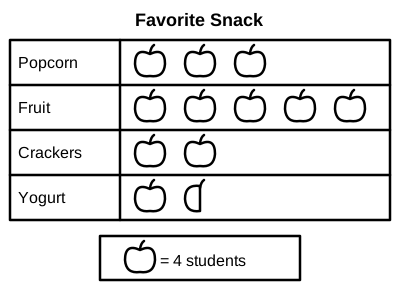
Favorite Snack
Key: each apple = 4 students. Popcorn: 3 apples. Fruit: 5 apples. Crackers: 2 apples. Yogurt: 1 and a half apples.
A half apple stands for half of 4, which is 2.
Use the graph above. Each apple stands for 4 students.
1.
How many students chose popcorn?
2.
How many students chose fruit?
3.
How many students chose yogurt?
4.
How many students voted in all?
5.
How many more chose fruit than crackers?
Make a picture graph of these votes with the key: each star = 2 votes. Red 8, blue 6, green 3, yellow 10.
Color
Stars (each = 2 votes)
6.
How many stars for green?
7.
How many stars for yellow?
Challenge:With a key of 5, how many pictures show 25?
English Language Arts
Objective: I can look through my year of writing, talk about how it changed, and choose my best pieces.
Builds on: Needs revising from Week 13 and the writing your child saved all year. One-minute check: ask, "What do writers do when they revise?" (They add, cut or change ideas and words to make the writing better.)
New words:
portfolio – a collection of your work that shows how you grew
schwa – the quick, weak "uh" sound in a syllable
Materials: Writing folders and notebooks from the whole year, Sticky notes in four colors (or four colored pencils), A large table or floor space, Writer's notebook, Paper, Pencil
Warm-Up · 5 min
Word study, about 3 minutes. Say: "In these words the last syllable has a weak vowel. It sounds like a quick 'uh.' That sound is called schwa. You cannot hear which vowel to write, so you must remember the ending." Write garden, dozen, button, metal, pedal and travel. Your child claps each word and sorts it by ending. (-en: garden, dozen. -on: button. -al: metal, pedal. -el: travel.) Spaced review from Week 15. Ask: "What is imagery?" (words that paint a picture using the senses)
Mini-Lesson · 10–15 min
Say: "A portfolio is a collection of work that shows how you grew as a reader and writer." Tell the plan: today choose, tomorrow reflect, Day 3 set goals, Day 4 build, Day 5 share. Write the three choosing tests on paper. Skill: it shows a skill you learned. Effort: it shows hard work and revising. Proud: it is a piece you are proud of. Next, model how to notice growth. Read these two samples from one writer, "Two Dog Pieces": September: "I like my dog. He is fun. We play." May: "My dog, Pickle, waits by the door every afternoon. When I get home, he spins in circles because he is so excited." Think aloud. Say: "I noticed the May piece has longer sentences. I noticed a linking word, because. I noticed a detail that shows how the dog feels." Ask: "Which test does the May piece pass?" (Skill. It uses a linking word and a strong detail.) Say: "Each time, I gave a reason I could point to."
Guided Practice · 10–15 min
1) Sort the year's work into four piles by quarter. Use dates, or go by the kind of writing. Quarter 1 (Weeks 1 to 9) has fables and opinion paragraphs. Quarter 2 (Weeks 10 to 18) has narratives, poems and a short report. Quarter 3 (Weeks 19 to 27) has the opinion essay. Quarter 4 (Weeks 28 to 36) has the research report. Mark each pile with one color. 2) Talk about each pile with these stems: "I noticed ___." "I agree, and ___." "I see it differently because ___." Start with: "In Quarter 2, I noticed you began using dialogue." Your child answers with a stem and a reason. 3) Ask: "Which pile shows the biggest change from the one before? What changed?" (Answers vary. Look for a named skill.) 4) Hold up one piece. Ask: "Which test does this pass? Why?" If stuck, say: "Point to one thing here that you could not do in September."
Independent Practice · 15–20 min
1) Your child chooses six pieces. They need at least one from each quarter, and the research report must be one of them. 2) On a sticky note for each piece, your child writes the test it passes and one skill word. Sample: "Effort. I revised my ending twice. Skill word: dialogue." 3) Your child checks that the six pieces show different kinds of writing: narrative, opinion, informative and a poem if possible. 4) Your child lists the six titles in the notebook. Look for: one piece from early fall, a reason on every note, and at least three kinds of writing.
Exit Ticket · 5 min
Ask the three questions aloud. For the third, your child holds up the piece and points to the part they mean.
Watch for: Choosing only the newest pieces, so the portfolio does not show growth.
Try: Ask for one piece from September or October. Lay it beside a recent piece and compare them together.
Exit ticket:
How is a portfolio different from a pile of all your work?
Why must one of your six pieces come from early in the year?
Hold up the piece you are proudest of. What part of it makes you proud?
Show answers
A portfolio holds chosen pieces that show how you grew.
So a reader can compare it with a later piece and see the growth.
Answers vary. Look for: a named piece and a reason tied to one part of it.
Support: Sort the work into quarters ahead of time. Your child chooses one piece from each pile, then two more.
Extend: Your child finds one piece they would revise now, marks two changes in colored pencil and explains each one.
Homework: Tell a family member which piece makes you proudest and one way your writing changed this year (10 minutes). Look for the stem "I noticed."
Practice page · Week 35, Day 1
English Language Arts
I can choose my best pieces for a portfolio and talk about how I grew.
Look: the portfolio tests
It shows a skill I learned.
It shows effort and revising.
It is a piece I am proud of.
Which test does each piece pass? Write skill, effort or proud.
1.
A story where Jamal used dialogue for the first time
2.
A report that Lucia revised three times
3.
A poem Kenji loves to read to his grandma
4.
Compare a piece from September and one from now. Finish: 'I noticed ____.'
5.
Your helper says your best piece is a poem. Answer politely: 'I see it differently because ____.'
Challenge:List the six pieces you picked. Write one skill word next to each.
Science
Objective: I can choose a testable question for my science fair investigation.
Standards: 3-5-ETS1-1, 3-5-ETS1-3
Builds on: Needs the Week 8 investigation (testable questions) and the Week 31 bean test (a fair test). One-minute check: ask, "In a fair test, how many things do we change?" (One.)
New words:
science fair – a time to show an investigation you planned, tested and explained
Materials: Science notebook from the whole year (for ideas), 5 sticky notes or slips of paper, Pencil, Sample test kit, used all week if your child has no other idea: 1 marble, a 30-centimeter ruler with a center groove (or a strip of stiff cardboard folded into a V and marked every 10 centimeters), 3 same-size books, 1 small, light paper cup, scissors, masking tape and a tape measure marked in centimeters
Day 171 — Choose a Science Fair Question — Wonder Warm-Up · 5 min
Spaced review from Week 31. Ask: "In our bean test, what one thing did we change? What stayed the same?" (The light changed. The seeds, soil and water stayed the same.) Then the wonder. Ask: "What have you wondered about this year that you could test at home?"
Mini-Lesson · 10–15 min
Say: "This week you run your own science fair investigation. It starts with a testable question. You change one thing and measure or count a result." Compare two questions. "Why are magnets cool?" has nothing to measure. "Does a bigger magnet lift more paper clips?" can be tested. Now show the sample kit. An adult cuts a doorway in the cup's rim, about 3 centimeters wide and tall. Prop the ruler's 30 end on the 3 books. Set the cup upside down at the low end, doorway facing the ramp. Hold the marble at the 10 mark and let go. Ask: "What could we change?" (Where the marble starts.) "What could we measure?" (How far the cup slides, in centimeters.) Say: "Our sample question is: Does a higher start make a marble push a cup farther?" Give two more samples. "Which paper soaks up the most water?" "Does a sugar cube dissolve faster in warm or cold water?" Say: "You may solve a design problem instead. Name the need, the criteria and the constraints." Sample: "Park the cup in a taped zone. Criteria: it stops there in 2 of 3 trials. Constraints: one ruler, up to 4 books, 20 minutes." Ask: "Is 'Why is the sky pretty?' testable?" (No. There is nothing to measure.) If stuck, say: "What will you change? What will you measure or count?"
Investigation / Hands-On · 15–20 min
Question Brainstorm. 1) Your child flips through the science notebook and writes 5 questions, one on each sticky note. 2) For each note, they answer three things. What will I change? What will I measure or count? Can I do it this week with things at home? 3) Record the answers in a table with four columns: Question, Change, Measure, Doable. 4) They cross out any question with nothing to measure, or one that needs more than 2 days. 5) They circle the strongest question. 6) An adult checks that it is safe: no flames, no strong cleaners and no harm to animals. Expect at least one question to pass all three checks. If none passes, use the sample question.
Science Notebook Entry · 10 min
Your child writes four frames in pencil. "My question is ___. I will change ___. I will measure ___ in ___. I chose it because ___." Sample: "My question is: Does a higher start make a marble push a cup farther? I will change the start mark. I will measure the slide in centimeters. I chose it because I like ramps."
Wrap-Up & Exit Ticket · 5 min
Read the three exit questions aloud; your child answers on paper. Praise any question that names what to change and what to measure.
Watch for: Choosing a question with nothing to measure, such as "Which animal is the best?"
Try: Ask, "What would you measure or count to answer it?" If there is nothing, rewrite the question together.
Exit ticket:
Turn this into a testable question: "Is ice interesting?"
A question asks, "Does the amount of water change how tall a bean plant grows?" What is changed, and what is measured?
What is your science fair question, and what one thing will you change?
Show answers
Answers vary. Look for: one thing to change and one thing to measure. Sample: "Does an ice cube melt faster in water or in air?"
The amount of water is changed. The height of the plant is measured.
Answers vary. Look for: a question that can be tested this week, with exactly one thing changed.
Support: Offer the three ready-made questions: the marble start, the paper that soaks up water, or the sugar cube. Your child picks one.
Extend: Your child writes a question with two things to test, such as start mark and floor surface. They plan to test them one at a time.
Homework: Explain the question to a family member and ask for their prediction. Look for: your child names what changes and what is measured.
Practice page · Week 35, Day 1
Science
I can choose a testable question for my science fair.
A Good Science Fair Question
A good question can be tested. You change one thing and measure or count what happens. 'Does a sugar cube dissolve faster in warm water or cold water?' is testable. You change the water temperature. You time how long the sugar cube takes to dissolve. 'Why are flowers pretty?' is hard to test, because there is nothing to measure.
Question Brainstorm. Write 5 questions. For each, tell what you would change and what you would measure.
Question
What I change
What I measure or count
Testable this week?
1.
My chosen question: ____
2.
The one thing I will change: ____
Circle the question you could test with a fair test this week.
3.
Which question is testable?
○ Why do people like music?○ Does a ball bounce higher on wood or on carpet?○ What lived on Earth first?
4.
What makes a question testable?
Challenge:Make this question testable: 'Which paper towel is best?'