3
    Third GradePowered by ThirdGrade.com

    Daily lesson plan

    Day 2 · Tuesday

    Week 24 · Reasoning: Fractions, Opinion Essays, Weather & Government

    See what your state adds or places differently

    Suggested daily schedule
    8:30–8:45 AM15 minMorning Circle / Read-Aloud / Calendar
    8:45–10:00 AM75 minEnglish Language Arts
    10:00–11:00 AM60 minMathematics
    11:00–11:15 AM15 minSnack and Movement Break
    11:15–12:00 PM30–45 minScience (every day)
    12:00–12:45 PM30–45 minSocial Studies (every day)
    12:45–1:30 PM45 minLunch and Choice Time
    1:30–2:15 PM45 minSpecials: PE / Art / Music (rotating)
    2:15–2:45 PM30 minIndependent Reading & Journaling

    Social Studies

    Objective: I can sort things into needs and wants and explain items that could be either.

    Standards: D2.Eco.1.3-5

    Builds on: Needs Day 1 (people choose because money and time are limited). One-minute check: ask "Name one thing every person must have each day." (Sample: food or water.)

    New words:
    • want – something people would like to have but can live safely without

    Materials: 12 index cards or paper slips, 2 paper plates labeled Needs and Wants, Notebook, Markers, Pencil

    1. Warm-Up · 5 min

      Spaced review from Week 22. Ask: "What do we call a person who runs for an office?" (A candidate.) Then ask: "You need water. Do you need lemonade?" Let your child explain. Say: "Today's question: how do we tell a need from a want?"

    2. Mini-Lesson · 10–15 min

      Say: "Needs are things people must have to live and stay safe and healthy. They are food, water, shelter, clothing and health care." Say: "Wants are things that are nice to have. We could live safely without them." Draw a coat in the notebook. Say: "Some things can be either. It depends on the situation." Say: "A warm coat is a need in a cold winter. A fourth coat is a want." Say: "A phone may be a need for an adult's job. For a child, it is usually a want." Say: "Every person has the same basic needs. Families meet them in different ways." Say: "Wants are not bad. They just come after needs." Ask: "Water or lemonade: which is the need?" (Water.) Ask: "Shoes are a need. Is a third pair of sandals a need?" (No. It is a want, because the need is already met.) Ask: "What makes something a need?" (People must have it to live and stay safe and healthy.) If stuck, say: "Ask: Could a person live safely and stay healthy without it?"

    3. Activity / Source Work · 15–20 min

      Card sort. 1) With markers, your child writes or draws one item on each card. The first six are bread, drinking water, a warm blanket, a home, a doctor visit when sick, and soap. The other six are a skateboard, candy, a board game and a movie ticket. Add a fancy cake and a second pair of sneakers. 2) Shuffle. Your child places each card on the Needs plate or the Wants plate and gives a reason. 3) Expect the first six on Needs and the other six on Wants. 4) Your child counts the cards in a chart with three columns: Needs, Wants, Could be either. 5) Pick two cards your child was unsure about. Ask: "When could this be a need? When is it a want?" Sample: "Sneakers are a need when the first pair no longer fits. A second pair that fits is a want." 6) Ask: "What is your evidence that soap is a need?" (It keeps people clean and healthy.) Sorts vary a little. Accept the other plate if the reason is sensible.

    4. Notebook Entry · 10 min

      Your child draws a T-chart with five needs and five wants. Then finish: "A tricky item is ___. It is a need when ___ and a want when ___." Sample: "A tricky item is a coat. It is a need when winter is cold and a want when I already have one that fits."

    5. Exit Ticket · 5 min

      Read the three questions aloud. Your child answers without the plates. Praise reasons that start with "because."

    Watch for: Calling anything they love a need, such as "I need that game."

    Try: Ask: "Could you live safely without it for a month?" If yes, it is a want.

    Exit ticket:
    1. Sort these four into needs and wants: rice, a toy robot, a place to sleep, stickers.
    2. Milk or a milkshake: which is closer to a need? Tell why.
    3. A raincoat can be a need or a want. Give one example of each.
    Show answers
    1. Needs: rice and a place to sleep. Wants: a toy robot and stickers.
    2. Milk. It is a basic food. A milkshake is a treat.
    3. Answers vary. Look for: a need when you have none and it rains often; a want when you already have one that fits.

    Support: Start with four clear cards with pictures: water, a home, candy and a toy. Add the other cards two at a time.

    Extend: Your child adds cards for things people do for us: a dentist visit, a haircut and a swim lesson. Sort and explain each.

    Homework: Your child finds five items at home and sorts them into needs and wants with a family member. Look for: a reason for each, and one tricky item.

    Practice page · Week 24, Day 2

    Social Studies

    I can sort needs and wants and explain items that could be either.

    Write need or want for each card.

    Word bank: need · want

    1. 1.

      clean water

    2. 2.

      a trampoline

    3. 3.

      a warm blanket in winter

    4. 4.

      bubble gum

    5. 5.

      a doctor's visit

    6. 6.

      concert tickets

    Explain the tricky item.

    1. 7.

      Tell when a bike could be a need and when it could be a want.

    Challenge: Name the five kinds of needs from our lesson.

    Materials: two paper plates · picture cards
    Mathematics

    Objective: I can show that equal parts can look different and that the same fraction of different wholes can be different amounts.

    Standards: 3.G.A.2, 3.NF.A.1

    Builds on: Needs Week 24 Day 1: partition a shape into parts with equal area. One-minute check: ask "A rectangle has 8 equal parts. What fraction of its area is one part?" (1/8)

    Materials: Grid paper, 1 small and 1 large paper circle (trace a cup and a plate), Crayon, Scissors, Notebook, Pencil

    1. Warm-Up · 5 min

      Spaced review from Week 20 Day 4. Ask: "On a 0 to 1 line in fourths, which fraction is 2 jumps from 0?" (2/4) Ask: "Which equivalent fraction sits at that point?" (1/2) Then practice ×6 facts with no clock. Ask 6 × 3, 6 × 5, 6 × 6 and 6 × 8 (18, 30, 36, 48).

    2. Mini-Lesson · 10–15 min

      Draw two 4 by 2 rectangles on grid paper. Ask: "How many squares are in each?" (8) On the first, shade the 4 squares of the top row with the crayon. On the second, shade a 2 by 2 block. Ask: "How many squares are shaded in each?" (4) Say: "Both parts cover 4 of the 8 equal squares. So both parts are 1/2 of the rectangle. Equal parts need the same area, not the same shape." Next, fold the small circle and the large circle in half. Say: "Both are 1/2. But half of the big circle is more paper. A fraction tells an amount compared with its own whole." Now your child does more. Your child draws a third 4 by 2 rectangle and shades 1/2 in a new way. Ask: "How do you know it is 1/2?" (4 of the 8 squares are shaded.)

    3. Guided Practice · 10–15 min

      1) Your child draws two 4 by 2 rectangles and shades 1/4 of each in different ways (2 squares each). 2) Your child draws two 4 by 3 rectangles and shades 1/3 of each in different ways (4 squares each). 3) Hold up one half of each circle. Ask: "Which 1/2 is more paper?" (the large one) 4) Ask: "Two squares are the same size. Is 1/4 of each the same amount?" (Yes. The wholes are equal.) If stuck, say: "Count the squares in the whole. Then count the shaded squares."

    4. Independent Practice · 15–20 min

      1) Draw a 4 by 3 rectangle. Shade 1/2 of it (6 squares). 2) Draw two more 4 by 3 rectangles. Shade 1/4 of each in different ways (3 squares each). 3) Draw one more. Shade 1/6 of it (2 squares). 4) You draw two 4 by 2 rectangles. Shade 2 squares in a different place on each. Ask: "Does each show 1/4?" (Yes. Each is 2 of 8 equal squares.) 5) Draw a 2 by 2 square and a 4 by 4 square. Shade 1/4 of each. Which 1/4 is more space? (the one in the large square; 4 squares, not 1) 6) Can two parts of one shape look different and both be 1/2? (Yes, if the areas are equal.) 7) Mei and Omar each paint 1/3 of their own wall. Mei's wall is bigger. Who paints more wall? (Mei) 8) Lin and Raj have same-size pies. Each eats 1/4, cut in different ways. Who eats more? (the same amount)

    5. Exit Ticket · 5 min

      Read each question aloud; your child answers on grid paper.

    Watch for: Believing equal parts must have the same shape.

    Try: Your child counts the squares in each part. If the counts match, the areas match.

    Fact fluency: ×6 facts

    Exit ticket:
    1. A grid has 16 equal squares. How many squares make 1/8 of it?
    2. Two parts of one rectangle look different. Each covers 3 of its 12 squares. Are both 1/4?
    3. Is 1/2 of a small pizza the same amount as 1/2 of a large pizza?
    Show answers
    1. 2
    2. Yes. Both cover 3 of 12 equal squares.
    3. No. Half of the large pizza is more.

    Support: Your child cuts out the shaded parts with scissors and counts the squares in each.

    Extend: Your child finds every way to shade 1/4 of a 4 by 2 rectangle with 2 touching squares. There are 10 ways: 6 side by side and 4 stacked.

    Homework: Fold two sheets of paper of different sizes in half. Write a sentence comparing the halves. Sample: Both are 1/2, but the big half is more paper.

    Practice page · Week 24, Day 2

    Mathematics

    I can show that equal parts can look different and that a fraction depends on its whole.

    Look: 1/2 two ways

    1. Draw a strip of 6 equal squares in one row.
    2. Shade the first 3 squares. On a copy, shade every other square.
    3. Both show 1/2: they cover the same area.

    Use a 2-by-4 rectangle of 8 equal squares.

    1. 1.

      Show 1/4 one way.

    2. 2.

      Show 1/4 a different way.

    3. 3.

      Show 3/4.

    Solve.

    1. 4.

      Noor and Felix each drink 1/2 of their own juice box. Noor's box is small. Felix's box is big. Did they drink the same amount?

    2. 5.

      Two shapes each show 1/3 shaded. Must the shaded parts be the same shape?

      ○ yes○ no

    Challenge: Draw a small square and a big square. Shade 1/2 of each. Which shaded part is more?

    English Language Arts

    Objective: I can use clue words and text features to find an author's purpose.

    Standards: RI.3.6, RI.3.5, RI.3.4

    Builds on: Needs yesterday's three purposes: persuade, inform and entertain. One-minute check: say "Don't miss our huge shoe sale!" Ask for the purpose. (Persuade.)

    Materials: Reader's notebook, Pencil

    1. Warm-Up · 5 min

      Word study: mark the parts. Write slowest, agreement, excitement, funniest, windy. Your child underlines each base word and circles the ending. (slow + est, agree + ment, excite + ment, funny + est, wind + y.) Ask: "What changed in funniest?" (The y changed to i.) Spaced review from Week 22. Say: "The path was slick, or slippery, after the rain." Ask: "What does slick mean? What kind of clue is it?" (Slippery. A synonym clue.)

    2. Mini-Lesson · 10–15 min

      Say: "Authors leave clues about their purpose. Some clues are words. Some are text features." Write three lists. Persuade clues: should, must, best, you'll love, join, buy. Inform clues: facts, numbers, headings, numbered steps, captions, diagrams. Entertain clues: characters, talking, a problem, feelings. Read this aloud and show the layout. "How to Plant a Bean Seed": What You Need: a cup, soil, one bean seed, water. Step 1: Fill the cup with soil. Step 2: Push the bean seed about one inch deep. Step 3: Water it until the soil is damp, and set the cup in a sunny window. Step 4: Keep the soil damp. In about a week, a sprout, a tiny new plant, will push up through the soil. Caption: A bean sprout bends toward the light. Think aloud: "I see a heading, numbered steps and a caption. I see numbers: one inch, a week. No one says 'you should.' The purpose is to inform." Point to each clue as you name it.

    3. Guided Practice · 10–15 min

      Use the bean text. 1) Ask: "Which feature lets you find what to do second, fast?" (The step numbers.) 2) Ask: "Where would you look to see what to gather first?" (Under the heading "What You Need.") 3) Ask: "Find sprout in Step 4. What is a sprout, and how does the text tell you?" (A tiny new plant. It is a definition clue.) 4) Ask: "Does the author share a view about beans?" (No. The text has only facts and steps.) If stuck, say: "Run your finger down the left side. What starts each line?"

    4. Independent Practice · 15–20 min

      Your child reads this alone. "Grow Something Green": Our school should give every third grader a bean seed this spring. Growing a plant is the best science lesson there is. You'll love checking your cup each morning. Beans grow fast, so nobody gets bored. Seeds cost only a few cents, so there is no good reason to wait. Ask your teacher today! 1) Write the purpose and three clue words. (Persuade: should, best, you'll love, ask.) 2) Write the author's view and your own with yesterday's frame. 3) Write a two-sentence entertain version about a bean seed. 4) Write a two-sentence inform version with a number or a heading. 5) Label one clue in each version. Samples: "Benji the bean hated the dark. 'Let me out!' he yelled." "Bean Facts: A bean plant needs water, light and air." Look for clues that match the purpose in each version.

    5. Exit Ticket · 5 min

      Read each question aloud. Your child writes the answers with both texts in view.

    Watch for: Deciding purpose from the topic: "It is about gardens, so it informs."

    Try: Your child underlines at least two clues before naming the purpose.

    Exit ticket:
    1. In "How to Plant a Bean Seed," which fact appears only in the caption?
    2. Read: "Lima the bean peeked out of the soil and gasped, 'It is bright up here!'" What is the purpose? Name one clue.
    3. The author of "Grow Something Green" says growing a plant is the best science lesson. Is that a fact or the author's view? How do you know?
    Show answers
    1. A bean sprout bends toward the light.
    2. Entertain. Clues: a talking bean character and its feelings.
    3. The author's view. "Best" is a persuade clue word, and people could disagree.

    Support: Keep the three clue lists open on the notebook page beside your child during reading.

    Extend: Your child finds a text with two purposes, such as a funny ad, and explains which is the main one.

    Homework: Find one text at home with a heading or a diagram. Tell a family member its purpose and two clues. Then read for 15 minutes. Look for clues that are features, not the topic.

    Practice page · Week 24, Day 2

    English Language Arts

    I can use clue words and text features to find an author's purpose.

    Look: Purpose clues

    1. Persuade clues: should, must, best, you'll love, join.
    2. Inform clues: facts, numbers, headings, steps, diagrams.
    3. Entertain clues: characters, talking, a problem, feelings.

    How to Make a Paper Boat

    Step 1: Fold a sheet of paper in half from top to bottom. Step 2: Fold the top corners down to the middle to make a triangle. Step 3: Fold each bottom strip up. Run your thumbnail along each crease, the sharp fold line, to make it flat. Step 4: Pull the bottom of the hat open and press it flat into a square. Step 5: Fold the bottom corner up to the top on each side to make a triangle. Step 6: Pull the bottom open again and press it flat into a smaller square. Step 7: Gently pull the two top points out to the sides. Your boat pops into shape!

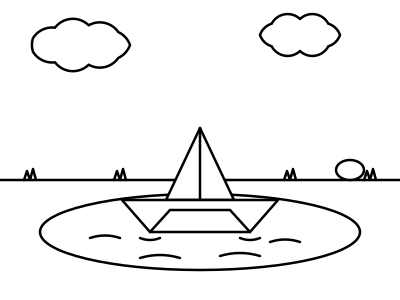
    A folded paper boat with a pointed top floats in a wide puddle on the ground.
    A paper boat can float for a little while.

    Use the text above.

    1. 1.

      What is the author's purpose?

      ○ Persuade○ Inform○ Entertain
    2. 2.

      Name two text features or clues that show it.

    3. 3.

      What does crease mean?

    Read: 'Every family should fold paper boats! You'll love racing them. Start this rainy day!'

    1. 4.

      What is the purpose?

      ○ Persuade○ Inform○ Entertain
    2. 5.

      Circle two persuade clue words.

    3. 6.

      Write one sentence about boats with an entertain purpose.

    4. 7.

      wash + able = ____

    5. 8.

      excite + ment = ____

    Challenge: Fold a paper boat with the steps. Was the text easy to follow? Why?

    Materials: a sheet of paper

    Science

    Objective: I can draw two possible designs, compare them against my criteria and choose the best plan.

    Standards: 3-5-ETS1-2, 3-ESS2-1

    Builds on: Needs the Day 1 page with criteria and constraints, and the box of parts. One-minute check: your child reads one criterion and one constraint aloud and says which is which.

    New words:
    • scoring chart – a table that shows how well each design meets each criterion

    Materials: Box of parts from Day 1, Science notebook with the Day 1 page, Ruler and pencil, 1 index card

    1. Day 117 — Plan and Compare Designs — Wonder Warm-Up · 5 min

      Spaced review from Day 1. Ask: "'Use only parts from our box.' Criterion or constraint? Why?" (Constraint. It limits the materials.) Then lay out the parts from the box. Ask: "Which of these could become part of your instrument? What job would it do?"

    2. Mini-Lesson · 10–15 min

      Say: "Good engineers think of more than one solution before they build. Then they compare." First, test an idea. Your child holds the index card by one edge with its flat side toward you. Blow on it. Then your child turns its thin edge toward you. Blow again. Ask: "When did the card get pushed more?" (When the flat side faced the moving air.) Say: "A big flat tail catches the wind. So a wind vane needs a tail bigger than its point." Now compare two designs. Design A: a straw arrow that spins on a pin stuck in a pencil eraser. Design B: a cardboard arrow taped tightly to a stick. Draw a scoring chart: designs down the side, criteria across the top. Ask: "Turns in a light breeze?" (A yes, B no. B is taped still.) "Stays standing?" (Both can, with a heavy base.) "Points to where the wind comes from?" (Only A, because it can turn.) Your child counts the checks. (A has 3. B has 1.) Say: "The best design meets the most criteria and stays inside the constraints." If stuck, say: "Go one box at a time. Can this design do this job?"

    3. Investigation / Hands-On · 15–20 min

      Two-Design Plan. 1) Your child sketches Design A and Design B for their own instrument, with labels. The two must differ in at least one real way, such as tail size or base. 2) With the ruler, they draw a scoring chart with their three criteria across the top. 3) For each box they ask, "Is this design likely to meet this criterion?" They mark a check or an X and say why. 4) They test both designs against the constraints. A design that breaks a constraint is out unless it can be changed. 5) They choose the design with the most checks and tell you why. 6) They write at least five numbered build steps. Wind vane sample: cut the point and tail, slit the straw ends and slide the pieces in. Then find the balance point and pin the straw to the eraser. Look for a choice that matches the chart and steps in a sensible order. A tie is fine. Your child picks one design and gives a reason.

    4. Science Notebook Entry · 10 min

      Your child keeps both sketches, the scoring chart and the build steps in the notebook. Frame: "I chose Design ___ because ___. One thing I am unsure about is ___." Sample: "I chose Design A because it earned three checks. I am unsure whether the base is heavy enough."

    5. Wrap-Up & Exit Ticket · 5 min

      Read the three exit questions aloud; your child answers on paper. Praise reasons that name a criterion.

    Watch for: Choosing the favorite design without using the scoring chart.

    Try: Count the checks together for each design. Then ask: "Which design does your own chart say is best?"

    Exit ticket:
    1. Design A earns 3 checks, but it needs a part you do not have. Design B earns 2 checks and fits every constraint. Which should you build?
    2. Which design did you choose? Give one reason that names a criterion.
    3. What is step 1 of your build, and which part does it use?
    Show answers
    1. Design B, unless A can be changed to use parts you have. A design must fit the constraints.
    2. Answers vary. Look for: a criterion in the reason, such as "it turns more easily."
    3. Answers vary. Look for: a clear first action, such as "cut the point and tail from cardboard."

    Support: Give your child the sample wind vane as Design A. They change just one part to make Design B.

    Extend: Your child adds a third design and scores all three. They tell which criterion was hardest to meet.

    Homework: Your child shows the plan to a family member and asks for one suggestion. Look for the suggestion written beside the plan.

    Practice page · Week 24, Day 2

    Science

    I can draw two designs, compare them and choose the best plan.

    Two-Design Plan. Sketch Design A and Design B with labels.

    1. 1.

      Design A

    2. 2.

      Design B

    Score each design with a check or an X for each criterion.

    CriterionDesign ADesign B


    1. 3.

      Which design did you choose? Why?

    2. 4.

      Write your first 3 build steps.

    3. 5.

      Why do engineers draw more than one design?

    Materials: scissors · tape · a ruler · your materials box

    Standards-matched clips that reinforce today's objectives.

    Social Studies

    Economics for Kids: Needs and Wants

    Teaching Without Frills

    Supports: I can sort things into needs and wants and explain items that could be either.

    D2.Eco.1.3-5
    Watch on YouTube