Objective: I can trace where my breakfast comes from and show it on a map.
Standards: D2.Geo.7.3-5, D2.Geo.11.3-5
Builds on: Needs Week 13 Days 3 and 4: how goods travel and why regions trade. One-minute check: ask "Which carries big loads across an ocean, a truck or a ship?" (A ship.)
Materials: Four breakfast items with labels, such as cereal, milk, a banana and orange juice, U.S. map and world map, 4 pieces of string or yarn, about 12 inches each, 4 sticky notes, Tape, Notebook, Pencil
Warm-Up · 5 min
Spaced review from Week 10. Ask: "Name two of the five Great Lakes." (Any two of Huron, Ontario, Michigan, Erie, Superior.) Then ask the big question: "How many places helped make your breakfast?" Write down your child's guess.
Mini-Lesson · 10–15 min
Say: "Each item on your plate took a trip. Today you are a detective who traces those trips." Model one item, a wheat cereal. Point to Kansas and North Dakota on the U.S. map. Say: "Wheat grows on the Great Plains, in states like these. A mill grinds the wheat into flour." "A factory bakes the flour into cereal. Trucks carry the boxes to a warehouse, then to our store." Write the steps: farm, mill, factory, warehouse, store, home. Now teach label reading. Say: "Product of or Grown in tells where a food grew." "Packed in or Distributed by tells where it was boxed, or where the company office is." "If the label does not say where it grew, we write a question mark." Ask: "A juice carton says Distributed by a company in New Jersey. Did the oranges grow there?" (We cannot tell. Write a question mark.) Ask: "A banana sticker says Guatemala. What does that tell us?" (The banana grew in Guatemala.) If stuck, say: "Find the words Product of or Grown in first."
Activity / Source Work · 15–20 min
Breakfast detective. 1) Your child reads the label on each of the four items. 2) Write each item's name on a sticky note. Stick it where the item grew or was made. Use the U.S. map or the world map. 3) Tape a piece of yarn from each note to your town. 4) Rank the trips from shortest to longest. Compare yarn lengths only on the same map. Items from another continent traveled farthest. 5) Ask: "Which item traveled the farthest? What is your evidence?" (Sample: "The sticker says Guatemala, and the yarn is longest.") Ask: "Which U.S. region sent the most items?" 6) Count the different places. Compare the count with the guess from the warm-up. Expect three or more places for most breakfasts. Your results will differ from other families' results. Look for the pattern: fresh milk and eggs often make short trips, and fruit often travels far.
Notebook Entry · 10 min
Your child makes a Breakfast Journey chart with four columns. Item, Where it came from, How it probably traveled, Region or country. Sample row: "Banana, Guatemala, truck then ship then truck, another country." Then finish the frame: "My breakfast connects me to ___ places."
Exit Ticket · 5 min
Read the questions aloud. Your child uses the chart and the map. Praise answers that point to a label as evidence.
Watch for: Assuming the place on the label is where the food grew, when it may only be where it was packed.
Try: Point out "Packed in" and "Distributed by" on a label. Your child marks those items with a question mark on the map.
Exit ticket:
Which of your breakfast items traveled the farthest? What is your evidence?
A label says "Packed in Ohio." Does that prove the food grew in Ohio? Explain.
Why can't one place grow everything we eat for breakfast?
Show answers
Answers vary. Look for: an item and place from the chart, backed by the label or the yarn.
No. It tells where the food was packed. It may have grown somewhere else.
Different places have different land and climate, so they grow different things.
Support: Trace two items, not four. You read the labels aloud while your child finds each place.
Extend: Your child adds a fifth item from another country. Ask: "Did it cross an ocean or come by land? Which ocean?"
Homework: Your child reads the labels on two dinner foods tonight and adds them to the Breakfast Journey chart. Look for a place copied from each label.
Practice page · Week 14, Day 4
Social Studies
I can trace where my breakfast comes from and show it on a map.
Read the labels on four breakfast items. Fill in the chart.
Item
Where it came from
How it probably traveled
Region or country
1.
Which item traveled the farthest?
2.
Which item traveled the shortest distance?
3.
Name one U.S. region that helped make your breakfast.
Answer in a sentence.
4.
Why can't one place make everything we eat?
Challenge:My breakfast connects me to ____ places.
Materials: four breakfast items with labels · U.S. map and world map · yarn · sticky notes
Mathematics
Objective: I can solve two-step party problems in the Party Planner Challenge.
Standards: 3.OA.A.3, 3.OA.D.8, 3.OA.A.4
Builds on: Needs two-step problems from Week 5 Day 5 and equations with ? from Week 12 Day 4. One-minute check: your child solves 8 × ? = 32 and tells what the ? stands for (4; the missing factor).
Materials: 30 counters (dried beans, coins or buttons), Notebook, Pencil
Warm-Up · 5 min
Spaced review from Week 12. Read: "28 stickers go 4 to a page. How many pages?" (7) Then try ×8 and ÷8 facts with no clock. Ask 3 × 8, 6 × 8, 40 ÷ 8 and 56 ÷ 8 (24, 48, 5, 7).
Mini-Lesson · 10–15 min
Say: "Party Planner, part 2, is shopping. Many shopping questions take two steps." Read: "6 tables each get 4 cups. Cups come in packs of 8. How many packs do we buy?" Ask: "What must we know first?" (How many cups we need.) Write Step 1: 6 × 4 = 24. Say: "We need 24 cups." Ask: "What do we find next?" (How many packs of 8 make 24.) Write Step 2: 8 × ? = 24. Ask: "What is the unknown?" (3) Say: "So we buy 3 packs of cups." Say: "Check it. 3 packs of 8 is 24 cups, and we need 24." Say: "Reread the question. Did we answer it?" (Yes. It asked for packs.) Now your child does more. Read: "Each of 6 tables gets 3 balloons. 5 more balloons go by the door. How many balloons?" Your child writes both steps. (6 × 3 = 18; 18 + 5 = 23 balloons)
Guided Practice · 10–15 min
Your child writes Step 1 and Step 2 on separate lines. Before each one, ask: "What must we know first?" 1) 4 tables each get 9 napkins. Napkins come in packs of 6. How many packs? (4 × 9 = 36; 36 ÷ 6 = 6 packs) 2) Each of 5 tables gets 4 cupcakes. 3 extra are baked. How many cupcakes? (5 × 4 = 20; 20 + 3 = 23) 3) We need 40 forks. Forks come in packs of 8. 2 packs are at home. How many more packs? (40 ÷ 8 = 5; 5 − 2 = 3 packs). If stuck, say: "What must we know before we can answer? Find that number first."
Independent Practice · 15–20 min
Your child solves each one and shows both steps for the stories. 1) 8 × ? = 48 (6). 2) 7 × 8 (56). 3) 72 ÷ 8 (9). 4) Draw 3 packs of 8 juice boxes as circles with dots. How many juice boxes? (24) 5) 24 guests each get 1 party hat. Hats come in bags of 6. 1 bag is at home. How many more bags? (24 ÷ 6 = 4; 4 − 1 = 3 bags) 6) 7 tables each get 2 candles. 6 more candles go on the cake. How many candles? (7 × 2 = 14; 14 + 6 = 20) 7) 5 packs hold 6 plates each. 24 guests each take one plate. How many plates are left? (5 × 6 = 30; 30 − 24 = 6) 8) 9 tables each get 3 flowers. Flowers come in bunches of 9. How many bunches? (9 × 3 = 27; 27 ÷ 9 = 3 bunches). Last, your child rereads each story question and circles the number that answers it.
Exit Ticket · 5 min
Read each question aloud; your child shows both steps for questions 1 and 2.
Watch for: Stopping after Step 1 and giving that number as the answer, such as 24 cups instead of 3 packs.
Try: Your child underlines the question first. After solving, ask: "Does your answer tell what the story asked?"
Fact fluency: ×8 and ÷8 facts
Exit ticket:
8 tables each get 2 bowls. Bowls come in packs of 4. How many packs?
6 tables each get 5 flowers. 4 more flowers go by the door. How many flowers?
Write an equation with ? and solve it: 9 equal packs hold 54 plates in all.
Show answers
4 packs (8 × 2 = 16; 16 ÷ 4 = 4)
34 flowers (6 × 5 = 30; 30 + 4 = 34)
9 × ? = 54; ? = 6 plates in each pack
Support: Use beans for each story. Your child builds Step 1, counts, then builds Step 2 with the same beans.
Extend: Your child plans a party for 32 guests and lists 3 items to buy in packs of 4 or 8. Sample: 32 cups in packs of 8 is 4 packs.
Homework: Solve this party problem and show both steps. 3 tables each get 8 spoons. Spoons come in packs of 6. How many packs? Answer: 3 × 8 = 24; 24 ÷ 6 = 4 packs.
Practice page · Week 14, Day 4
Mathematics
I can solve two-step party problems in the Party Planner Challenge.
Look: 5 tables each get 6 cups. Cups come in packs of 10.
Step 1: how many cups? 5 × 6 = 30.
Step 2: how many packs? 10 × ? = 30.
The answer is 3 packs.
Write step 1 and step 2. Then answer.
1.
Each of 3 tables gets 8 balloons. 5 more balloons go on the door. How many balloons?
2.
Each of 4 tables gets 7 plates. Plates come in packs of 4. How many packs?
3.
Each of 18 guests gets 1 hat. Hats come in bags of 6. One bag is already at home. How many more bags are needed?
Write an equation with ? and solve.
4.
Juice boxes come in packs of 6. You need 42 juice boxes. How many packs?
Challenge:Plan your own party for 24 guests. How many tables, and how many cupcakes if each guest gets 2?
Materials: counters
English Language Arts
Objective: I can share my published book, and as a listener I can retell what I heard and ask good questions.
Standards: SL.3.4, SL.3.2, SL.3.3, W.3.4, L.3.2.B
Builds on: Needs the booklet from Day 3 and the retelling practice from Week 12 Day 4. One-minute check: ask, "Which three parts go in a short retelling?" (Who it is about, the problem and how it ended.)
New words:
Author's Chair – the special seat where a writer reads finished work aloud to listeners
Materials: Picture book booklet from Day 3, Colored pencils or markers, Stapler or yarn for binding, A chair for the Author's Chair, An envelope, Pencil, Notebook
Warm-Up · 5 min
Flex week, enrichment day 2. Word study, about 3 minutes. Ask each question aloud. "If you replay a song, what do you do?" (Play it again.) "A puppy that will disobey does what?" (It does not do what it is told.) "If you distrust a wobbly ladder, how do you feel about it?" (You are not sure it is safe.) Then your child uses unlock in a sentence. Spaced review from Week 13. Ask: "Fix this: The children is ready." (The children are ready.)
Mini-Lesson · 10–15 min
Say: "Today you become a published author and sit in the Author's Chair. A speaker has three jobs: read clearly, keep a steady pace and show each picture." Read one page of the booklet two ways. First read it fast and flat. Then read it at a steady pace with expression. Ask: "Which was easier to understand? Why?" (The second. I could hear every word and the feeling.) Say: "A listener has jobs too. Look at the speaker. Listen so you can retell. Afterward, recount the story in three sentences: beginning, problem, ending. Then ask one question that starts with How, Why or What." Give a sample question: "Why did you show rain in that picture?" Last, teach the envelope. Write this sample in the notebook, with a new line at each slash: Ms. Ana Reyes / 12 Birch Lane / Madison, Wisconsin 53703. Say: "The name goes on the top line. The house number and street go in the middle. The city, state and ZIP code go on the bottom line. A comma goes between the city and the state."
Guided Practice · 10–15 min
1) Your child makes the title page with a correctly capitalized title and the word "by" with their name. (Check the first, last and important words.) 2) Bind the book with staples or yarn. Any coloring left can wait until after the sharing. 3) Your child practices reading the book once, pausing to show each picture. 4) Your child addresses the envelope to a relative with a pencil, using the sample. It can carry an invitation to a second reading. Ask: "Where is the comma?" (Between the city and the state.) If stuck, say: "Point to the city. Point to the state. The comma sits between them."
Independent Practice · 15–20 min
Hold the Author's Chair with at least one listener. 1) Your child sits in the chair and reads the book. 2) Each listener recounts it in three sentences and asks one How, Why or What question. Your child answers with a detail. 3) Switch roles. Read this story aloud once. "The Scarecrow's Hat": Every morning, crows ate the corn in Wes's garden. Wes built a scarecrow from a broom and an old coat. The crows landed right on its arms. They were not scared at all. Wes thought hard. Then he tied three pie tins to the scarecrow's hat. When the wind blew, the tins flashed and clanged. The crows flew off with angry squawks. That night, Wes counted every ear of corn. Not one was missing. 4) Your child recounts it and asks you one question. (Sample: Crows eat the corn in Wes's garden. His scarecrow does not scare them. He adds noisy pie tins, and the crows leave. Question: "Why did the tins scare the crows?")
Exit Ticket · 5 min
Ask the three questions aloud. For the second, your child writes the city and state in the notebook.
Watch for: As a listener, asking a yes-or-no question or telling their own story instead.
Try: Write question starters in the notebook: "Why did you...?" "How did you feel when...?" "What happened after...?"
Exit ticket:
You read too fast in the Author's Chair. What should you change, and why?
Write our city and state the way they go on an envelope. Where is the comma?
What question did you ask about 'The Scarecrow's Hat', and what was the answer?
Show answers
Slow down to a steady pace so listeners can understand every word.
Answers vary by family. Look for: a comma between the city and the state, with capitals on both.
Answers vary. Look for: a How, Why or What question and an answer with a story detail.
Support: Your child reads to just one listener. For retelling, they hold up three fingers: beginning, problem, ending.
Extend: Your child adds an "About the Author" page with three facts and a correctly capitalized heading.
Homework: Read the published book to someone who missed the Author's Chair. Ask them one question about it. Look for: a steady pace and each picture shown.
Practice page · Week 14, Day 4
English Language Arts
I can read aloud with expression, retell what I hear and write an address.
Look: Writing an address
Line 1: the person's name.
Line 2: the house number and street.
Line 3: the city, a comma, then the state and ZIP code: Tulsa, Oklahoma 74103
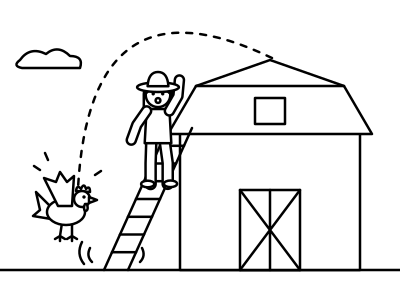
Rosie on the Roof
Rosie the hen was stuck on the barn roof. "Help!" she clucked. Farmer Ida climbed a wobbly ladder. Up, up, up she went. Just as Ida reached out, Rosie flapped her wings and fluttered down to the ground all by herself. Ida stared. "Well," she said, "you could have told me you could do that!"
Read the story aloud three times, then answer.
1.
Which line should you read in a loud, worried voice?
2.
Retell the story in 3 sentences: beginning, problem, ending.
3.
Write a How, Why or What question you could ask the writer.
4.
Name two jobs of a speaker in the Author's Chair.
Add the missing comma to each address line, then build the word.
5.
Austin Texas 78701
6.
Portland Maine 04101
7.
re + play = ____
Challenge:Address an envelope to someone in your family.
Materials: an envelope
Science
Objective: I can run a fair test to find out which habitat conditions pill bugs choose.
Standards: 3-LS4-3, 3-5-ETS1-3
Builds on: Needs fair tests from Week 8: change one thing and keep the rest the same. One-minute check: ask, "In a fair test, how many things do you change?" (One.)
New words:
isopod – a small animal with a jointed shell and 14 legs, such as a pill bug
Materials: Shallow tray, shoebox lid or baking pan, 2 paper towels of the same kind and a little water, 6 to 10 pill bugs, gently collected from under a log, stone or leaf pile, If no pill bugs can be found: a small cup of isopods from a pet store (keep these in their container afterward; never release them outdoors), or use the sample counts in the investigation, Spoon, Timer, Science notebook and pencil, Soap for handwashing
Day 69 — Flex Challenge: Pill Bug Habitat Choice — Wonder Warm-Up · 5 min
Spaced review from Week 10. Ask: "Is a pill bug living, once living or never alive? How do you know?" (Living. It eats, grows and has young.) Then tell where the pill bugs were found. Ask: "What was that place like: wet or dry, light or dark?" (Usually damp and dark.) Big question: "Do pill bugs choose damp places?"
Mini-Lesson · 10–15 min
Say: "Pill bugs are not insects. They are isopods, relatives of crabs and shrimp. They breathe with gill-like parts that must stay moist." Say: "Our question: do pill bugs choose a damp place or a dry place?" Say: "Remember the fair-test rule. Change only one thing. Keep everything else the same." Hold up the two paper towels. Ask: "Which one thing will we change?" (Damp or dry.) "What must stay the same?" (The tray, the kind of towel, the light, the starting spot.) "What will we count?" (The pill bugs on each side.) Say the care rules: "Move them with the spoon. Never squeeze. They go home today." Ask: "Why keep the light the same on both sides?" (So we know damp or dry caused the choice.) If stuck, say: "If two things differ, which one did the pill bugs choose? We could not tell."
Investigation / Hands-On · 15–20 min
Damp or Dry Fair Test. Safety: handle pill bugs gently, and wash hands with soap afterward. 1) Wet one towel and squeeze it out. Lay it on half the tray. Lay the dry towel on the other half. 2) Your child writes a prediction. 3) Spoon all the pill bugs onto the middle line. Start the timer. 4) Every 2 minutes for 10 minutes, your child counts the pill bugs on each side. Table: Time | Damp side | Dry side, with rows for 2, 4, 6, 8 and 10 minutes. 5) Return the pill bugs to their log or leaf pile. Pet-store isopods go back in their cup. Expect more on the damp side by the end. Some may curl up or wander. If not, say: "Real results vary. Look for the pattern." No animals at all? Set up the tray anyway. Then use these made-up sample counts for 8 pill bugs, which show the usual pattern. Damp side: 3, 5, 6, 7, 7. Dry side: 5, 3, 2, 1, 1. Ask: "What might have changed our results?" (Uneven light, or pill bugs that did not move.)
Science Notebook Entry · 10 min
In the notebook, your child records the question, the prediction, the table and a drawing of the tray. Then they finish: "Most pill bugs chose the ___ side. I think this is because ___." Sample: "Most pill bugs chose the damp side. I think this is because their breathing parts must stay moist."
Wrap-Up & Exit Ticket · 5 min
Read the three questions aloud, and your child uses the data table for question 1. Praise answers that name the two things Sam changed.
Watch for: Changing two things at once, such as putting the damp side in shade.
Try: Before starting, your child points to each side and names the only difference. Fix anything else that differs.
Exit ticket:
At the 10-minute count, which side had more pill bugs?
Why do pill bugs need a damp habitat?
Sam puts his damp towel in sunlight and his dry towel in shade. Why is his test not fair?
Show answers
Answers vary. Look for: an answer that matches the table, usually the damp side.
They breathe with gill-like parts that must stay moist.
Two things change, the wetness and the light. He cannot tell which one the pill bugs chose.
Support: Count together at each check. Your child records tally marks, not numbers.
Extend: Your child plans a second fair test: a damp paper towel against damp dead leaves. They list what changes and what stays the same.
Homework: With an adult, lift a stone or log outdoors, then put it back gently. List the living things you find. Note whether the ground was damp or dry.
Practice page · Week 14, Day 4
Science
I can run a fair test to find out which habitat conditions pill bugs choose.
Damp or dry? Count the pill bugs on each side every 2 minutes.
Minute
Damp side
Dry side
1.
My prediction:
2.
Which side did most pill bugs choose?
3.
What was the one thing you changed in your fair test?
4.
Why did you keep the tray, the light and the pill bugs the same on both sides?
Think like a scientist.
5.
Why might pill bugs live under logs and leaves?
6.
What did you do with the pill bugs at the end? Why?
Challenge:Plan a new fair test: do pill bugs choose light or dark? What will you change, and what will you keep the same?
Materials: a shallow tray or shoebox lid · 2 paper towels, one damp and one dry · 6 to 10 pill bugs · a timer · soap for handwashing