Objective: I can build a salt-dough map that shows U.S. landforms and regions.
Standards: D2.Geo.2.3-5, D2.Geo.3.3-5
Builds on: Needs the Week 5 relief map of your state and the Week 10 landforms. One-minute check: ask "On a relief map, what do the raised parts show?" (High land, such as mountains.)
Materials: Salt dough made ahead (2 cups flour, 1 cup salt, about 3/4 cup water) or modeling clay, Cardboard base, about 12 by 18 inches, U.S. map that shows landforms, 8 toothpicks and 8 small paper flags, Tape, Ruler, Markers or paint (for the next day, when the dough is dry), Notebook, Pencil
Warm-Up · 5 min
Spaced review from Week 4. Ask: "What is a plain?" (A wide area of flat land.) Then ask the big question: "If you ran your hand across the whole country, where would it bump?"
Mini-Lesson · 10–15 min
Say: "Today you are a mapmaker. You will build a map that shows high land and low land." Plan in pencil on the cardboard. Your child copies the outline of the United States from the map. A simple shape is fine. Then mark the plan together. Draw zigzags in the West for the Rockies, from Canada toward New Mexico. Draw small humps in the East for the Appalachians, from Maine toward Alabama. Write "plains" in the middle. Draw a line for the Mississippi from Minnesota to the Gulf of Mexico. Draw five small shapes for the Great Lakes. Say: "Rivers start on higher land and flow downhill to bigger water." Ask: "Which range will you build taller?" (The Rockies.) Ask: "Why are the Appalachians lower?" (They are older and worn down.) Ask: "Where does the Mississippi end?" (At the Gulf of Mexico.) If stuck, say: "Point to it on the printed map first. Then mark the same spot on yours."
Activity / Source Work · 15–20 min
Safety: do not taste the dough, because raw flour is not safe to eat. Wash hands afterward. 1) Your child presses a thin layer of dough over the whole outline. 2) Pinch up the Rockies, tall and pointed. 3) Build the Appalachians, low and rounded. 4) Smooth the Great Plains flat. 5) Draw grooves with a toothpick: the Mississippi, the Missouri joining it from the west, and the Colorado in the Southwest. 6) Press five small dents for the Great Lakes. 7) Tape flags to toothpicks. Label the five regions, the Great Lakes and both mountain ranges. Stand them in the dough. 8) Measure. Hold the ruler beside each landform and fill in a chart with two columns: Landform, Height on my map. Rows: Rockies, Appalachians, Great Plains. Expect the Rockies to be tallest and the plains lowest. If not, add or press down dough. Heights will differ from map to map. Look for the pattern: West high, middle flat, East low hills. Check that every river groove runs toward bigger water.
Notebook Entry · 10 min
Your child writes a map key for the 3D map. Tell what each shape and color will stand for. Sample: "Tall points are the Rockies. Low bumps are the Appalachians. Grooves are rivers. Blue is water." Then finish the frame: "Building in 3D helped me see that ___." Sample: "The West is much higher than the middle of the country."
Exit Ticket · 5 min
Read the questions aloud. Your child points to the 3D map, then writes a short answer. Praise correct landform names.
Watch for: Building all the mountains the same height, or drawing rivers that start at the sea.
Try: Hold the ruler beside each range and compare. Then your child traces a river from high land down to the sea.
Exit ticket:
Point to the highest land on your map. What is it called, and which region is it in?
Which landform did you keep flat, and where is it?
Trace the Mississippi with a finger. Where does it start, and where does it end?
Show answers
The Rocky Mountains, in the West.
The Great Plains, in the middle of the country.
It starts in Minnesota and flows south to the Gulf of Mexico.
Support: You draw the outline and the plan marks. Your child builds with modeling clay on top of them.
Extend: Your child adds the Sierra Nevada and the Cascade mountains near the West Coast. Use the printed map to place them.
Homework: When the dough is dry tomorrow, your child colors it with markers or paint: brown mountains, green plains, blue water. Then show a family member. Look for: your child explains the key.
Practice page · Week 14, Day 3
Social Studies
I can build a salt-dough map that shows U.S. landforms and regions.
Make a map key for your 3D map.
Color or shape
What it shows
1.
What color or shape did you use for mountains?
2.
What did you use to show rivers?
Answer each question about your map.
3.
Which mountains did you make taller?
4.
What flat landform did you smooth out in the middle of the country?
5.
Why should the dough dry before you paint it?
6.
What does relief mean on a map?
Challenge:Building in 3D helped me see that ____.
Materials: salt dough (flour, salt and water) or modeling clay · cardboard · toothpicks · paint or markers
Mathematics
Objective: I can use arrays to plan equal groups in the Party Planner Challenge.
Standards: 3.OA.A.3, 3.OA.A.1, 3.OA.B.5
Builds on: Needs arrays from Week 4 and switching the order of factors from Week 13 Day 1. One-minute check: your child draws 2 rows of 6, then turns the paper. Ask what both arrays total (12).
Spaced review from Week 13. Ask: "If 3 × 9 = 27, what is 9 × 3?" (27) Then try ×4 and ×6 facts with no clock. Ask 4 × 7, 4 × 9, 6 × 6 and 6 × 5 (28, 36, 36, 30). Your child tells how one answer was found.
Mini-Lesson · 10–15 min
Say: "This is the Party Planner Challenge. It takes two days. You plan a party for 24 guests. Every table must seat the same number." Count out 24 beans as guests. Say: "Try tables of 4." Your child makes rows of 4 beans. Ask: "How many tables?" (6) Write 6 × 4 = 24. Say: "So 6 tables of 4 seat all 24 guests." Say: "Now try tables of 5." Your child makes rows of 5. Ask: "Does this plan work?" (No. 4 guests are left without a full table.) Say: "A plan works only when every guest has a seat and every table matches." Now your child does more. Say: "Try tables of 8." Ask: "How many tables? Which equation fits?" (3 tables; 3 × 8 = 24) Ask: "What if the room had 8 small tables instead?" (8 tables of 3; 8 × 3 = 24)
Guided Practice · 10–15 min
Find more plans for 24 guests. No table may seat more than 10. The room holds at most 10 tables. Your child tests each plan with beans. 1) Tables of 6 (4 tables; 4 × 6 = 24). 2) Tables of 2 (12 tables; too many, because the room holds only 10). 3) Tables of 7 (does not work; 3 guests are left over). 4) Your child draws two working plans as arrays on grid paper and writes each equation. If stuck, say: "Make rows of that size. Is any guest left without a full table?"
Independent Practice · 15–20 min
Now plan for 36 guests with the same two limits. Your child tests with beans and writes each answer. 1) Tables of 9 (4 tables; 4 × 9 = 36). 2) Tables of 6 (6 tables; 6 × 6 = 36). 3) Tables of 4 (9 tables; 9 × 4 = 36). 4) Tables of 8 (does not work; 4 guests are left over). 5) Draw the plan with tables of 6 as an array on grid paper. Label it. (6 rows of 6) 6) Tables of 3 need how many tables? Why does that plan break a limit? (12 tables; the room holds only 10) 7) A smaller room fits only 6 tables. Which plans still work? (4 tables of 9, or 6 tables of 6) 8) Each of the 4 tables of 9 gets 2 balloons. How many balloons? (8)
Exit Ticket · 5 min
Put the beans away. Read each question aloud; your child answers on paper and may sketch.
Watch for: Listing a plan that leaves guests out, such as 4 tables of 5 for 24 guests.
Try: Your child builds the plan with beans. Every bean must sit in a full row, and every row must match. Count the beans left over.
Fact fluency: ×4, ×6 facts
Exit ticket:
20 guests sit at tables of 5. How many tables?
Name two other ways to seat 20 guests at equal tables.
28 guests sit at 4 equal tables. How many guests are at each table?
Show answers
4 tables
Any two of these. 5 tables of 4, 2 tables of 10, 10 tables of 2. Also 1 table of 20, or 20 tables of 1.
7 guests
Support: Plan for 12 guests and build every plan with beans. Plans: 2 tables of 6, 3 of 4, 4 of 3, 6 of 2.
Extend: Your child finds every plan for 40 guests, then for 32 guests, with the same limits. Answers for 40: 4 tables of 10, 5 of 8, 8 of 5, 10 of 4. Answers for 32: 4 of 8, 8 of 4.
Homework: Draw a plan to seat 18 guests at equal tables and write its equation. Sample: 3 tables of 6; 3 × 6 = 18.
Practice page · Week 14, Day 3
Mathematics
I can use arrays to plan equal groups in the Party Planner Challenge.
Look: 18 guests at tables of 3
Draw an array: each row is one table with 3 guests.
Keep adding rows until you have 18 guests.
You drew 6 rows, so 6 tables. 6 × 3 = 18.
Find every way to seat 18 guests with the same number at each table.
Tables
Guests at each table
Check
1.
List all the ways with at most 10 guests at each table and at most 10 tables.
2.
18 guests sit at tables of 2. How many tables?
3.
The room fits at most 4 tables, and each table holds at most 6 guests. Which plan works?
Draw and solve.
4.
Draw an array for 4 tables with 5 guests each. How many guests?
5.
Is 5 tables of 4 guests the same number of guests? Why?
Challenge:Can 17 guests sit at equal tables with more than 1 guest and more than 1 table? Explain.
Materials: graph paper · counters
English Language Arts
Objective: I can plan a picture book version of my narrative where the illustrations add to the words.
Standards: RL.3.7, W.3.4, W.3.5
Builds on: Needs the revised narrative from Week 13 and the picture work from Week 10 Day 3. One-minute check: ask, "What can a picture show that words might skip?" (A feeling, the setting or a small detail.)
Materials: One picture book from your child's shelf, 2 sheets of plain paper folded together into an 8-page booklet, Colored pencils or markers, Final narrative draft, Notebook, Pencil
Warm-Up · 5 min
Flex week, enrichment day 1. Word study, about 3 minutes. Dictate this sentence: "Do not untie the boat, or it will disappear." Your child writes it in the notebook. Check it together. Ask: "Which two words have a prefix?" (Untie and disappear.) Your child fixes any misspelled word. Spaced review from Week 13. Ask: "How do you capitalize the title 'a walk in the rain'?" (A Walk in the Rain)
Mini-Lesson · 10–15 min
Say: "Today you start publishing your story as a picture book. In a good picture book, the pictures do not just repeat the words. They add things: a feeling, the setting or a detail the words never say." Open the picture book. Cover the words on one page with your hand. Your child tells what is happening from the picture alone. Uncover the words. Ask: "What did the picture tell you that the words did not?" (Answers vary.) Now read this model page aloud. "The Wobbly Cake", page 2. Words: Nora carried the cake to the table. Picture: Nora's tongue pokes out. The cake leans to one side. Under the table, the dog waits with its mouth open. Think aloud. Say: "The words tell what Nora does. The picture adds her feeling. She is working hard to keep the cake steady. It also adds the dog, which the words never mention." Ask: "What mood does this picture make?" (Tense or funny. Something is about to go wrong.)
Guided Practice · 10–15 min
Plan the booklet together. 1) Your child splits the narrative into 6 or 7 chunks of one or two sentences. They draw a pencil line at each break. (Look for: one moment in each chunk.) 2) Save the first booklet page for the title. Your child lightly pencils one chunk at the bottom of each page after it. 3) For each page, ask: "What will this picture show that your words leave out?" Your child writes a tiny note in the corner. (Samples: show my shaking hands; show rain on the window.) 4) Ask: "Which page has the strongest feeling? How will the face and body show it?" (Look for: one body clue.) If stuck, say: "Close your eyes and stand inside that page. What do you see that you never wrote?"
Independent Practice · 15–20 min
1) Your child sketches the pictures in pencil for at least 4 pages. 2) Each sketch adds at least one detail beyond the words. 3) Your child revises any page where the words now repeat the picture. They cut or change that sentence. Example: if the picture shows a red umbrella, cut "It was red." Look for three things. Each picture adds a feeling, a setting detail or a surprise. The words and the picture do not say the same thing twice. The story still reads in order.
Exit Ticket · 5 min
Ask the three questions aloud while your child holds the booklet and points to the pages.
Watch for: Drawing pictures that only repeat the sentence, so the pictures add nothing.
Try: Cover the words. A family member guesses the page from the picture. Then your child adds one detail they could not have guessed.
Exit ticket:
Name two kinds of things a picture can add that the words leave out.
On one page of your book, what does your picture add?
Which words did you cut or change because the picture now shows that idea?
Show answers
Answers vary. Look for two: a feeling, a setting detail, an action or a funny detail.
Answers vary. Look for: one clear added detail, such as a face or the weather.
Answers vary. Look for: one sentence that was cut or changed, or one that could be.
Support: Your child plans only 4 pages and draws stick figures. Keep the focus on what each picture adds.
Extend: Your child hides one secret detail in the background of every picture, such as a cat that follows the story.
Homework: Finish and color 2 pages of the picture book. Look for: one added detail in each picture.
Practice page · Week 14, Day 3
English Language Arts
I can plan pictures that add to my words.
Look: Pictures that add
A good picture does not just repeat the words.
It can add a feeling, a setting detail or something the words never say.
If the picture shows it, you can cut those words.
Page 3 of a Picture Book
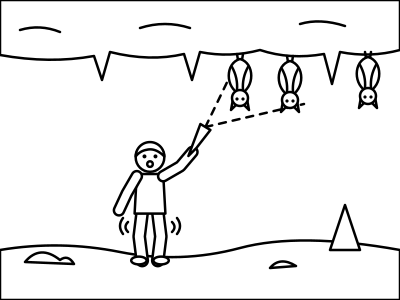
Gus stepped into the cave. It was very quiet.
The picture: Gus holds a flashlight. His knees are shaking. Bats hang upside down above his head.
Use the page above.
1.
Write two things the picture shows that the words do not say.
2.
What feeling does the picture show? How can you tell?
3.
The writer added 'Gus held a flashlight.' Should the writer keep it or cut it?
○ keep○ cut
4.
Plan one page of your own book: write the words, then write what your picture will add.
5.
Sketch that page.
Write what each word means.
6.
uncover
7.
dishonest
8.
refill
Science
Objective: I can investigate how an animal's color can help it survive in its habitat.
Standards: 3-LS4-2, 3-LS4-3
Builds on: Needs Day 2: adaptations help a living thing fit its habitat. One-minute check: ask, "Is an animal's fur color something it has or something it does?" (Has. It is physical.)
New words:
camouflage – colors or patterns that help a living thing blend in with its surroundings
Materials: 45 pieces of yarn or paper strips, each about as long as a finger: 15 green, 15 brown, 15 red, A patch of lawn, or a green or brown rug, towel or blanket, Timer, Science notebook and pencil
Day 68 — Flex Challenge: Camouflage Hunt — Wonder Warm-Up · 5 min
Spaced review from Week 11. Ask: "Name one physical adaptation and one behavioral adaptation." (Sample: thick fur; migrating.) Then the wonder. Say: "A green caterpillar and a bright red caterpillar sit on a leaf. Which one might a bird find first? Why?" Take one guess.
Mini-Lesson · 10–15 min
Say: "Animals of one kind are not all exactly alike. Some have colors that blend in with their habitat better. Blending in is called camouflage." Say: "Many birds hunt by sight. They find the animals that stand out. The ones that blend in are more likely to live and have young." Say: "Peppered moths come in a light form and a dark form. On pale bark, birds have trouble seeing light moths. On dark, sooty bark, dark moths are harder to see." Hold one red and one green yarn piece against today's background. Ask: "Which is easier to see?" (The one that does not match.) "On dark bark, which moth is safer?" (The dark one.) "Did the moth choose its color?" (No. Its color came from its parents.) If stuck, say: "Squint your eyes. Which piece disappears first?" Say: "Today you are the hungry bird."
Investigation / Hands-On · 15–20 min
Yarn Worm Hunt. Safety: afterward, pick up all 45 pieces so no pet or bird swallows yarn. 1) Your child predicts which color will be picked most and which least. They write it down. 2) Your child looks away. Scatter all 45 worms across the lawn or rug. 3) Set the timer for 30 seconds. Your child, the bird, picks up worms one at a time with one hand. 4) Sort the catch by color and count it. Table: Color | Round 1 picked | Round 2 picked | Total. 5) Scatter all 45 again and repeat. 6) Your child draws a bar graph of the three totals. Change only the worm color. Keep the same number of each color, time, place and picker. Expect the color most like the background to be picked least. If not, say: "Real results vary. Look for the pattern." Ask: "Which color survived best? What is your evidence?" (The shortest bar.)
Science Notebook Entry · 10 min
Your child records the prediction, the table and the bar graph in the notebook. Then they finish: "The ___ worms survived best because ___. This shows that camouflage ___." Sample: "The green worms survived best because they matched the grass. This shows that camouflage helps animals hide from predators."
Wrap-Up & Exit Ticket · 5 min
Your child answers on paper and uses the data table for question 1. Praise comparing the result with the prediction, even if the prediction was wrong.
Watch for: Thinking an animal picks or changes its color on purpose to match its habitat.
Try: Say: "Most animals are born with their color. The ones that happen to blend in get eaten less often."
Exit ticket:
Which color of worm was picked least in your test? Why?
A green frog and a yellow frog sit on a green lily pad. Which one is a heron more likely to see? Why?
Does an animal choose its color to match its habitat? Explain.
Show answers
Answers vary. Look for: the color most like the background, because it was hard to see.
The yellow frog. It stands out against the green pad.
No. Most animals are born with their color. The ones that blend in are more likely to survive.
Support: Use only the green and red worms, 15 of each. Count the catch together.
Extend: Repeat on a different background, such as a brown blanket. Your child predicts the change before starting.
Homework: Find one camouflaged animal in a book or outdoors, such as a moth on bark. Draw it on its background. Look for matching colors.
Practice page · Week 14, Day 3
Science
I can investigate how an animal's color can help it survive in its habitat.
Yarn worm hunt. Record how many of each color you caught in each round.
Color
Round 1
Round 2
Total
1.
My prediction: the color that will be found the least is ________.
2.
Make a bar graph of your totals in the box.
3.
Which color 'survived' best? Why?
Answer about real animals.
4.
How does camouflage help a real animal survive?
5.
A green tree frog sits on a brown rock. Is it well hidden? Why?
Challenge:Name an animal whose color helps it hunt, not hide.
Materials: 45 short pieces of yarn or paper: 15 green, 15 brown, 15 red · a timer