Builds on: Needs Day 3: the land or water feature that helped your town start. One-minute check: ask, "Why was our town founded here?" (The reason on the Why Here chart.)
New words:
historic – from long ago and important to remember
caption – the words beside a picture that tell what it shows
Materials: Notebook, 1 historic photo of your town (from a library book, the historical society or a relative's album), A current photo of the same place (or visit the place), 1 family photo from home, Highlighter, Pencil
Day 39 — How Has Our Community Changed? — Big Question Warm-Up · 5 min
Review from Day 3. Ask: "Name one land or water feature that helped our town start." (The feature on the Why Here chart.) Then ask the big question: "What did our main street look like 100 years ago? What might be the same?"
Mini-Lesson · 10–15 min
Say: "Communities change over time. The number of people grows or shrinks. Buildings go up or come down. Jobs, roads and ways to travel change. New neighbors bring new foods and traditions. Some things stay, such as a river, a hill or an old building." Teach the frame: "Then there was ____; now there is ____." Next, show how to question a photo. Hold up the family photo. Say: "Before we trust an old photo, we ask four things about it." Ask and answer together: "Who made it? When? Where? Why was it taken?" Then ask: "What can this photo not tell us?" (What happened before or after, what was outside the picture, what people thought.) Say: "A photo is strong evidence for how a place looked. It is weak evidence for how people felt." Ask: "Name two things that can change in a town." (Sample: buildings, jobs.) "Name one thing that often stays the same." (Sample: a river.) "What four questions do we ask about a photo?" (who, when, where, why) If stuck, say: "Start with: who held the camera?"
Activity / Source Work · 15–20 min
Practice, then study your own town. 1) Read this source aloud. It was written for this lesson. Stony Ford is a made-up town. "In 1905 Stony Ford had one dirt road, a blacksmith shop and 300 people. Children walked to a one-room school. Today Stony Ford has 9,000 people, paved streets, a bus line and three schools. The blacksmith shop is now a bakery. The stone bridge still carries people across the creek." 2) Your child tells three changes with the then-and-now frame, and one thing that stayed. (Changes: 300 people to 9,000; dirt road to paved streets; one school to three. Stayed: the stone bridge.) 3) In the notebook, make a source card for your town's historic photo: Who made it? When? Where? Why? Read the caption. Write "not known" where it does not say. 4) Ask: "Is this photo useful for learning how our town changed? What can it not tell us?" 5) Compare it with the current photo. Your child lists three changes and one thing that stayed. Real places vary. Look for the pattern: most things changed and something lasted.
Notebook Entry · 10 min
Your child makes a Then-and-Now chart with five rows: people, buildings, jobs, transportation, schools. Fill what your sources show. Write "find out" in any row you cannot fill yet. Sample row: Transportation. Then: horses and wagons. Now: cars and buses. Highlight one thing that stayed the same.
Wrap-Up & Exit Ticket · 5 min
Read the exit questions aloud; your child may look at the source card. Praise answers that say which was then and which is now.
Watch for: Listing differences without saying which was the past and which is now.
Try: Use the frame "Then there was ____; now there is ____" for every change.
Exit ticket:
In Stony Ford, what happened to the blacksmith shop? What does that tell you about how jobs changed?
Look at your source card. Who made the old photo and when? Name one thing the photo cannot tell us.
Tell one way our own town has changed. Use the words then and now.
Show answers
It became a bakery. Few people need a blacksmith now, because few people travel by horse.
Answers vary. Look for: the maker and date from the caption, or "not known," and a limit such as what people thought.
Answers vary. Look for: a change from the photos or a local source, told with then and now.
Support: Compare one pair of photos only. Your child finds two changes and says each with the then-and-now frame.
Extend: Interview an older relative or neighbor about how the town has changed. Add one memory to the chart, with a source card for the interview.
Homework: Show a family member the historic photo and tell one change you see. Ask what they remember. Look for: the words then and now.
Practice page · Week 8, Day 4
Social Studies
I can compare a community in the past and today.
Riverton, Then and Now
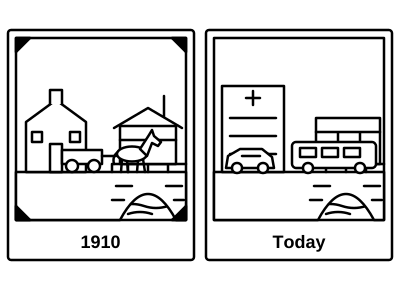
In 1910, Riverton had 600 people. Horses pulled wagons down Main Street. Most people worked at the sawmill or on farms. Children learned in a two-room schoolhouse. Today Riverton has 9,000 people. Cars and a bus line use Main Street. People work at a hospital, shops and offices. There are four schools. The stone bridge over the river still stands.
Fill in the Then-and-Now chart from the reading.
Topic
Then (1910)
Now
1.
Population:
2.
Getting around:
3.
Jobs:
4.
Schools:
5.
What stayed the same?
Compare old and new photos of our town.
6.
One way our town changed (then and now):
7.
One thing that stayed the same:
Challenge:How many more people live in Riverton now than in 1910?
Materials: historic and current photos of our town
Mathematics
Objective: I can choose a strategy to solve mixed ×7, ×8 and ×9 facts.
Standards: 3.OA.C.7, 3.OA.B.5, 3.OA.A.3
Builds on: Needs the three strategies from Days 1 to 3. One-minute check: ask which strategy fits 9 × 6. Your child solves it (10 groups minus one group; 60 − 6 = 54).
Spaced review from Week 3. Write 604 − 287. Your child solves it in columns (317). Then ask 7 × 6, 8 × 4 and 9 × 5 (42, 32, 45). Your child tells how each answer was found.
Mini-Lesson · 10–15 min
Say: "You know three strategies. Today you pick the one that fits the fact." Write three lines for your child to read aloud. For ×7: 5 groups and 2 groups. For ×8: double the ×4 fact. For ×9: 10 groups minus one group. Write 7 × 8. Say: "I see 7 groups. I can break them into 5 and 2." Write 40 + 16 = 56. Say: "I can also turn it to 8 × 7 and double." Write 4 × 7 = 28, then 28 doubled is 56. Say: "Both ways give 56. Use the way that feels clear to you." Ask: "Which way do you like for this fact? Why?" (Answers vary. Any reason is fine.) Now your child does more. Write 9 × 8. Ask: "Which strategies could work? Solve it your way." (80 − 8 = 72, or 36 doubled is 72)
Guided Practice · 10–15 min
For each fact, your child names a strategy first, then writes the steps. 1) 7 × 7 (35 + 14 = 49). 2) 8 × 8 (32 doubled is 64). 3) 9 × 9 (90 − 9 = 81). 4) 6 × 9, turned to 9 × 6 (60 − 6 = 54). If stuck, say: "Look for a 7, 8 or 9. Which strategy goes with that number of groups?"
Independent Practice · 15–20 min
Your child writes the strategy steps beside each answer. 1) 7 × 9 (63). 2) 8 × 3 (24). 3) 9 × 4 (36). 4) 4 × 7 (28). 5) 6 × 7 (42). 6) Your child outlines 8 rows of 7 on grid paper. Then your child colors it to show one strategy. (Two halves of 28, or 5 rows and 3 rows; 56) 7) Mateo has 7 boxes with 8 crayons in each. How many crayons in all? (56) 8) A garden has 9 rows of 6 tulips. How many tulips in all? (54) Last, your child puts a star by any fact that felt slow. Stars are useful. They show what to practice tonight.
Exit Ticket · 5 min
Read each question aloud; your child answers on paper with no notes in view.
Watch for: Mixing up 7 × 8 (56) and 6 × 9 (54) because the products are close.
Try: Your child solves both side by side with a strategy. Then check 54: its digits add to 9, so it is the ×9 fact.
Fact fluency: ×7, ×8 and ×9 facts
Exit ticket:
What is 9 × 7? Name the strategy you used.
Show two different strategies for 8 × 6.
Which fact is still hardest for you? Which strategy helps with it?
Show answers
63 (10 groups minus one group, 70 − 7; or 5 groups and 2 groups, 45 + 18)
48. Samples: 24 doubled is 48; or 5 groups and 3 groups, 30 + 18 = 48; or turned to 6 × 8, 40 + 8 = 48.
Answers vary. Look for: one named fact and a strategy that fits it.
Support: Choose one table only, such as ×9. Your child draws each fact on grid paper and colors the parts before writing any numbers.
Extend: Your child solves 7 × 9 three ways and compares them. Answers: 45 + 18 = 63; 70 − 7 = 63; 35 + 28 = 63.
Homework: Your child solves each starred fact again and writes the strategy. Then solve 8 × 7 and 9 × 6. Answers: 56; 54.
Practice page · Week 8, Day 4
Mathematics
I can choose a strategy to solve mixed ×7, ×8 and ×9 facts.
Look: pick a strategy
×7: split into ×5 and ×2. 7 × 4 is 20 and 8, 28.
×8: double the ×4 fact. 8 × 4 is 16 doubled, 32.
×9: ×10 minus one group. 9 × 4 is 40 − 4, 36.
Multiply.
1.
7 × 8 = ____
2.
9 × 9 = ____
3.
8 × 6 = ____
4.
7 × 7 = ____
5.
9 × 3 = ____
6.
8 × 2 = ____
Solve.
7.
Lin plants 7 rows of 9 beans. How many beans?
8.
A school has 8 vans. Each van holds 9 students. How many students can ride?
Challenge:7 × 8 can be solved as a ×7 fact or a ×8 fact. Show both ways.
Materials: Multiplication chart (optional)
English Language Arts
Objective: I can write a conclusion, read my paragraph aloud, and answer listeners' questions.
Standards: W.3.1.D, SL.3.3, L.3.2.B, L.3.3.B
Builds on: Needs Day 3: a draft with an opinion, two reasons, linking words and an example. One-minute check: ask, "Name three linking words." (Any three from the chart.)
New words:
conclusion – the last sentence; it tells the opinion again in different words
Materials: Your child's opinion paragraph draft from Day 3, The 'Game Night' mentor paragraph (Day 1), Reader's notebook, Pencil, An envelope, or paper folded like one (homework)
Warm-Up · 5 min
Word study, dividing words. Ask: "Which word means a student?" (pupil) "Which word means a very short time?" (moment) "Which word tells what water is after a night in the freezer?" (frozen) Your child says one sentence with fever. Spaced review from Week 4. Ask: "What does a fable end with?" (A moral, or lesson.)
Mini-Lesson · 10–15 min
Say: "A paragraph needs an ending. A conclusion tells the opinion again in different words and wraps up the paragraph." Read the first and last sentences of "Game Night." 'I think every family should have a game night.' 'For these reasons, game night deserves a spot on every family's calendar.' Think aloud: "Both sentences say game night is worth having. The words changed. 'Should have' became 'deserves a spot on the calendar.'" Write three stems in the notebook: That is why ___. For these reasons, ___. So next time, ___. Then show a weak ending. Say: "'I think every family should have a game night.' That only copies the first sentence, so readers learn nothing new." Model with the plant paragraph from Day 3: "That is why a pot of soil belongs on every kid's windowsill."
Guided Practice · 10–15 min
1) Together, write two conclusions for your child's draft, each with a different stem. 2) Ask: "Which one is stronger? Why?" (Look for: it gives the opinion again without copying it.) 3) Read "Game Night" aloud while your child listens. Your child asks you one question about it. (Sample: "Why did your cousin change?") Answer with a detail. 4) Say: "When we talk, we may say gonna or kinda. In writing, we use going to and kind of." Ask: "How would you write 'I wanna play'?" (I want to play.) If stuck on the conclusion, say: "Underline the key words in your opinion. Now say the same idea with different words."
Independent Practice · 15–20 min
1) Your child adds the stronger conclusion to the draft. 2) Your child checks the draft for talking words and fixes any. 3) Your child reads the whole paragraph aloud to a family listener, slowly and clearly. 4) The listener asks one or two questions, such as "Which reason matters most to you?" Your child answers with a reason or detail from the paragraph. 5) Your child rewrites one sentence that the questions showed was unclear. Checklist: an opinion, two reasons, linking words and a conclusion in new words. Last, write this address: 24 Oak Street, Dayton, Ohio 45402. Say: "Put a comma after the street and after the city. No comma goes before the ZIP code."
Exit Ticket · 5 min
Read each question aloud. Your child answers the first two aloud and tells you about the listener for the third.
Watch for: Copying the opinion sentence word for word as the conclusion.
Try: Underline the key words in the opinion. Your child says the idea aloud with different words, then writes it.
Exit ticket:
What is the job of a conclusion?
The opinion is 'Kids should learn to swim.' Which conclusion is better: 'Kids should learn to swim' or 'That is why swimming lessons are worth every splash'? Why?
What question did your listener ask, and how did you answer?
Show answers
It tells the opinion again in different words and wraps up the paragraph.
The second one. It gives the idea in fresh words, and the first only copies the opinion.
Answers vary. The reply should include a reason or example from the paragraph.
Support: Point to the three stems from the Mini-Lesson. Your child picks one and finishes it aloud before writing.
Extend: Your child writes a second conclusion and one sentence telling which is stronger and why.
Homework: Your child copies the final paragraph neatly and addresses an envelope to a relative. Or use 24 Oak Street, Dayton, Ohio 45402. Look for: commas after the street and the city.
Practice page · Week 8, Day 4
English Language Arts
I can write a conclusion, read my paragraph aloud and use writing words, not talking words.
Look: conclusion stems
That is why ____.
For these reasons, ____.
So next time, ____.
The Library Is the Best
I think the library is the best place in town. First, you can borrow books for weeks without paying anything. Another reason is that the library has quiet corners for reading and homework. For example, my brother finishes his math there every Tuesday.
Answer each one.
1.
Which is the best conclusion for the library paragraph?
○ The library has books.○ For these reasons, everyone should visit the library.○ My brother likes math.
2.
Write a different conclusion that says the opinion in new words.
3.
Fix the talking words: I'm gonna read kinda fast.
4.
Read your own paragraph aloud. Write one question a listener asked and your answer.
Split each word. Then circle VC/CV or V/CV.
5.
hel|met
○ VC/CV○ V/CV
6.
fe|ver
○ VC/CV○ V/CV
7.
bas|ket
○ VC/CV○ V/CV
Challenge:Add a conclusion to your own opinion paragraph.
Science
Objective: I can make a bar graph of my data and write a conclusion that uses evidence.
Standards: 3-PS2-1, 3-PS2-2
Builds on: Needs the finished Day 3 table, plus bar graphs from math. One-minute check: your child reads the three circled middle values aloud.
Materials: Completed results table, Graph paper or lined paper, Ruler and pencil, Crayons, Science notebook and tape or glue, Ramp setup from Day 3 plus a fourth same-size book, and tape measure (for the 4-book prediction test)
Day 39 — Analyze and Conclude — Wonder Warm-Up · 5 min
Spaced review from Week 6. Ask: "A ball bounces 30 inches, then 22, then 16. Will the next bounce be higher or lower than 16?" (Lower. Each bounce is lower than the one before.) Then your child looks at the results table. Ask: "What pattern do you see in your numbers?"
Mini-Lesson · 10–15 min
Say: "A conclusion answers the question with data. It has three parts: what the data shows, whether the prediction was supported, and a reason." Model with the sample ramp data. Say: "The car rolled farther from higher ramps. It rolled 24 inches from 1 book, 40 from 2 books and 57 from 3 books. My prediction was supported. I think the car was going faster at the bottom of the higher ramp." Then sketch the start of a bar graph. Draw a line up the side and number it by 10s to 60. Ask: "Where does the top of the 40 bar go?" (On the 40 line.) "Where does the 24 bar stop?" (A little below halfway from 20 to 30.) "Which sentence in my conclusion had the numbers?" (The second one.) If stuck, say: "Answer the question first. Then say 'I know because' and give two numbers."
Investigation / Hands-On · 15–20 min
1) Your child draws the graph with the ruler and pencil. Setups go along the bottom. Distance goes up the side, counting by 10s. 2) Draw one bar for each middle value and shade it with a crayon. 3) Label both sides and add a title, such as "How Far the Car Rolled." 4) Your child writes a conclusion of 3 to 5 sentences with these frames: "My data shows ___. My prediction was ___. I think this happened because ___." Look for at least two numbers from the table. 5) If time allows, your child uses the pattern to predict the distance from 4 books, then tests it 3 times. Keep the car, board and start line the same. The result may not fit, because a very steep ramp can make the car bump the floor. Say: "Real results vary. A surprise is worth writing down."
Science Notebook Entry · 10 min
Your child tapes the graph and conclusion into the notebook. If they tested 4 books, they add: "I predicted ___ inches. The middle value was ___ inches." Sample conclusion: "My data shows the car rolled 24 inches from 1 book and 57 from 3 books. My prediction was supported."
Wrap-Up & Exit Ticket · 5 min
Read the three exit questions aloud; your child answers on paper. Praise every sentence that uses a number as evidence.
Watch for: Writing a conclusion that only repeats the prediction and leaves out the data.
Try: Ask, "What numbers prove it?" Your child adds two numbers from the table to the first sentence.
Exit ticket:
Here is some data: 1 magnet lifted 4 clips, and 2 magnets lifted 7 clips. Write one conclusion sentence that uses both numbers.
Was your own prediction supported? Give one number from your table as evidence.
Which bar on your graph is the shortest? What does that tell you about that setup?
Show answers
Answers vary. Look for: "Two magnets lifted more clips than one: 7 clips compared with 4."
Answers vary. Look for: yes or no, with a number from the table.
Answers vary. Look for: the setup named, and that it had the smallest distance (or count).
Support: Draw and number the side of the graph for your child. Your child draws the bars and says the conclusion aloud first.
Extend: Your child writes a new testable question that the results raised. Sample: "Does the car roll as far on carpet?"
Homework: Your child practices explaining the investigation to a family member in about a minute. Look for: the question, two numbers and the conclusion.
Practice page · Week 8, Day 4
Science
I can make a bar graph of my data and write a conclusion that uses evidence.
Make a bar graph of your middle values. Label both sides and add a title.
1.
My bar graph
Write your conclusion with these sentence starters.
2.
My data shows ____.
3.
My prediction was ____.
4.
I think this happened because ____.
Challenge:Sofia's car rolled 18 inches from 1 book and 35 inches from 2 books. How much farther did it roll from 2 books?