3
    Third GradePowered by ThirdGrade.com

    Daily lesson plan

    Day 2 · Tuesday

    Week 34 · Synthesis: Area, Shapes, Research, Traits & Civic Action

    See what your state adds or places differently

    Suggested daily schedule
    8:30–8:45 AM15 minMorning Circle / Read-Aloud / Calendar
    8:45–10:00 AM75 minEnglish Language Arts
    10:00–11:00 AM60 minMathematics
    11:00–11:15 AM15 minSnack and Movement Break
    11:15–12:00 PM30–45 minScience (every day)
    12:00–12:45 PM30–45 minSocial Studies (every day)
    12:45–1:30 PM45 minLunch and Choice Time
    1:30–2:15 PM45 minSpecials: PE / Art / Music (rotating)
    2:15–2:45 PM30 minIndependent Reading & Journaling

    Social Studies

    Objective: I can continue my civic action, check my progress toward my goal and adjust my plan.

    Standards: D4.7.3-5, D4.8.3-5

    Builds on: Needs yesterday's first log row and the goal number in the planner. One-minute check: your child reads the count from yesterday's row. (Answers vary. It should match the log.)

    New words:
    • progress – how far you have come toward a goal

    Materials: Action log from Day 1, Civic Action Project planner, Graph paper (or plain paper ruled into squares), Ruler, Materials box, Notebook, Pencil

    1. Warm-Up · 5 min

      Spaced review from Week 31. Ask: "Name the four ways people give to their community." (Time, talent, things and money.) Ask: "Which ways does your project use?" (Answers vary.) Your child reads yesterday's log row aloud. Then ask the big question: "Are we on track to reach our goal? How can we tell?"

    2. Mini-Lesson · 10–15 min

      Say: "Partway through, we check our progress. Progress is how far we have come toward the goal." Model with the made-up sock drive. Write in the notebook: Goal 40 pairs. Monday 13. Tuesday 8. Say: "First add the days. 13 + 8 = 21 pairs so far." Say: "Then subtract from the goal. 40 - 21 = 19. The drive needs 19 more." Ask: "What could help the drive collect more?" (Sample: a reminder flyer, asking a neighbor or moving the box.) Say: "Sometimes helpers disagree about a change. Then we decide fairly. Each person gives one reason. Everyone listens. Then we vote." Ask: "Why does each person give a reason before the vote?" (So everyone hears the ideas and the choice is fair.) "The drive has 21 pairs and wants 40. Is it past halfway?" (Yes. Half of 40 is 20.) If stuck, say: "Add what we have. Then count up from that number to the goal."

    3. Activity / Source Work · 15–20 min

      Action Day 2. 1) With an adult, your child takes the materials box, does the next step of the plan and adds a log row. 2) Draw this table in the notebook: Day | Count today | Total so far | Still needed. Your child fills in a row for each day. 3) Make a progress bar graph on the graph paper. Draw one bar for each day. Each bar shows the total so far. 4) Label the bottom "Day" and the side with what you are counting. 5) With the ruler, draw a dashed line across at the goal number. 6) Hold a family meeting. Each person names one change and one reason. Vote. Your child writes the winning change in the planner. Keep the goal the same. Change only one thing, so you can see whether it helps. Expect the bars to step upward. Real results vary. Look for the pattern: is the total climbing toward the dashed line? If your project has no count, such as a letter, graph the steps finished. If the action runs long, hold the family meeting at dinner.

    4. Notebook Entry · 10 min

      Your child completes these frames: "So far we have ___. We need ___ more to reach our goal. We decided to change ___ because ___." Sample: "So far we have 21 pairs. We need 19 more to reach our goal. We decided to move the box because people did not see it."

    5. Exit Ticket · 5 min

      Your child solves the first two exit questions on paper. Praise checking the numbers against the log and listening during the vote.

    Watch for: Seeing a small Day 2 count and wanting to quit.

    Try: Show the graph. Say: "Look how far the total has climbed." Then pick one change that is easy to try today.

    Exit ticket:
    1. A card project wants to make 30 cards. The helpers made 12 cards, then 9 cards. How many cards so far?
    2. How many more cards does that project need to reach 30?
    3. What change did your family vote for today, and what was the reason?
    Show answers
    1. 21 cards (12 + 9 = 21).
    2. 9 more cards (30 - 21 = 9).
    3. Answers vary. Look for: one specific change linked to what the log shows.

    Support: Draw a number line from 0 to the goal. Your child marks the total so far, then hops to the goal by tens and ones.

    Extend: Your child predicts the final total if each coming day matches today's count. Then your child says whether the goal will be reached.

    Homework: With an adult, your child does one more small step and logs it. Look for all four parts in the new row.

    Practice page · Week 34, Day 2

    Social Studies

    I can check my progress toward my goal and adjust my plan.

    Look: am I on track?

    1. Add the counts from each day.
    2. Subtract the total from the goal.
    3. The difference is how many more you need.

    Sofia raised her goal from 30 to 40 hats. She collected 12 on Monday and 9 on Tuesday.

    1. 1.

      How many hats so far?

    2. 2.

      How many more does she need?

    3. 3.

      Name one change that could help her collect more.

    4. 4.

      The family does not agree on a change. What is a fair way to decide?

      ○ Each person gives a reason, then vote.○ The loudest person decides.○ Do nothing.

    Action Day 2: make a bar graph of your counts.

    1. 5.

      Draw one bar for each day and a dashed line at your goal.

    2. 6.

      So far we have ____. We need ____ more.

    Challenge: If Sofia collects 9 hats every day, how many more days will she need?

    Materials: graph paper · action log
    Mathematics

    Objective: I can recognize rhombuses and parallelograms and tell how they relate to squares and rectangles.

    Standards: 3.G.A.1

    Builds on: Needs Week 34 Day 1 (every square is a rectangle) and Week 33 Day 4 (a rhombus has 4 equal sides). One-minute check: ask "How many equal sides does a rhombus have?" (4)

    New words:
    • same-direction sides – two sides that run the same way and would never meet, like train tracks
    • parallelogram – a quadrilateral with two pairs of same-direction sides

    Materials: 8 straws: 6 cut to 6 inches and 2 cut to 3 inches, Scissors (to cut the straws and the new card), Tape (to join the straw ends loosely), Ruler, Index card (to test square corners), The 8 quadrilateral cards from Day 1, 1 new card cut from grid paper, a slanted parallelogram. Draw a top side 5 long. Draw the bottom side 5 long, 3 rows lower and shifted 2 squares right. Join the ends., Grid paper, Notebook, Pencil

    1. Warm-Up · 5 min

      Spaced review from Week 33 Day 2. Ask: "What is a vertex?" (A corner where two sides meet.) Ask: "How many vertices does an octagon have?" (8) Then practice ×9 facts with no clock. Ask 9 × 4, 9 × 7 and 9 × 9 (36, 63, 81).

    2. Mini-Lesson · 10–15 min

      Tape the four 6-inch straws into a square. Ask: "What do you know about a square?" (4 equal sides and 4 square corners) Push the square sideways so it leans. Ask: "Did any side change length?" (No) Test a corner with the index card. Ask: "Are the corners still square?" (No) Say: "It has 4 equal sides, so it is a rhombus. The square was a rhombus too, one with square corners." Look at the top and bottom straws. Slide the ruler from one to the other without turning it. Say: "They run the same way and would never meet, like train tracks. They are same-direction sides." Test the left and right straws the same way. Say: "A quadrilateral with two pairs of same-direction sides is a parallelogram. So this rhombus is a parallelogram." Note for you: later grades call these parallel sides. Now your child does more. Your child tapes two 6-inch and two 3-inch straws into a rectangle, tests it, then pushes it sideways. (Both shapes have two pairs of same-direction sides. The leaning one is a parallelogram that is not a rectangle.)

    3. Guided Practice · 10–15 min

      Use the 9 cards. Your child slides the ruler to test each pair of opposite sides. 1) Sort the cards into parallelograms and not parallelograms. (6 parallelograms: 2 squares, 2 rectangles, the rhombus and the slanted card; 3 are not: roof, kite and lopsided) 2) Which of the 6 parallelograms are rhombuses? (3: the rhombus card and the 2 squares) 3) Is the roof card a parallelogram? (No. Only its top and bottom run the same way.) 4) Is the slanted card a rhombus? Measure its sides. (No. Its sides are not all equal.) If stuck, say: "Lay the ruler on one side. Slide it to the opposite side without turning. Does it line up?"

    4. Independent Practice · 15–20 min

      For each shape, your child lists every name that fits from this list: quadrilateral, parallelogram, rectangle, rhombus, square. 1) The 4 by 4 square card. (all five names) 2) The 6 by 2 rectangle card. (quadrilateral, parallelogram, rectangle) 3) The rhombus card. (quadrilateral, parallelogram, rhombus) 4) The slanted card. (quadrilateral, parallelogram) 5) The kite card. (quadrilateral only) 6) On grid paper, your child draws a top side 4 long. The bottom side is 4 long, 2 rows lower and shifted 3 squares right. Join the ends. (quadrilateral, parallelogram) 7) A frame is made of 4 sticks, each 2 feet long. It leans, so its corners are not square. (quadrilateral, parallelogram, rhombus) 8) A gate has two 4-foot bars and two 3-foot bars. Opposite bars match and run the same way. Its corners are not square. (quadrilateral, parallelogram)

    5. Exit Ticket · 5 min

      Read each question aloud; your child answers on paper and may handle the straw shapes.

    Watch for: Thinking a rhombus must look like a diamond standing on its point.

    Try: Turn the rhombus card several ways and measure the four sides again. Position does not change the name.

    Fact fluency: ×9 facts

    Exit ticket:
    1. What makes a quadrilateral a rhombus?
    2. You push a straw rectangle sideways. What changes, and what stays the same?
    3. A shape has two pairs of same-direction sides. Its sides are 7, 3, 7 and 3 cm, and its corners are not square. List every name that fits.
    Show answers
    1. It has 4 equal sides.
    2. The corners are no longer square. The side lengths and the two pairs of same-direction sides stay.
    3. Quadrilateral and parallelogram

    Support: Keep both straw models on the table. Your child pushes each one and retests the corners and sides before naming any card.

    Extend: Your child pushes the straw square a little, then a lot. Ask: "Is each shape a rhombus?" (Yes. The 4 sides stay equal. Only the corners change.)

    Homework: Your child finds one rhombus and one parallelogram in pictures, tiles or signs and sketches them. Sample: a leaning fence panel is a parallelogram; a diamond-shaped road sign is a rhombus.

    Practice page · Week 34, Day 2

    Mathematics

    I can recognize rhombuses and parallelograms and tell how they relate to squares and rectangles.

    Look: rhombus and parallelogram

    1. A rhombus has 4 equal sides. Its corners do not have to be square.
    2. A parallelogram has opposite sides that are the same length and run the same way.
    3. Push a square sideways and it becomes a rhombus.

    List every name that fits each shape.

    Word bank: quadrilateral · parallelogram · rectangle · rhombus · square

    1. 1.

      A rhombus that leans to one side

    2. 2.

      A rectangle that is not a square

    3. 3.

      A long parallelogram that leans

    4. 4.

      A square

    Answer each question.

    1. 5.

      What is a rhombus?

    2. 6.

      Is a square a rhombus?

      ○ yes○ no
    3. 7.

      Kai pushes a straw square sideways. What shape does it become?

    Challenge: Name a shape that is a parallelogram but not a rectangle.

    Materials: straws · ruler

    English Language Arts

    Objective: I can read aloud with expression and use a book's pictures to help me choose my voice.

    Standards: RF.3.4.B, RF.3.4.C, RL.3.7

    Builds on: Needs stage directions from yesterday and using pictures to learn about characters from Week 1 Day 2. One-minute check: ask, "Yesterday, what told you how Desi should sound?" (the stage directions in parentheses)

    New words:
    • self-correct – to notice your own reading mistake and fix it yourself

    Materials: The story in this lesson, Your child's own picture book or illustrated storybook, A stuffed animal or a family member as an audience, 3 sticky notes, Reader's notebook, Pencil

    1. Warm-Up · 5 min

      Word study, about 3 minutes. Write circle, giraffe, orange, dance and city. Your child underlines each c or g and circles the letter that follows. Ask: "Which c in circle is soft?" (The first c. It comes before i.) "Why is the second c hard?" (It comes before l.) Your child reads all five words. Spaced review from Week 11. Ask: "Which sentence shows a feeling: 'Sam was scared' or 'Sam's knees shook'?" (Sam's knees shook.)

    2. Mini-Lesson · 10–15 min

      Say: "Reading with expression means your voice matches what is happening and how the characters feel." Write three clues on a notebook page: 1) punctuation, 2) speaking words such as whispered, 3) the picture. Say: "A picture shows the mood. Look at faces, bodies and light." Read the story aloud. The notes in brackets tell what each picture shows. "Midnight Snack": [Picture 1: A hallway at night with one tiny night-light. A boy in pajamas tiptoes with a finger on his lips.] Ravi crept down the hall. "Don't creak," he whispered to the floor. [Picture 2: The kitchen. A huge shadow with pointed ears stretches across the wall. Ravi's eyes are wide.] Something moved by the fridge! Ravi froze. "Who is there?" he asked. [Picture 3: The light is on. A small gray cat sits beside a tipped-over cereal box. Ravi is laughing.] Click! Grandma turned on the light. "It is only Pepper," she said. "And she found the cereal first!" Think aloud about Picture 1. Say: "The boy tiptoes with a finger on his lips. The words say whispered. So I read slowly and very softly." Read the first part that way. Next, model a fix. Read the first sentence as "Ravi kept down the hall." Say: "That does not make sense. I stop and reread. The picture shows tiptoeing. The word is crept." Say: "Good readers self-correct. They fix a word that does not make sense."

    3. Guided Practice · 10–15 min

      1) Reread the note for Picture 2. Ask: "How does Ravi feel? What in the picture shows it?" (Scared. His eyes are wide and the shadow is huge.) Your child reads that part twice: once flat, then with a voice that fits. 2) Ask: "Which mark tells you how to read 'Something moved by the fridge!'?" (The exclamation point. It shows strong feeling.) 3) Reread the note for Picture 3. Ask: "What does the picture tell you that the words do not?" (Pepper is a small cat. She tipped over the box. Ravi is laughing.) "So how should Grandma sound?" (calm and amused) 4) Say: "Catch my mistake." Read "Ravi froze" as "Ravi frost." Ask: "What should I do?" (Stop, read it again and change it to froze.) If stuck, say: "Look at the face in the picture. Name the feeling. Now make your voice feel that way."

    4. Independent Practice · 15–20 min

      1) Your child looks through their own picture book. They put sticky notes on three pages where the picture shows a strong feeling. 2) On each note they write one mood word, such as sneaky, scared or relieved. 3) Your child reads the book aloud to the stuffed animal and changes voice at each note. If a word does not make sense, they stop, reread and fix it. 4) In the notebook, your child writes two sentences about one page. Sample: "The picture shows the bear hiding behind a tree with big eyes. I used a small, shaky voice." Look for: three clear voice changes, a detail named from a picture, and at least one fix made without your help.

    5. Exit Ticket · 5 min

      Ask the three questions aloud. Your child may look back at the story and at the sticky-note pages.

    Watch for: Using the same loud, excited voice on every page.

    Try: Before each page, ask: "How does the character feel here? Point to the clue." Your child matches the voice to that answer.

    Exit ticket:
    1. In the first part of "Midnight Snack," which word tells you how loud to read Ravi's words?
    2. Picture 2 shows a huge shadow with pointed ears. How does that help you read the lines that follow?
    3. Open one of your sticky-note pages. What does the picture show, and what voice did you choose?
    Show answers
    1. Whispered.
    2. It shows a scary moment, so the reader uses a quick, nervous voice.
    3. Answers vary. Look for: one detail from the picture and a voice that fits it.

    Support: Echo read. You read one sentence with expression, and your child repeats it the same way.

    Extend: Your child finds a page where the picture shows something the words leave out. They explain how it changes their voice.

    Homework: Read a picture book aloud to a family member for 10 minutes. Point out one picture that changed your voice. Look for at least two different voices.

    Practice page · Week 34, Day 2

    English Language Arts

    I can read with expression and use pictures and clues to fix my reading.

    Look: clues for expression

    1. ! means strong feeling. ? means your voice goes up.
    2. Words like whispered or shouted tell you how loud to read.
    3. The picture shows the mood: dark colors or a scared face mean a tense moment.

    The Storm

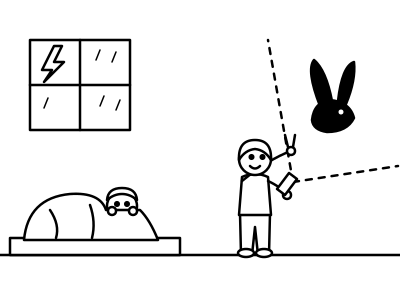
    Thunder boomed. Mia hid under her blanket. 'Is it over?' she whispered. Then the lights went out! Her brother Sam clicked on a flashlight and made a shadow rabbit on the wall. Mia giggled. 'Do it again!' she shouted.

    During a storm, Mia peeks out from under her blanket while her brother Sam shines a flashlight to make a shadow rabbit on the wall.

    Use the story above.

    1. 1.

      How should you read 'Is it over?'

      ○ loudly and angrily○ quietly, with your voice going up
    2. 2.

      How should you read 'Do it again!'?

      ○ loud and happy○ slow and sleepy
    3. 3.

      The picture shows Mia peeking out from a blanket. What mood does it show?

    4. 4.

      Mia reads 'Thunder bloomed.' It does not make sense. What should she do?

    5. 5.

      Which word makes sense? Sam clicked on a ____.

      ○ flashlight○ flash

    Write the word that fits. Each one has a soft c or soft g.

    Word bank: pencil · page · giant

    1. 6.

      I sharpened my ____.

    2. 7.

      Turn to the next ____.

    3. 8.

      The ____ was as tall as a tree.

    Challenge: Read the story twice: once flat and once with expression. What changed?

    Science

    Objective: I can collect survey data carefully and record it in a tally chart.

    Standards: 3-LS3-1

    Builds on: Needs the Day 1 plan and chart, plus tally bundles from Week 16. One-minute check: your child shows 9 with tally marks. (One bundle of five and four more.)

    Materials: Tally chart from Day 1 (Day 166), Clipboard or hardcover book, Pencil, Hand mirror (only for a people survey, so your child can check their own trait)

    1. Day 167 — Collect Data — Wonder Warm-Up · 5 min

      Spaced review from Week 31. Ask: "Name three things in a plant's environment." (Any three: sunlight, water, soil, temperature, wind.) Then practice the polite words twice. "Hello. I am doing a science survey about traits. May I look at your dog's fur?" Change the last words to fit your trait. Then the wonder. Ask: "Will your prediction turn out right? How will we know?"

    2. Mini-Lesson · 10–15 min

      Say: "Careful data is data we can trust." Teach five rules. One: ask permission first. Two: make one tally mark right away. Three: count nobody twice. Four: if you cannot tell, ask, or mark a "not sure" row. Never guess. Five: be kind, because every trait is just variation. Show bundling on scrap space in the notebook. Draw four marks, then cross them with the fifth. Say: "Each bundle is five. Count bundles by fives, then count on." Now show a mistake. Say: "I checked Grandma, Dad, Aunt Jo, then Dad again." Ask: "What went wrong?" (Dad was counted twice.) Say: "Write initials or a short note beside each mark. Then nobody is counted twice." Ask: "A row has two bundles and three marks. How many?" (13) "A dog is too far away to see its fur. What do you do?" (Move closer with permission, or mark not sure.) "A neighbor says no thank you. What do you do?" (Say thanks anyway and do not count them.) If stuck, say: "Touch each bundle and count by fives. Then count the extra marks."

    3. Investigation / Hands-On · 15–20 min

      Data Collection. 1) Your child sets the chart on the clipboard and takes a pencil. 2) They check at least 10, in person, by phone with relatives or from family photos with permission. For a people survey, they use the hand mirror to add themselves. 3) They make one tally mark for each, right away, with initials or a note. 4) When finished, they count each row and write the totals. 5) They add the totals. The sum must equal the number checked. Change nothing between one check and the next: look or ask the same way each time. Watch for which row grows fastest. Expect more than one choice to get marks. That is variation. If every mark lands in one row, say: "Real results vary. Some groups are alike. Check five more and look for the pattern." Safety: stay with an adult outdoors, and do not touch animals you do not know.

    4. Science Notebook Entry · 10 min

      Your child copies the finished chart neatly into the notebook. Then they complete three frames. "I checked ___. The most common choice was ___. I noticed ___." Sample: "I checked 12 dogs. The most common choice was short fur. I noticed only 2 dogs had long fur."

    5. Wrap-Up & Exit Ticket · 5 min

      Read the three exit questions aloud; your child answers on paper. Praise marks made right away and totals that add up.

    Watch for: Losing track and counting someone twice, or forgetting to make a mark.

    Try: Your child writes initials beside every mark. At the end, they count the initials and compare with the totals.

    Exit ticket:
    1. A tally row shows three bundles and two more marks. What number is that?
    2. Your three rows total 4, 5 and 2, but you checked 12 dogs. What does that tell you?
    3. Why do you make each tally mark right away instead of at the end?
    Show answers
    1. 17
    2. The totals add to 11, so one dog is missing or miscounted. Check the marks again.
    3. So you do not forget anyone or count someone twice.

    Support: Check family and close friends only. Your child says each choice aloud, and you make the marks together.

    Extend: Check 20 in two groups, such as adults and children, on two charts. Your child compares the most common choice in each group.

    Homework: Finish checking anyone left on the list and update the totals. Look for: row totals that add up to the number checked.

    Practice page · Week 34, Day 2

    Science

    I can collect survey data and record it in a tally chart.

    Data Collection. Ask each person kindly. Make one tally for each person.

    ChoiceTallyTotal


    1. 1.

      How many people did I survey?

    2. 2.

      Add all my totals. Does the sum equal the number of people?

    3. 3.

      Did I find variation?

    Practice reading a tally chart.

    1. 4.

      Kai surveyed hair texture: straight 6, wavy 3, curly 4. How many people did Kai survey?

    2. 5.

      How do you show 7 with tally marks?

    Challenge: Which choice is most common in your chart so far?

    Materials: tally chart from Day 1 · clipboard or hardcover book · hand mirror

    Standards-matched clips that reinforce today's objectives.

    English Language Arts

    'Too Much Glue' read by Nicole Byer

    Storyline Online

    Supports: I can read aloud with expression and use a book's pictures to help me choose my voice.

    RF.3.4.B
    RL.3.7
    Watch on YouTube