Builds on: Needs Week 14 Day 4 (tracing breakfast with labels) and Week 28 Day 4 (world trade). One-minute check: your child finds the Atlantic Ocean, the Pacific Ocean and your state on the world map. (All three are found.)
Materials: World map or globe (to copy from), 1 large sheet of plain paper (for the breakfast map), 3 to 5 breakfast foods with labels, such as a banana, oatmeal, orange juice and cocoa, Colored pencils (at least 2 colors), Notebook, Pencil
Warm-Up · 5 min
Spaced review from Week 26. Ask: "What is an import?" (A good that one country buys from another country.) Then set out the breakfast foods. Ask the big question: "How many countries helped make this breakfast?" Write your child's guess.
Mini-Lesson · 10–15 min
Say: "Today you are a mapmaker. Your map will tell the story of one breakfast. A good map has a title, a key and a compass rose." Model one food. Find Guatemala on the world map. Say: "Many bananas sold in the U.S. grow in Guatemala, Ecuador or Costa Rica. Bananas need warm weather all year." Say: "A ship carries them to a U.S. port, and a truck brings them here." Copy this Food Facts chart into the notebook. Bananas: Guatemala, Ecuador, Costa Rica. Oats: Canada and the northern Midwest. Oranges for juice: Florida, Brazil, Mexico. Cocoa: Côte d'Ivoire and Ghana in West Africa. Coffee: Brazil and Colombia. Say: "Each country grows or makes some things well, so countries trade. We depend on their farmers, and they depend on our buyers." Ask: "Why are bananas not grown in most of the U.S.?" (Most of it is too cold in winter.) Ask: "Which ocean would a ship from West Africa cross to reach us?" (The Atlantic.) Ask: "What three parts does your map need?" (A title, a key and a compass rose.) If stuck, say: "Find the country on the world map first."
Activity / Source Work · 15–20 min
Breakfast map challenge. 1) Your child sketches the world on the large sheet of paper, copying the world map. Rough shapes for the seven continents are fine. Label the Atlantic and Pacific Oceans. 2) Your child reads each food label for "Product of" or "Grown in." If a label does not say, use the Food Facts chart and write "likely." 3) Mark a dot and the food's name at each place. Plot at least four foods. Mark your home with a star. 4) Draw a route from each dot to the star. Use one color for ships over oceans and a second color for trucks or trains over land. Add an arrowhead at the home end. 5) Add a title, a compass rose and a key. The key shows both colors, the dot and the star. 6) Count the countries on the map. Compare the count with the guess. Ask for evidence: "Which food crossed water? How does your map show it?" (Sample: the bananas. The ship color runs from Guatemala to a U.S. port.) Look for routes that start at a growing place and end at home.
Notebook Entry · 10 min
Your child writes two sentences. "I was surprised that ___." "My breakfast shows interdependence because ___." Sample: "I was surprised that oats may come from Canada. My breakfast shows interdependence because farmers in three countries grew it."
Exit Ticket · 5 min
Your child answers with the finished map in view. Praise a clear key and arrows that point home.
Watch for: Drawing the route from home to the country, as if we sent the food there.
Try: Ask: "Where does the trip start? Where does the food end up?" Your child draws the arrowhead at the home end.
Exit ticket:
Point to one route on your map. Where does it start? Which kinds of travel does your key show for it?
Bananas need warm weather all year. How does that explain where a banana route starts?
Suppose ships stopped crossing the oceans for a month. How would your breakfast change? What does that show?
Show answers
Answers vary. Look for: a growing place as the start, and the ship or truck color read from the key.
It starts in a country that is warm all year, such as Guatemala, Ecuador or Costa Rica.
Answers vary. Look for: foods from other countries would run out, so we depend on farmers and shippers far away.
Support: Sketch the continents yourself. Your child plots three foods and draws the routes.
Extend: Your child adds a third color for a food your own state grows and sends elsewhere.
Homework: Your child shows the breakfast map to a family member and tells one food's story. Look for the key being used.
Practice page · Week 32, Day 4
Social Studies
I can make a world map that shows where the foods in a breakfast come from.
A Breakfast Trip
Pineapples sold in the U.S. often grow in Costa Rica. They ride a ship to a U.S. port and then a truck to the store. Much of the cinnamon we sprinkle comes from Indonesia. Some wheat for toast grows in Kansas and rides a train to a bakery. Many oranges for juice grow in Florida or Brazil.
Breakfast Map: plot 5 breakfast foods on a world map. Draw a route from each place to your home. Fill in the table.
Food
Country or state
Ship, truck or train
1.
How many different countries helped make your breakfast?
2.
Which food traveled the farthest?
Answer each question.
3.
Name one place in the reading where pineapples grow.
4.
What three parts should every map have?
5.
How does your breakfast show global interdependence?
Challenge:Use two colors in your map key: one for ship routes and one for truck or train routes. Which color did you use more?
Materials: world outline map · breakfast food packages with labels · ruler
Mathematics
Objective: I can solve the Garden Fence Challenge and explain which rectangle is the best design.
Standards: 3.MD.D.8, 3.MD.C.7.b
Builds on: Needs Week 31 Day 3 (same perimeter, different areas) and Week 31 Day 2 (same area, different perimeters). One-minute check: ask the perimeters of a 2 by 4 and a 1 by 5 rectangle (12 units; 12 units).
Materials: String tied in a loop 24 inches around (each inch stands for 1 foot of fence), Ruler, Grid paper, 20 square tiles (or 1-inch paper squares), Notebook, Pencil
Warm-Up · 5 min
Spaced review from Week 30 Day 4. A rectangle has a perimeter of 16 units and a length of 5 units. Your child finds the width (5 + 5 = 10; 16 − 10 = 6; 6 ÷ 2 = 3 units). Then practice ×4 and ×7 facts with no clock. Ask 4 × 6, 4 × 8, 7 × 5 and 7 × 8 (24, 32, 35, 56).
Mini-Lesson · 10–15 min
Read the challenge aloud: "Ms. Okafor has 24 feet of fence for a rectangle garden. Which shape gives the most room to plant?" Bend the string loop into a long, thin rectangle 1 inch wide. Your child measures the long side with the ruler (11 inches). Check the fence: 1 + 11 + 1 + 11 = 24. Say: "One length plus one width is half the fence. Half of 24 is 12." Write 1 + 11 = 12. Start a table with three columns: width, length, area. Write 1 × 11 = 11. Say: "So the 1 by 11 garden has an area of 11 square feet." Outline it on grid paper. Next row: width 2. Ask: "What length makes 12?" (10) Write 2 × 10 = 20. Say: "The fence is the same, but the area grew." Now your child does more. Your child bends the string to width 3, then fills in the row. (3 by 9; 3 × 9 = 27 square feet)
Guided Practice · 10–15 min
Your child finishes the table and outlines each garden on grid paper. 1) Width 4. (4 by 8; 4 × 8 = 32 square feet) 2) Width 5. (5 by 7; 5 × 7 = 35 square feet) 3) Width 6. (6 by 6; 6 × 6 = 36 square feet) 4) Ask: "Which garden is best for planting? Why?" (The 6 by 6 square. It has the most area, 36 square feet.) Ask: "What about width 7?" (It is the 5 by 7 garden turned.) If stuck, say: "The width and length must make 12. What goes with this width?"
Independent Practice · 15–20 min
Now flip the problem. Mr. Diaz has 20 square patio tiles, each 1 foot on a side. He wants the shortest border. Your child builds each patio with tiles. 1) A 1 by 20 patio. Find its perimeter. (1 + 20 + 1 + 20 = 42 feet) 2) A 2 by 10 patio. (2 + 10 + 2 + 10 = 24 feet) 3) A 4 by 5 patio. (4 + 5 + 4 + 5 = 18 feet) 4) Which patio needs the shortest border? (4 by 5, the one closest to a square) 5) A new garden has 18 feet of fence. List every rectangle and its area. (1 by 8, area 8; 2 by 7, area 14; 3 by 6, area 18; 4 by 5, area 20) 6) Which of those is best for planting? (4 by 5, area 20 square feet) 7) One bag of soil covers 6 square feet. How many bags cover the 36 square foot garden? (36 ÷ 6 = 6 bags) 8) A gate 3 feet wide replaces part of the 24 feet of fence. How much fence is needed now? (24 − 3 = 21 feet) Last, your child writes one sentence of advice to each gardener.
Exit Ticket · 5 min
Read each question aloud; your child may sketch or make a small table but uses no string or tiles.
Watch for: Forgetting that one length plus one width is only half of the fence.
Try: Your child bends the string into a rectangle and measures one long side and one short side. Together they make 12, half of 24.
Fact fluency: ×4 and ×7 facts
Exit ticket:
A garden has 28 feet of fence. What must one length plus one width make?
With 28 feet of fence, which rectangle gives the most garden area?
With 12 square tiles, which rectangle needs the shortest border?
Show answers
14 feet (half of 28)
7 by 7 (area 49 square feet)
3 by 4 (perimeter 14 units)
Support: Give your child the table with the widths and lengths filled in. Your child only multiplies to find each area.
Extend: Your child tries 38 feet of fence and explains why no square with whole-number sides works. (The two sides must make 19. The best is 9 by 10, area 90 square feet.)
Homework: Your child explains the Garden Fence Challenge to a family member and shows the table. Then your child solves it for 10 feet of fence. (1 by 4, area 4; 2 by 3, area 6; the best is 2 by 3)
Practice page · Week 32, Day 4
Mathematics
I can solve the Garden Fence Challenge and explain which rectangle is the best design.
You have 28 feet of fence. Length plus width must make 14. Fill in the table.
Length
Width
Area (square feet)
1.
1 by ____
2.
2 by ____
3.
3 by ____
4.
4 by ____
5.
Which rectangle gives the most garden?
Mr. Tanaka has 30 square patio tiles. Each tile is 1 foot on each side. He wants the least border.
6.
List the rectangles he can make with 30 tiles and their perimeters.
7.
Which rectangle needs the least border? Write one sentence to Mr. Tanaka.
Challenge:Make up a challenge with 36 feet of fence. Which garden is best?
Materials: string loop · grid paper
English Language Arts
Objective: I can interview a family expert, ask good follow-up questions and recount what I learned (enrich day).
Builds on: Needs open questions from Week 28 and follow-up questions from Week 17. One-minute check: ask "Which gets a longer answer: Do you like cooking? or How did you learn to cook?" (How did you learn to cook?)
New words:
interview – a talk in which one person asks questions to learn from another
Materials: Writer's notebook, Pencil, A family member or neighbor with a skill to share, One large index card
Warm-Up · 5 min
Word study (about 3 minutes). Use four words in meaning. Ask: "Which word fits? My grandma ___ me to knit." (taught) "Which word fits? I ___ the ball with one hand." (caught) "Which word means hard, not easy?" (tough) "Which word means one more time?" (again) Your child says a new sentence with each word. Spaced review from Week 3. Ask: "Where do the quotation marks go? Mom said, Dinner is ready." (Around Dinner is ready.)
Mini-Lesson · 10–15 min
Say: "Today is the Family Expert Interview. An interview is a talk where you ask questions to learn from someone. A good interviewer listens closely and asks follow-up questions that dig deeper." Write three follow-up stems: "Can you tell me more about ___?" "Why did you ___?" "What happened next?" Read aloud this model, "Talking with Uncle Dev": Q: How did you learn to play the drums? A: My neighbor gave me lessons when I was nine. I practiced on a pillow first. Q: Why a pillow? A: Drums are loud! A pillow let me learn the beats quietly. Q: What was the hardest part? A: Keeping a steady beat with both hands. "Slow is smooth," my teacher said. Think aloud: "The first question was planned. Why a pillow? was a follow-up. It used a word he had just said." Ask: "Which other question could be a follow-up?" (What was the hardest part?) Point to the last line. Say: "The teacher's exact words have quotation marks."
Guided Practice · 10–15 min
Hold a two-minute practice interview. You are the expert on a skill you really have, such as making pancakes. 1) Your child writes three How, Why or What questions about your skill. 2) Your child asks two of them and takes notes in short phrases. 3) Your child asks one follow-up that uses something you just said. (Sample: "You said the pan must be hot. Why?") 4) Your child recounts two things you said, in order. If stuck, say: "Say back one thing I told you. Now ask why or how about it."
Independent Practice · 15–20 min
Your child interviews a family member or neighbor for about 10 minutes. If no one else is home, you are the expert. 1) Ask at least five questions, with two follow-ups, and take notes. 2) On the index card, write an Expert Card. Recount the three most important things you learned, in order. 3) Add one quote in quotation marks. 4) Add one describing word that fits the expert in real life, such as patient, skillful or helpful. Tell what the expert did that shows it. Sample: "Uncle Dev is patient. He practiced on a pillow first." Check the card with the expert for mistakes.
Exit Ticket · 5 min
Ask the three questions. Your child may look at the notes and the Expert Card.
Watch for: Reading the list of questions one after another without listening to the answers.
Try: Pause after each answer. Your child repeats one word the expert said before asking the next question.
Exit ticket:
Which of your questions today was a follow-up? What answer did it follow?
Recount one important thing your expert told you.
Which describing word did you choose for your expert? What did the expert do that proves it?
Show answers
Answers vary. Look for: a question that used something the expert had just said.
Answers vary. Look for: a correct detail from the interview, said in a complete sentence.
Answers vary. Look for: a word such as patient or skillful and a real action that shows it.
Support: Write the five interview questions together first. Your child reads them from the notebook and you help with one follow-up.
Extend: Your child turns the Expert Card into a paragraph with a hook, three facts and a closing sentence.
Homework: Read your Expert Card to another family member. Answer one question they ask about it in a complete sentence.
Practice page · Week 32, Day 4
English Language Arts
I can ask follow-up questions and recount what an expert said.
An Interview with Aunt Rosa
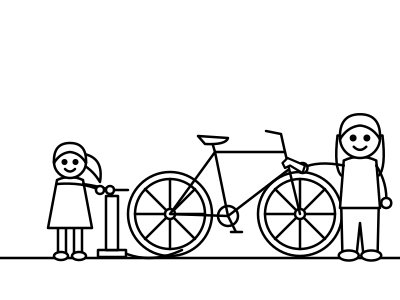
Me: How did you learn to fix bikes? Aunt Rosa: My dad taught me when I was ten. We fixed a rusty old bike together. First, we cleaned the chain. Then we pumped up the flat tires. Last, we tightened the brakes. Me: What was the hardest part? Aunt Rosa: The brakes! I had to try three times. "Never give up on a good bike," my dad said.
Use the interview above.
1.
Which question was a follow-up question?
○ How did you learn to fix bikes?○ What was the hardest part?
2.
Write a new follow-up question for Aunt Rosa.
3.
Recount the three steps in order.
4.
Copy the quote with its quotation marks.
5.
Which describing word fits Aunt Rosa in real life? Tell what she did that shows it.
Sort: does the word have gh that says /f/?
6.
tough
○ yes○ no
7.
taught
○ yes○ no
Challenge:Interview a family member. Write the three most important things they said, in order.
Science
Objective: I can design a bird with traits that help it survive in a chosen habitat and explain my choices.
Standards: 3-LS4-2, 3-LS4-3
Builds on: Needs the Week 30 Day 4 beak model and Week 11 on habitats. One-minute check: ask, "What is a habitat?" (The place where a living thing gets its food, water, shelter and space.)
New words:
field guide – a book that helps people name living things and tells where they live
Materials: Tweezers, a clothespin, a spoon and 2 chopsticks or unsharpened pencils (model beaks), 3 small dishes: 30 grains of dry rice, 20 dried beans, 20 small cereal pieces, Cup to drop the food into (model stomach), Drawing paper and colored pencils, Bean cups and Bean Log from Week 31, Science notebook and pencil
Flex Day 4 — Enrich: Design-a-Bird Project — Wonder Warm-Up · 5 min
Bean check: record both cups in the Bean Log. Spaced review from Week 30. Ask: "In the beak model, which beak picked up beans best? Why did that matter?" (Answers vary. Listen for: that beak had an advantage for that food.) Then the wonder. Ask: "What would the best bird for a snowy forest look like?"
Mini-Lesson · 10–15 min
Say: "Today you are a scientist and an artist. You will design a bird for one habitat. Its traits must help it survive there." Read three habitat cards aloud. Snowy forest: big seeds inside cones, long cold winters, white ground. Marsh: insects in soft mud, shallow water, tall brown reeds. Meadow: tiny seeds on the ground, green and tan grass, hawks overhead. Say: "Real birds do not choose their traits. They inherit them. In each habitat, birds with helpful traits survive and raise more young." Ask: "Would thick, fluffy feathers help in the snowy forest? In a hot marsh?" (Yes in snow, because they hold warmth. In heat the bird could get too warm.) Ask: "Why might brown streaked feathers help among reeds?" (Camouflage.) Ask: "Can one bird be the best in every habitat?" (No. A trait that helps in one place can hurt in another.) If stuck, say: "Name the food first. Then ask which body part gets that food."
Investigation / Hands-On · 15–20 min
Design-a-Bird. 1) Your child picks a habitat and its food: beans for big seeds, cereal for insects, rice for tiny seeds. 2) Beak test. Count slowly to 20 while your child moves food into the cup with one beak. They use one hand and take one piece at a time. Count the pieces moved. 3) Repeat with each of the 4 beaks on the same food. Change only the beak. Keep the food, the count to 20, the hand and the dish the same. Table: Beak | Pieces moved. 4) Your child picks the beak shape with the highest number. 5) They choose 2 more traits for that habitat. Ideas: feather color, thick feathers, long wading legs or strong gripping feet. 6) They draw and label the bird. 7) Ask: "Would your bird survive well, less well or not at all in another habitat?" Tweezers often do well with rice and cereal. The clothespin often grips beans. Real results vary. Use your own data.
Science Notebook Entry · 10 min
Your child writes a field guide entry in the notebook: the bird's name, habitat, food, beak results and 3 labeled traits. Each trait needs a reason. Frame: "My bird's ___ helps it ___ in the ___." Sample: "My bird's thin, pointed beak helps it pull insects from mud in the marsh."
Wrap-Up & Exit Ticket · 5 min
Ask the three exit questions aloud; your child points to the table and the drawing while answering. Praise reasons that link a trait to the habitat.
Watch for: Giving one bird every helpful trait, such as thick feathers in a hot marsh.
Try: For each trait ask: "Would this help here, or make life harder?" Your child erases traits that do not fit.
Exit ticket:
Which beak worked best for your bird's food? What is your evidence?
A bird with thick white feathers lives well in a snowy forest. How well might it survive in a hot, green marsh? Why?
Do birds choose their beak shapes? Where do the shapes come from?
Show answers
Answers vary. Look for: the beak with the highest number in the table.
Less well, or not at all. It could get too warm, and white feathers would stand out to predators.
No. Beak shapes are inherited from parents. Birds with helpful beaks survive and raise more young.
Support: Choose the habitat together and test only 2 beaks. Your child labels one trait with a reason.
Extend: Your child designs a second bird for another habitat. They explain what would happen if the two birds traded places.
Homework: Present your bird to a family member. Explain one trait and how it helps the bird survive. Look for: a clear link between the trait and the habitat.
Practice page · Week 32, Day 4
Science
I can design a bird with traits that help it survive in a habitat.
Design-a-Bird. Test each beak on your bird's food for 20 seconds and record the results.
Beak
Food
Amount picked up
1.
My bird's habitat and food: ____
2.
Best beak for my bird: ____
Finish your design.
3.
Name 2 more traits that help your bird in its habitat and tell why.
4.
Draw your bird and label its 3 traits.
5.
Why did the other beaks not work as well?
Challenge:How does your bird show that variation can help a species survive?
Materials: tweezers, clothespin, spoon and chopsticks · dry rice, beans and small cereal pieces · timer