3
    Third GradePowered by ThirdGrade.com

    Daily lesson plan

    Day 2 · Tuesday

    Week 23 · Reasoning: Fractions, Opinion Essays, Weather & Government

    See what your state adds or places differently

    Suggested daily schedule
    8:30–8:45 AM15 minMorning Circle / Read-Aloud / Calendar
    8:45–10:00 AM75 minEnglish Language Arts
    10:00–11:00 AM60 minMathematics
    11:00–11:15 AM15 minSnack and Movement Break
    11:15–12:00 PM30–45 minScience (every day)
    12:00–12:45 PM30–45 minSocial Studies (every day)
    12:45–1:30 PM45 minLunch and Choice Time
    1:30–2:15 PM45 minSpecials: PE / Art / Music (rotating)
    2:15–2:45 PM30 minIndependent Reading & Journaling

    Social Studies

    Objective: I can fix the trickiest ideas about rights, responsibilities and voting.

    Standards: D2.Civ.2.3-5, D2.Civ.3.3-5

    Builds on: Needs Week 21 Days 2 and 3 (First Amendment freedoms, responsibilities) and Week 22 Day 1 (voting rules). One-minute check: ask "Is helping to keep your street clean a right or a responsibility?" (A responsibility.)

    Materials: Scored Week 21 and Week 22 checks, Rights and responsibilities T-chart from Week 21, 10 index cards, 3 sheets of paper for label mats, Markers, Notebook, Pencil

    1. Warm-Up · 5 min

      Spaced review from Week 21. Ask: "Which amendment lists freedom of speech?" (The First Amendment, in the Bill of Rights.) Then your child circles any missed item on the scored Week 21 and Week 22 checks.

    2. Mini-Lesson · 10–15 min

      Lay out the T-chart. Say: "A right is a freedom the law protects for you. A responsibility is something you should do for others and your community." Say: "Voting is both." Say: "The First Amendment protects five freedoms. Here is a memory clue: RAPPS." Write the letters down the notebook page. "R is religion: follow any religion or none. A is assembly: gather peacefully. P is press: report the news." "The second P is petition: ask the government to fix a problem. S is speech: say what you think." Say: "Now the voting rules. A voter must be a U.S. citizen and at least 18. Almost every state asks voters to register. Each voter gets one vote, on a secret ballot." Say: "Jaden is 9. He cannot vote yet. He can still learn about the plans and go along when an adult votes." Ask: "Neighbors hand the council a signed request for a dog park. Which freedom is that?" (Petition.) Ask: "Why is voting on both sides of the T-chart?" (The law protects it, and the community needs it.) If stuck, say: "Ask: Is this something I am allowed to do, or something I should do for others?"

    3. Activity / Source Work · 15–20 min

      Scenario sort. 1) With a marker, your child labels three mats: Right, Responsibility, Voting rule. 2) Read each scenario aloud. Your child writes two or three key words on a card, places it and gives a reason. "A news site reports that the town pool will close." (Right: press.) "A driver stops at a red light on an empty road." (Responsibility: following laws.) "A voter marks her ballot behind a screen." (Voting rule: secret ballot.) "Neighbors hold a peaceful march for a safer bridge." (Right: assembly.) "A 16-year-old must wait two more years to vote." (Voting rule: age 18.) "A shop owner pays taxes that help pay for the fire department." (Responsibility.) "A family chooses a place of worship, or none." (Right: religion.) "A student picks up litter at the playground." (Responsibility.) "Residents sign a request for a bike path." (Right: petition.) "A man who voted this morning may not vote again today." (Voting rule: one vote each.) 3) Your child counts the cards on each mat in a chart: Right, Responsibility, Voting rule. Expect 4, 3 and 3. Look for at least 8 of 10. Sorts vary. Accept another mat if the reason is good.

    4. Notebook Entry · 10 min

      Under the RAPPS letters, your child writes one example of their own for each freedom. Then rewrite any missed check item correctly, with a reason. Sample: "R is religion. A family may follow any religion or none."

    5. Exit Ticket · 5 min

      Read the three questions aloud. Your child answers without the mats. Praise examples your child made up alone.

    Watch for: Calling anything they like a "right," such as "the right to dessert."

    Try: Ask: "Does the Constitution or a law protect this for everyone?"

    Exit ticket:
    1. What five freedoms does RAPPS help you remember?
    2. A citizen has just turned 18 and wants to vote. In almost every state, what must she do first?
    3. Sort these two: returning a lost wallet, and speaking at a town meeting. Which is a right and which is a responsibility?
    Show answers
    1. Religion, assembly, press, petition and speech.
    2. Register to vote.
    3. Speaking at a town meeting is a right. Returning a lost wallet is a responsibility.

    Support: Use only six scenario cards, two per mat.

    Extend: Your child writes two new scenario cards and asks a family member to sort them.

    Homework: Your child teaches RAPPS to a family member and gives one example for each letter. Look for: five freedoms, each with its own example.

    Practice page · Week 23, Day 2

    Social Studies

    I can fix tricky ideas about rights, responsibilities and voting.

    Write right, responsibility or voting rule for each card.

    Word bank: right · responsibility · voting rule

    1. 1.

      A TV reporter shares news about the school budget.

    2. 2.

      Ms. Chen serves on a jury.

    3. 3.

      A voter marks a ballot behind a curtain.

    4. 4.

      A 16-year-old cannot vote yet.

    5. 5.

      A family pays its taxes.

    6. 6.

      People sign a request for a new bus stop.

    Answer the question.

    1. 7.

      Write what each letter of RAPPS stands for.

    Challenge: Is voting a right, a responsibility or both? Tell why.

    Materials: index cards
    Mathematics

    Objective: I can find equivalent fractions and compare fractions with models.

    Standards: 3.NF.A.3.A, 3.NF.A.3.B, 3.NF.A.3.D

    Builds on: Needs Week 21 Days 1 and 2 (equivalent fractions) and Week 22 Days 1 and 2 (comparing). One-minute check: ask "Which piece of the same strip is bigger, 1/3 or 1/8?" (1/3)

    Materials: 3 paper strips of the same length (cut from one sheet), Crayon, Grid paper, Notebook, Pencil

    1. Warm-Up · 5 min

      Spaced review from Week 20 Day 2. Ask: "A 0 to 1 line shows sixths. How many jumps from 0 reach 4/6?" (4) Then practice ×6 facts with no clock. Ask 6 × 4, 6 × 7, 6 × 8 and 6 × 9 (24, 42, 48, 54). Your child names a strategy for one fact.

    2. Mini-Lesson · 10–15 min

      Say: "Equivalent fractions name the same amount. Today we fold to find them." Fold a strip in half. Shade one part with the crayon. Ask: "What fraction is shaded?" (1/2) Fold it in half again and open it. Ask: "How many equal parts now? How many are shaded?" (4; 2) Say: "The shading did not change. Its new name is 2/4." Fold once more and open. Ask: "What is the name now?" (4/8) Say: "Same amount, more parts, new name. So 1/2 = 2/4 = 4/8." Now compare. Fold a second strip in half. Hold it beside the eighths strip. Say: "Both strips are the same whole." Point to one part of each. Ask: "Which is bigger, 1/2 or 1/8?" (1/2) Say: "More parts means smaller parts. So 1/2 > 1/8." Point to 2 parts, then 5 parts, of the eighths strip. Say: "These parts are the same size, and 5 is more. So 2/8 < 5/8." Now your child does more. Your child folds the third strip into fourths. Ask: "Which is bigger, 1/4 or 1/2? Which is more, 1/4 or 3/4?" (1/2; 3/4)

    3. Guided Practice · 10–15 min

      Draw bars on grid paper. 1) Draw a bar 6 squares long. Draw lines to make 3 equal parts. Shade 2 parts (2/3). Now draw a line at every square. Ask: "What is the new name?" (4/6) 2) Draw a bar 8 squares long with 4 equal parts. Shade 2 parts (2/4). Draw a line at every square. Your child names it in eighths (4/8). 3) Compare 2/8 and 7/8 (2/8 < 7/8; same-size parts, and 7 is more). 4) Compare 1/3 and 1/4 (1/3 > 1/4; thirds are bigger parts). Check with two bars 12 squares long. Mark thirds every 4 squares and fourths every 3 squares. If stuck, say: "Are the parts the same size? Or is the number of parts the same?"

    4. Independent Practice · 15–20 min

      Your child may fold or draw for any item. 1) 1/2 = ?/4 (2) 2) 1/2 = ?/8 (4) 3) 4/8 = ?/4 (2) 4) Draw a bar 6 squares long. Shade 3 squares. Name the shaded part in sixths and in halves (3/6 and 1/2). 5) Compare 1/6 and 4/6 (1/6 < 4/6). 6) Compare 3/6 and 3/8 (3/6 > 3/8). 7) Rosa and Tim have granola bars of the same size. Rosa eats 3/4 of hers. Tim eats 3/8 of his. Who eats more? (Rosa; fourths are bigger parts than eighths) 8) Kim paints 2 of 4 equal parts of a fence. Ben paints 4 of 8 equal parts of a same-size fence. Who paints more? (They paint the same amount; 2/4 = 4/8)

    5. Exit Ticket · 5 min

      Put the strips away. Read each question aloud; your child answers on paper and may draw.

    Watch for: Saying 1/8 is greater than 1/2 because 8 is more than 2.

    Try: Hold one part of each folded strip side by side. Ask which piece of a snack bar your child would pick.

    Fact fluency: ×6 facts

    Exit ticket:
    1. A strip has 2 equal parts with 1 part shaded. Each part is cut into 3 pieces. What fraction is shaded now?
    2. Compare 3/8 and 7/8 with < or >.
    3. Compare 1/2 and 1/3 with < or >. Tell why.
    Show answers
    1. 3/6
    2. 3/8 < 7/8
    3. 1/2 > 1/3. Halves are bigger parts than thirds.

    Support: Your child folds a strip for every item before writing. Start with halves and fourths only.

    Extend: Your child writes two equivalent pairs and two comparisons, then draws a bar for each. Sample: 3/6 = 1/2 and 5/6 > 1/6.

    Homework: Fold a strip into 4 equal parts and shade 2. Write two names for the shaded part (2/4 and 1/2). Then write one comparison, such as 1/4 < 3/4.

    Practice page · Week 23, Day 2

    Mathematics

    I can find equivalent fractions and compare fractions with models.

    Look: fold a strip

    1. Fold a strip in half and shade one half.
    2. Fold it in half again: the shading covers 2/4.
    3. Same shading, more parts, new name.

    Fill in the missing number.

    1. 1.

      3/4 = ?/8

    2. 2.

      2/6 = ?/3

    3. 3.

      1/2 = ?/8

    Write <, > or =. Draw a model if you are not sure.

    1. 4.

      2/8 ___ 5/8

      ○ <○ >○ =
    2. 5.

      1/3 ___ 1/2

      ○ <○ >○ =
    3. 6.

      4/6 ___ 2/3

      ○ <○ >○ =
    4. 7.

      3/8 ___ 3/4

      ○ <○ >○ =

    Challenge: Two same-size pies: one is shared by 4 friends, one by 8 friends. Who gets the bigger share? Write a comparison.

    English Language Arts

    Objective: I can make inferences and figure out word meanings using clues (catch-up day).

    Standards: RL.3.1, L.3.4.A, RI.3.4

    Builds on: Needs Week 22: the inference formula and context clues. One-minute check: say "Ming's cheeks turned pink, and she stared at her shoes while the class clapped. How does Ming feel?" (Shy or embarrassed.)

    Materials: Reader's notebook, Five sticky notes, Pencil, Your child's own book

    1. Warm-Up · 5 min

      Word study: mark the parts. Write cleaner, readable, movement, rainy, cried. Your child underlines each base word and circles the ending. (clean + er, read + able, move + ment, rain + y, cry + ed.) Ask: "What happened to the y in cried?" (It changed to i before -ed.) Spaced review from Week 13. Write "The kittens naps in the sun." Ask: "Fix the verb." (The kittens nap in the sun.)

    2. Mini-Lesson · 10–15 min

      Say: "Today we practice inferring again, this time with detective steps." Write the four steps. Step 1: find a clue. Step 2: say what you know. Step 3: make the inference. Step 4: check that every clue fits. Read this aloud. "The Mystery at the Pond": When Rosa reached the pond, the water was still. Then small V-shaped ripples slid across it, and a stick floated past with its bark chewed off. On the muddy bank, the edge of the pond, stood a stump with a pointed top. Wood chips lay all around it. Rosa smiled and whispered, "You've been busy." She sat down on a log to wait, as still as a stone. Model the first two steps: "A stick with its bark chewed off. I point to it. I know some animals chew wood. I am not ready to infer yet. One clue is not enough, so I look for more."

    3. Guided Practice · 10–15 min

      Run the steps together. 1) Your child points to three more clues. (Ripples, the pointed stump, wood chips.) 2) Ask: "Which animal chews trees and swims? What do you infer?" (A beaver. A beaver lives at this pond.) 3) Check it. Ask: "Would a duck fit every clue?" (No. Ducks swim, but they cannot chew wood.) 4) Find the word ripples. Ask: "What do you think ripples are? Point to your clue words." (Small waves. Clues: "V-shaped" and "slid across" the water.) Write the inference and the word meaning in the notebook. If stuck, say: "Which animal from last week gnaws on trees?"

    4. Independent Practice · 15–20 min

      1) Your child writes one clue from the story on each of the five sticky notes. 2) Sort the notes under two headings in the notebook: Clues About the Animal, Clues About Rosa. 3) Write one inference for each heading. Start with "I infer ___ because ___." 4) Read your child's own book for the last ten minutes. Jot one inference with two clues. Look for at least two clues for the beaver. Look for Rosa's feeling (happy, pleased or excited) backed by her smile and whisper. Sample: "I infer Rosa is pleased because she smiled and whispered to the beaver."

    5. Exit Ticket · 5 min

      Read each question aloud. Your child writes the answers with the story in view.

    Watch for: Naming the animal but not the clues that prove it.

    Try: An answer counts only when it has "I know because" plus two clues.

    Exit ticket:
    1. Why does Rosa sit "as still as a stone"? What can you infer?
    2. What does "bank" mean in this story? Which words are the clue?
    3. A reader guesses that a fish made the clues. Which clue does a fish not fit?
    Show answers
    1. She hopes to see the beaver and does not want to scare it away.
    2. The land at the edge of the pond. Clue: "the edge of the pond."
    3. The pointed stump or the wood chips. A fish cannot chew a tree on land.

    Support: Read the story aloud twice. The second time, pause at each clue so your child can call out "Clue!"

    Extend: Your child writes a four-sentence mystery that hides a different animal. You infer the animal from the clues.

    Homework: Read for 15 minutes. Write one inference about a character with two clues. Look for two different clues, not the same one twice.

    Practice page · Week 23, Day 2

    English Language Arts

    I can make inferences and figure out word meanings with clues.

    Look: Detective steps

    1. Find the clue.
    2. Say what you know.
    3. Make the inference, then check that every clue fits.

    Prints in the Snow

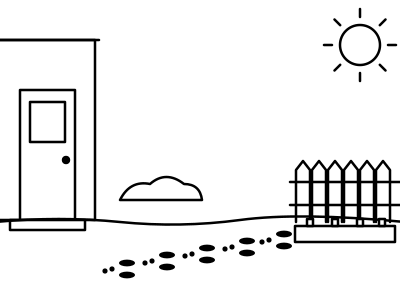
    When Amir opened the back door, the snow was smooth except for a line of small prints. Each set showed two long back feet and two small round front prints. The prints led to the garden, where the carrot tops had been nibbled down to stubs. Amir grinned and ran to get his camera.

    A line of small animal prints crosses smooth snow from a back door to a fenced garden where carrot tops are nibbled down to stubs.
    Prints led across the yard.

    Be a detective.

    1. 1.

      What animal do you infer visited the yard?

    2. 2.

      Underline two clues about the animal.

    3. 3.

      How does Amir feel? Which clue shows it?

    4. 4.

      What do you think Amir will do with his camera?

    5. 5.

      What does stubs mean in this story?

    Use the y-to-i rule.

    1. 6.

      happy + er = ____

    2. 7.

      cry + ed = ____

    Challenge: Write one clue you could add to the story to show the rabbit is still nearby.

    Science

    Objective: I can tell weather from climate and explain the safety plan for severe weather.

    Standards: 3-ESS2-2, 3-ESS3-1

    Builds on: Needs Week 20 Day 1 (weather or climate) and Week 21 (watches, warnings and the family safety poster). One-minute check: ask, "Which one is about many years, weather or climate?" (Climate.)

    Materials: 12 index cards, Marker and pencil, Safety poster from Week 21, Science notebook

    1. Day 112 — Flex Catch-Up: Weather vs. Climate and Safety — Wonder Warm-Up · 5 min

      Spaced review from Day 1. In the notebook, sketch a scale with 30 and 40 labeled and 5 spaces between. Draw the liquid 2 marks above 30. Ask: "What is the reading?" (34°F.) Then the wonder. Ask: "Weather alerts use the words watch and warning. Which one means act right now?" Take a guess.

    2. Mini-Lesson · 10–15 min

      Clue 1: time words. Say: "Weather words tell about one short time: today, now, tonight, tomorrow, yesterday. Climate words tell the long pattern: usually, most years, every summer, all year." Say: "It is windy this afternoon." Ask: "Weather or climate? Which words told you?" (Weather. This afternoon.) Say: "Our falls are usually cool and dry." Ask the same. (Climate. Usually.) If stuck, say: "Cover the weather word. Is the sentence about one time or many years?" Clue 2: alert words. Say: "A watch means dangerous weather could happen, so be ready. A warning means it is happening or about to happen nearby, so act now." Ask: "The radio says 'severe thunderstorm watch.' Is it time to get ready or to act?" (Be ready. Sample: plan where to go indoors.) Ask: "It changes to a severe thunderstorm warning. Now what?" (Act now. Go indoors and stay away from windows.) Say: "Watch means get set. Warning means go."

    3. Investigation / Hands-On · 15–20 min

      Clue-Word Sort and Alert Drill. 1) Write these 8 sentences on cards with the marker. "Sleet is hitting the window right now." "Tonight will be clear and cold." "Yesterday a strong wind knocked over our trash can." "It is 85°F at the park this afternoon." "Our town usually gets about 40 inches of snow a year." "July is our hottest month most years." "This desert gets very little rain in a normal year." "Winters on this mountain are always long." 2) Your child underlines the clue word on each card in pencil and sorts the cards into two piles. Expect the first four under weather and the last four under climate. 3) Write four alerts on cards: flood watch, winter storm warning, high wind watch, tornado warning. 4) Hold up one at a time. Your child says "Be ready" or "Act now" and names one action. Use the safety poster for ideas. Samples: flood watch, know the way to higher ground. Winter storm warning, stay indoors and off the roads. High wind watch, plan to bring loose things indoors. 5) For the tornado warning, your child walks to your family's safe place from Week 21.

    4. Science Notebook Entry · 10 min

      Your child makes two lists, Weather clue words and Climate clue words, with at least four in each. Then give the frames: "A watch means ___. A warning means ___. If I hear a warning, I will ___." Sample: "A watch means be ready. A warning means act now. If I hear a warning, I will go to our safe place."

    5. Wrap-Up & Exit Ticket · 5 min

      Read the three exit questions aloud; your child answers on paper. Praise answers that name the clue word.

    Watch for: Sorting by the weather word, such as snow or hot, instead of the time clue.

    Try: Cover the weather word with a finger. Ask: "Is this about one time or about many years?"

    Exit ticket:
    1. Weather or climate: 'Most Januaries here bring deep snow.' Which word is the clue?
    2. The radio announces a winter storm watch. Does that mean be ready or act now? Name one thing to do.
    3. Write one climate sentence about your own town. Underline your clue word.
    Show answers
    1. Climate. The clue is 'most.'
    2. Be ready. Sample: check supplies and plan to stay home.
    3. Answers vary. Look for: a long-pattern clue word, such as "Our summers are usually humid."

    Support: Underline the clue words on the cards before your child sorts. Read each alert card aloud twice.

    Extend: Your child writes two tricky sentences that pair a stormy word with a climate clue. Sample: "It usually storms here in spring." (Climate.)

    Homework: Your child quizzes a family member with three sentences of their own, weather or climate. Look for a clear clue word in each.

    Practice page · Week 23, Day 2

    Science

    I can use clue words for weather and climate and know watch from warning.

    Underline the clue word. Then circle weather or climate.

    1. 1.

      Sleet is falling right now.

      ○ weather○ climate
    2. 2.

      Our town usually gets 3 feet of snow a year.

      ○ weather○ climate
    3. 3.

      Tomorrow will be breezy.

      ○ weather○ climate
    4. 4.

      Every summer, the lake gets warm enough to swim.

      ○ weather○ climate

    Alert drill. Circle Be ready or Act now. Then write the action.

    1. 5.

      Hurricane watch

      ○ Be ready○ Act now
    2. 6.

      Flash flood warning

      ○ Be ready○ Act now
    3. 7.

      Blizzard warning

      ○ Be ready○ Act now
    4. 8.

      Severe thunderstorm watch

      ○ Be ready○ Act now

    Materials: index cards · your safety poster from Week 21

    Standards-matched clips that reinforce today's objectives.

    Mathematics

    Comparing fractions visually and on number line | 3rd grade | Khan Academy

    Khan Academy

    Supports: I can find equivalent fractions and compare fractions with models.

    3.NF.A.3.D
    Watch on YouTube
    English Language Arts

    Using context clues to figure out new words | Reading | Khan Academy

    Khan Academy

    Supports: I can make inferences and figure out word meanings using clues (catch-up day).

    L.3.4.A
    RI.3.4
    Watch on YouTube