3
    Third GradePowered by ThirdGrade.com

    Daily lesson plan

    Day 2 · Tuesday

    Week 22 · Reasoning: Fractions, Opinion Essays, Weather & Government

    See what your state adds or places differently

    Suggested daily schedule
    8:30–8:45 AM15 minMorning Circle / Read-Aloud / Calendar
    8:45–10:00 AM75 minEnglish Language Arts
    10:00–11:00 AM60 minMathematics
    11:00–11:15 AM15 minSnack and Movement Break
    11:15–12:00 PM30–45 minScience (every day)
    12:00–12:45 PM30–45 minSocial Studies (every day)
    12:45–1:30 PM45 minLunch and Choice Time
    1:30–2:15 PM45 minSpecials: PE / Art / Music (rotating)
    2:15–2:45 PM30 minIndependent Reading & Journaling

    Social Studies

    Objective: I can name offices people vote for at the local, state and national levels.

    Standards: D2.Civ.1.3-5, D2.Civ.2.3-5

    Builds on: Needs Week 19 Day 1 (the three levels of government). One-minute check: ask "Name the three levels of government, from closest to you to largest." (Local, state, federal.)

    New words:
    • office – a government job that a person is elected or chosen to do
    • ballot measure – a question on the ballot that voters decide themselves by marking yes or no

    Materials: Notebook, 9 index cards or paper slips, 4 sheets of paper for three sorting mats and a sample ballot, Marker, Pencil

    1. Warm-Up · 5 min

      Spaced review from Week 19. Ask: "Which level of government takes care of town parks and local streets?" (Local government.) Then ask the big question: "Is the President the only leader people vote for?"

    2. Mini-Lesson · 10–15 min

      Say: "An office is a government job. Voters choose people for offices at all three levels." With the marker, your child labels three paper sorting mats: Local, State, National. Say: "National means federal." Say: "Local offices include mayor, town council member and school board member. Many counties elect a sheriff." Say: "State offices include the governor and state legislators, who make state laws." Say: "National offices are President, U.S. senator and U.S. representative." Say: "Here is a tricky one. Voters in our state choose our two U.S. senators. Yet senators work in Congress for the whole country. So senator is a national office." Say: "Some ballots also ask a question, such as 'Should the town borrow money for a new fire truck?' Voters mark yes or no. That is a ballot measure." Say: "Local leaders decide about schools, roads and parks. Yet fewer people usually vote in local elections than for President." Ask: "Is a school board member local, state or national?" (Local.) Ask: "On a ballot measure, who decides?" (The voters.) If stuck, say: "Ask who this person works for: our town, our whole state or the whole country?"

    3. Activity / Source Work · 15–20 min

      Office sort and sample ballot. 1) Your child writes one office on each of nine cards. Write mayor, governor, President and sheriff. Write U.S. senator, school board member and state legislator. Write town council member and U.S. representative. 2) Shuffle the cards. Your child sorts them onto the mats and says who each person works for. Expect four local, two state and three national cards. The sheriff is local. 3) Copy this made-up sample ballot onto the fourth sheet. "Willow Creek ballot. President of the United States. United States Senator. Governor. State Representative. Mayor of Willow Creek. School Board Member. Measure A: Shall Willow Creek build a walking trail along the river? Yes or No." 4) Your child writes L, S or N beside each contest. (President and Senator: N. Governor and State Representative: S. Mayor and School Board Member: L.) Say: "Read the first word. 'State' tells you the level." 5) Ask: "Which line is not an office? What is your evidence?" (Measure A. It asks a yes or no question, not for a person.) Real ballots vary. Look for the three levels.

    4. Notebook Entry · 10 min

      In the notebook, your child draws three stacked boxes labeled Local, State and National. List the offices in each. Add one thing each level decides. Sample: "Local: mayor, parks. State: governor, state highways. National: President, the armed forces."

    5. Exit Ticket · 5 min

      Read the three questions aloud. Your child answers without the mats. Praise answers that name the level.

    Watch for: Placing the governor or U.S. senators in the Local group because they are "ours."

    Try: Draw the nested circles from Week 19. Ask: "Does this person work for our town, our whole state or the whole country?"

    Exit ticket:
    1. Sort these three offices by level: sheriff, governor, U.S. representative.
    2. A ballot asks, "Should the county add a small tax to repair bridges? Yes or No." What is this kind of ballot question called, and who decides it?
    3. Why should people vote in local elections, not only for President?
    Show answers
    1. Sheriff: local. Governor: state. U.S. representative: national.
    2. A ballot measure. The voters decide it themselves.
    3. Local leaders decide things close to daily life, such as schools, roads and parks.

    Support: Sort only six cards, two per level. First draw a house on the Local mat and a flag on the National mat.

    Extend: Your child asks an adult when the next local election is and which offices will be on that ballot.

    Homework: Your child asks a family member which office affects your family most, and why. Look for: a reason linked to a real decision.

    Practice page · Week 22, Day 2

    Social Studies

    I can name offices people vote for at the local, state and national levels.

    Write local, state or national for each office.

    Word bank: local · state · national

    1. 1.

      school board member

    2. 2.

      governor

    3. 3.

      President

    4. 4.

      town council member

    5. 5.

      state senator

    6. 6.

      U.S. representative

    Answer the questions.

    1. 7.

      A ballot asks, "Should the town build a skate park?" What is this kind of question called?

    2. 8.

      In our area, voters choose ______ (local), ______ (state) and ______ (national).

    Challenge: Which level makes decisions about your neighborhood park? Why might it matter to vote in that election?

    Materials: three colors of index cards · a sample ballot from your local election office (with an adult)
    Mathematics

    Objective: I can compare fractions that have the same numerator.

    Standards: 3.NF.A.3.D

    Builds on: Needs Week 19 Day 2 (more equal parts make smaller parts) and Week 22 Day 1 (comparing with signs). One-minute check: ask "Which piece is smaller, 1/4 or 1/2?" (1/4)

    Materials: Fraction wall from Week 21 Day 1 (six marked strips, each 24 cm long), Sign cards <, > and = from Day 1, Centimeter ruler, 2 paper strips of the same size (for folding), Notebook, Pencil

    1. Warm-Up · 5 min

      Spaced review from Week 21 Day 2. Ask: "A square has 4 equal parts and 2 are shaded. What is another name for 2/4?" (1/2) Then practice ×8 facts with no clock. Ask 8 × 2, 8 × 5 and 8 × 9 (16, 40, 72). Ask: "How does 8 × 10 help with 8 × 9?" (One group of 8 fewer. 80 − 8 = 72.)

    2. Mini-Lesson · 10–15 min

      Say: "Yesterday the denominators matched. Today the numerators match. We have the same number of pieces, but the pieces are different sizes." Ask: "Would you want a sandwich cut into 3 equal parts or 8 equal parts?" (3. The parts are bigger.) On the wall, your child measures one third and one eighth with the ruler. (8 cm and 3 cm) Say: "More parts in the whole means smaller parts. So 1/3 > 1/8." Place the > card and read it together: "One third is greater than one eighth." Write 3/4 and 3/8. Say: "Both are 3 pieces." Ask: "Which pieces are bigger, fourths or eighths?" (fourths) Your child finds the end of each fraction on the wall. (18 cm and 9 cm) Say: "So 3/4 > 3/8." Now your child does more. Write 2/3 and 2/6. Your child names the bigger pieces, checks on the wall and places a sign card. (Thirds are bigger. 2/3 ends at 16 cm and 2/6 ends at 8 cm. 2/3 > 2/6)

    3. Guided Practice · 10–15 min

      Before each one, ask: "Which pieces are bigger?" Your child places a sign card and explains. 1) 1/6 and 1/2 (1/6 < 1/2) 2) 2/4 and 2/8 (2/4 > 2/8; 12 cm and 6 cm) 3) 3/8 and 3/6 (3/8 < 3/6; 9 cm and 12 cm) 4) Order 1/2, 1/8 and 1/3 from least to greatest. (1/8, 1/3, 1/2) If stuck, say: "Which whole is cut into more parts? Those parts are smaller. You have the same number of each."

    4. Independent Practice · 15–20 min

      Your child writes <, > or = and checks problems 1 to 3 on the wall. 1) 1/4 ___ 1/3 (<) 2) 1/6 ___ 1/8 (>) 3) 2/6 ___ 2/4 (<) 4) 4/8 ___ 4/4 (<) 5) 3/2 ___ 3/4 (>) 6) You draw two same-size rectangles. Cut one into 2 equal parts and one into 3 equal parts. Shade 1 part of each. Your child writes the comparison. (1/2 > 1/3) 7) Two same-size pizzas are cut into 3 and 4 equal slices. Jo eats 2 slices of the first. Sam eats 2 slices of the second. Who eats more? (Jo. 2/3 > 2/4) 8) Three same-size jars hold beans. They are 1/6, 1/2 and 1/8 full. Which jar holds the most? (the jar that is 1/2 full) Ask about two answers: "How do you know without the wall?"

    5. Exit Ticket · 5 min

      Put the wall away. Read each question aloud; your child answers on paper.

    Watch for: Choosing the fraction with the bigger denominator as the greater fraction.

    Try: Fold the two same-size strips, one into 2 parts and one into 8 parts. Your child holds one part of each side by side.

    Fact fluency: ×8 facts

    Exit ticket:
    1. Which is greater, 1/8 or 1/2?
    2. Compare 5/6 and 5/8. Write <, > or =.
    3. Two fractions have the same numerator. How do you know which is greater?
    Show answers
    1. 1/2
    2. 5/6 > 5/8
    3. Answers vary. Look for: the one with the smaller denominator, because its pieces are bigger.

    Support: Use only unit fractions. Ask the sandwich question before each one: "Would you want 1 of 2 parts or 1 of 6 parts?"

    Extend: Your child explains without the wall why 5/4 is greater than 5/6. (Fourths are bigger pieces, and 5/4 is more than 1 whole.)

    Homework: Your child folds two same-size paper strips, one into halves and one into fourths. Your child shades one part of each and writes the comparison. (1/2 > 1/4)

    Practice page · Week 22, Day 2

    Mathematics

    I can compare fractions that have the same numerator.

    Look: 2/3 and 2/6

    1. Same numerator means the same number of pieces.
    2. Sixths are smaller than thirds.
    3. So 2/3 > 2/6.

    Write <, > or =.

    1. 1.

      2/4 ___ 2/6

      ○ <○ >○ =
    2. 2.

      1/8 ___ 1/3

      ○ <○ >○ =
    3. 3.

      3/6 ___ 3/8

      ○ <○ >○ =
    4. 4.

      5/6 ___ 5/8

      ○ <○ >○ =
    5. 5.

      1/2 ___ 1/4

      ○ <○ >○ =

    Solve.

    1. 6.

      Order from least to greatest: 1/4, 1/2, 1/8, 1/3

    2. 7.

      Two same-size pans of lasagna: one is cut into 4 pieces, one into 8 pieces. Yuki takes 1 piece from each pan. Which piece is bigger?

    Challenge: Is 3/4 of a small pizza always more than 3/8 of a big pizza? Why?

    English Language Arts

    Objective: I can use a three-column chart to show the text clues and background knowledge behind my inferences.

    Standards: RL.3.1, RI.3.1, RI.3.3, L.3.5.C

    Builds on: Needs yesterday's formula: text clue + what I know = inference. One-minute check: say "The dog's paws are muddy, and the flower bed is dug up. What can you infer?" (The dog dug in the flower bed.)

    Materials: Reader's notebook, Ruler, Pencil

    1. Warm-Up · 5 min

      Word study: build compound words. Write one list: side, door, tooth, play, back, bath. Write a second list: brush, yard, walk, ground, tub, bell. Your child joins pairs to build six spelling words (sidewalk, doorbell, toothbrush, playground, backyard, bathtub). Say: "No space and no new letters." Spaced review from Week 13. Ask: "Which is right: The girls is reading, or The girls are reading?" (The girls are reading.)

    2. Mini-Lesson · 10–15 min

      Your child uses the ruler to draw three columns: Text Clue | What I Know | Inference. Say: "Good readers can show where an inference comes from." Read this aloud. "Winter Visitors": Every November, Mrs. Tran fills her bird feeder with seeds. By December, snow covers the ground, and the bushes have no berries left. Now the feeder is empty by noon each day. In January, Mrs. Tran hangs a second feeder beside the first. Then April comes. The snow melts, and insects buzz in the grass. The feeder stays full for days at a time. Model row 1 and write it. Clue: snow covers the ground, and no berries are left. Know: birds eat seeds and berries from plants. Inference: birds cannot find food, so they crowd the feeder. Say: "The author never said the birds were hungry. I figured it out." Point out the cause and effect: "Snow hides their food, so more birds visit."

    3. Guided Practice · 10–15 min

      1) Fill in row 2 together with the April clue. Ask: "Why does the feeder stay full?" (Clue: the snow melts and insects buzz. Know: birds eat insects and new plants. Inference: birds find food in other places.) 2) Your child lists the time words that show the order in the notebook (November, December, January, April). 3) Ask: "What caused the change from December to April?" (Spring brought the birds' food back.) 4) Write five words in a line, each more sure than the last: wonder, guess, suspect, believe, know. Ask: "Which word fits our April inference?" (Suspect or believe. The clues are strong, but the author did not say it.) If stuck, say: "Read the April sentences again. What do birds eat besides seeds?"

    4. Independent Practice · 15–20 min

      Your child reads this story alone and adds three rows to the chart. "Grandpa Joe's Garden": Grandpa Joe knelt by his tomato plants and frowned. Half the leaves had holes, and a few tomatoes had bite marks. He rubbed his chin and looked toward the woods. Then he went to the shed and came back with a roll of wire fence. That night, he set a flashlight by the window. Two mornings later, every tomato was whole. Grandpa whistled as he watered. 1) Fill in a row for the holes and bite marks. 2) Fill in a row for the wire fence. 3) Fill in a row for the flashlight. 4) Under the chart, write each inference as a sentence. Start each with "I suspect," "I believe" or "I know." Good answers: an animal is eating the plants. Grandpa plans to fence the garden. He plans to watch for the animal at night. Sample: "I suspect a rabbit is eating the tomatoes."

    5. Exit Ticket · 5 min

      Your child answers in the notebook and may reread the two texts.

    Watch for: Copying a clue into the Inference column, so the row only repeats the text.

    Try: Ask, "Did the author say this exact thing?" If yes, move it to the Clue column.

    Exit ticket:
    1. In "Winter Visitors," why does Mrs. Tran hang a second feeder in January?
    2. At the end of "Grandpa Joe's Garden," every tomato is whole and Grandpa whistles. What can you infer?
    3. Which word shows you are more sure: guess or believe? Use it in a sentence about Grandpa Joe.
    Show answers
    1. So many hungry birds come that one feeder is not enough. Clue: the first feeder is empty by noon.
    2. The fence kept the animal out, and Grandpa is happy.
    3. Believe. Sample: I believe the fence kept the animal out.

    Support: Before reading, talk for one minute about gardens and hungry animals. This fills the What I Know column aloud.

    Extend: Your child names two animals that might eat tomatoes. Then your child lists one clue that would help decide, such as tiny tracks.

    Homework: Read for 15 minutes in your own book. Fill in one row of the three-column chart. Look for an inference the page does not state.

    Practice page · Week 22, Day 2

    English Language Arts

    I can use a chart to show clues, what I know and my inferences.

    Look: How sure am I?

    1. Some inferences are guesses. Some we are very sure of.
    2. From least sure to most sure: wonder, guess, suspect, believe, know.
    3. Pick the word that fits how sure you are.

    The Empty Bowl

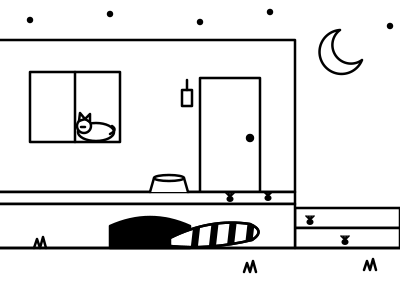
    Every evening, Ben filled the cat bowl on the back porch. Lately, the bowl was empty before breakfast, but his cat was asleep inside. Small muddy prints that looked like tiny hands led up the steps. One night Ben heard a clatter. He saw a bushy tail with dark rings slip under the porch.

    Ben's back porch at night, with an empty cat bowl on the porch, small muddy prints on the steps and a bushy ringed tail sliding under the porch.
    Ben's back porch at night.

    Fill in the chart with three clues from the story.

    Text clueWhat I knowInference


    1. 1.

      Who do you infer is eating the cat food?

    2. 2.

      Why do you think the cat is not the one eating it?

    3. 3.

      Put these in order from least sure to most sure: know, guess, suspect.

    4. 4.

      Write one inference about the story that starts with 'I suspect'.

    Sort the compound words: playground, bedroom, bathtub, backyard.

    1. 5.

      Outside: ____

    2. 6.

      Inside: ____

    Challenge: What do you think Ben will do next? Use a clue.

    Science

    Objective: I can describe tropical climates and the living things that thrive there.

    Standards: 3-ESS2-2, 3-LS4-3

    Builds on: Needs Day 1: tropical climates lie along the equator. Also needs Week 11: a rainforest is warm and very wet. One-minute check: your child points to the red band on the Day 1 map and names its climate (tropical).

    New words:
    • savanna – warm grassland with scattered trees, a rainy season and a long dry season
    • wet season – the months when most of a place's rain falls
    • dry season – the months when little or no rain falls

    Materials: Climate map from Day 1, World atlas or globe, 12 small paper slips, Science notebook, pencil and crayons, Library book with rainforest and savanna pictures (optional)

    1. Day 107 — Tropical Climates — Wonder Warm-Up · 5 min

      Spaced review from Day 1. Ask: "Why is it warm near the equator much of the year?" (Sunlight comes almost straight down, so it is not spread out.) Then the wonder. If you have the library book, show a rainforest and a savanna. Ask: "Both places are warm all year. So why does one grow giant trees and the other mostly grass?"

    2. Mini-Lesson · 10–15 min

      Say: "Tropical climates are warm in every month. What changes from place to place is the rain." Draw this table in the notebook and read it together. Rain in inches. Rainforest town: January 10, April 12, July 6, October 7. Savanna town: January 0, April 1, July 8, October 2. These are sample numbers. Ask: "Which town gets plenty of rain in all four months?" (The rainforest town.) "Which months are dry in the savanna town?" (January, April and October.) Say: "A rainforest has rain in every season. A savanna has a wet season and a long dry season." Ask: "Trees need water all year to grow tall and crowded. Where can they do that?" (In the rainforest.) If stuck, say: "Put your finger on the zero. What could a tree drink that month?" Say: "On a savanna, grasses and scattered trees last through the dry months. The Amazon in South America is the largest rainforest. The Serengeti in Africa is a famous savanna. Herds of wildebeest walk far there, following the rain and fresh grass."

    3. Investigation / Hands-On · 15–20 min

      Rainforest or Savanna Sort. 1) Your child finds the Amazon and the Serengeti in the atlas and marks both on the Day 1 map. 2) Write one name on each slip. Rainforest: toucan, jaguar, poison dart frog, howler monkey, kapok tree, orchid. Savanna: gazelle, lion, giraffe, elephant, acacia tree, tall grass. 3) Mix the slips. Your child sorts them into two columns. 4) Your child picks one slip and tells how that living thing fits its home. Sample: "A giraffe's long neck reaches leaves high in acacia trees." 5) Mix-up test. Move the poison dart frog to the savanna. Ask: "Would it survive well, less well or not at all? What is your evidence?" (Not at all, or less well. A frog's thin skin must stay damp, and the dry season lasts for months.) Accept another answer if the evidence fits.

    4. Science Notebook Entry · 10 min

      Title the page "Tropical Climates." Give the frames: "A tropical climate is ___ all year. A rainforest has ___. A savanna has ___." Sample: "A tropical climate is warm all year. A rainforest has rain in every season. A savanna has a wet season and a long dry season." Then your child draws both places with crayons and labels one plant and one animal in each.

    5. Wrap-Up & Exit Ticket · 5 min

      Read the three exit questions aloud. Praise any answer that gives a reason about rain.

    Watch for: Thinking every tropical place is a thick, wet jungle.

    Try: Point to the savanna town's dry months in the table. Ask: "What would this land look like after months with almost no rain?" (Dry and brown, with few trees.)

    Exit ticket:
    1. A place is warm all year. Rain falls for five months, and almost none falls for seven. Is it a rainforest or a savanna? How do you know?
    2. Why can tall trees grow close together in a rainforest?
    3. A wildebeest eats grass. Would it survive well in a thick, shady rainforest? Give one reason.
    Show answers
    1. A savanna. It has a wet season and a long dry season.
    2. Rain falls in every season, so the trees have water all year.
    3. No, not well. Little grass grows on the dark forest floor, so it would find little food.

    Support: Sort only six slips first: toucan, jaguar, kapok tree, giraffe, lion and tall grass. Add the others once those are placed.

    Extend: Your child draws a bar graph of the rain table, with two bars for each month. Ask which month shows the biggest difference (April, 11 inches).

    Homework: Your child looks in the kitchen for three foods that grow in tropical climates. Look for foods such as bananas, pineapple, cocoa, coconut or mango.

    Practice page · Week 22, Day 2

    Science

    I can describe tropical climates and the living things that live there.

    Rainforest or savanna? Write each living thing in the right column.

    RainforestSavanna


    1. 1.

      orangutan

    2. 2.

      howler monkey

    3. 3.

      macaw

    4. 4.

      cheetah

    5. 5.

      wildebeest

    6. 6.

      baobab tree

    Write your answer.

    1. 7.

      How is a rainforest different from a savanna?

    2. 8.

      Pick one animal. How does it fit its home?

    Challenge: Every month in a tropical place averages above about 64°F. What does that tell you about winter there?

    Materials: a world map · pictures of a rainforest and a savanna