3
    Third GradePowered by ThirdGrade.com

    Daily lesson plan

    Day 2 · Tuesday

    Week 20 · Reasoning: Fractions, Opinion Essays, Weather & Government

    See what your state adds or places differently

    Suggested daily schedule
    8:30–8:45 AM15 minMorning Circle / Read-Aloud / Calendar
    8:45–10:00 AM75 minEnglish Language Arts
    10:00–11:00 AM60 minMathematics
    11:00–11:15 AM15 minSnack and Movement Break
    11:15–12:00 PM30–45 minScience (every day)
    12:00–12:45 PM30–45 minSocial Studies (every day)
    12:45–1:30 PM45 minLunch and Choice Time
    1:30–2:15 PM45 minSpecials: PE / Art / Music (rotating)
    2:15–2:45 PM30 minIndependent Reading & Journaling

    Social Studies

    Objective: I can describe how Congress is set up and how a bill becomes a law.

    Standards: D2.Civ.1.3-5, D2.Civ.5.3-5

    Builds on: Needs Day 1, where Congress is the branch that makes laws. One-minute check: ask, "Which branch makes laws, and what is it called?" (The legislative branch, called Congress.)

    New words:
    • bill – an idea for a law that Congress votes on
    • veto – to reject a bill; only the President can veto a bill from Congress
    • senator – a member of the Senate, one of the two houses of Congress
    • representative – a member of the House of Representatives, the other house of Congress
    • census – a count of every person in the country, taken every 10 years

    Materials: Notebook, Pencil, U.S. map, 2 sheets of paper, 3 sticky notes, Prep notes: the names of your state's two U.S. senators and your U.S. representative. Use a voter guide, a newspaper, a librarian or the official House and Senate websites.

    1. Warm-Up · 5 min

      Spaced review from Week 19. Ask: "What is a term?" (The set number of years an elected leader serves.) Then ask: "Congress makes laws. Do you think every state sends the same number of people?"

    2. Mini-Lesson · 10–15 min

      Say: "Congress has two parts, called houses: the Senate and the House of Representatives." Say: "The Senate has 100 senators. Every state gets 2, large or small. Senators serve 6-year terms." Say: "The House has 435 voting members, called representatives. States with more people get more of them. Representatives serve 2-year terms." Point to California and Wyoming on the map. Say: "California has the most people and more than 40 representatives. Wyoming has few people and 1." Say: "Every 10 years a census counts everyone in the country. Then the House seats are shared out again." Say: "A bill is an idea for a law. A bill must pass both houses. Then it goes to the President. The President can sign it into law or veto it, which means reject it." Ask: "Which house gives every state the same number?" (The Senate.) "Why does California get more representatives than Wyoming?" (More people live there.) "What two choices does the President have with a bill?" (Sign it or veto it.) If stuck, say: "Senate: the same for every state. House: more people, more seats."

    3. Activity / Source Work · 15–20 min

      Bill journey. 1) Your child writes a pretend bill on one sheet of paper: "Every post office must have a bike rack." 2) Label the sticky notes House, Senate and President's desk. Stick them across the room. 3) Stop 1, the House. Everyone votes yes or no. More yes votes means it passes. An even split means it fails. Ask: "Is it a law yet?" (Not yet.) 4) Stop 2, the Senate. Vote again and ask again. 5) Stop 3, the President's desk. Your child, as President, signs or vetoes. If signed, write LAW across the top. If vetoed, say: "Congress can still pass it if two thirds of each house vote yes." 6) Your child writes a second bill on the other sheet. This time it fails in the Senate. Ask: "What happens now?" (It stops. It does not become a law.) 7) Open your prep notes and find your state on the map. Your child fills in: "My state's two U.S. senators are ___ and ___. My U.S. representative is ___." Families in Washington, D.C., or a territory have a non-voting member in the House and no senators. Look for three stops in order.

    4. Notebook Entry · 10 min

      In the notebook, your child draws a building with two sides. Label one side "House: 435 voting members, 2-year terms, more people means more seats." Label the other side with the Senate facts. Copy the filled-in blanks below. Sample label: "Senate: 100 members, 2 from each state, 6-year terms."

    5. Exit Ticket · 5 min

      Read the three questions aloud. Praise answers that tell the two houses apart.

    Watch for: Thinking a bill becomes a law as soon as one house votes yes.

    Try: Walk the journey again. Stop at each sticky note and ask, "Is it a law yet?"

    Exit ticket:
    1. A bill passes the House but fails in the Senate. Is it a law? Explain.
    2. Texas has many more people than Vermont. Which state has more representatives? Which has more senators?
    3. How long is a senator's term? How long is a representative's term?
    Show answers
    1. No. A bill must pass both houses and then go to the President.
    2. Texas has more representatives. Neither has more senators. Each state has 2.
    3. A senator serves 6 years. A representative serves 2 years.

    Support: Use only two numbers, 100 and 435, and the drawing of two houses. Leave the term lengths for the Day 5 review.

    Extend: Ask: "Why do a big state and a small state get the same number of senators?" Share this: in 1787 small states feared being outvoted. So the writers gave every state two.

    Homework: Your child retells the bill journey to a family member, stop by stop. Look for the House, the Senate and the President in order.

    Practice page · Week 20, Day 2

    Social Studies

    I can tell how Congress is set up and how a bill becomes a law.

    Fill in the chart about the two houses of Congress.

    HouseSenate


    1. 1.

      How many voting members are in the House of Representatives?

    2. 2.

      How many members are in the Senate?

    3. 3.

      How many senators does each state have?

    4. 4.

      How long is a representative's term? How long is a senator's term?

    5. 5.

      Put the bill's stops in order: President, Senate, House.

    Fill in with an adult. Use the official House and Senate websites. (If you live in Washington, D.C., or a U.S. territory, write the name of your delegate in the House.)

    1. 6.

      My state's two U.S. senators are ______ and ______.

    2. 7.

      My U.S. representative is ______.

    Challenge: A state has 4 representatives and 2 senators. How many members of Congress does it have in all?

    Materials: U.S. map · paper for a pretend bill
    Mathematics

    Objective: I can place any fraction between 0 and 1 on a number line.

    Standards: 3.NF.A.2.A, 3.NF.A.2.B

    Builds on: Needs the halves, thirds and fourths lines from Week 20 Day 1. One-minute check: draw a 0 to 1 line with 4 equal spaces. Your child points to 1/4 (the first tick after 0).

    Materials: Centimeter ruler, Unlined paper, Pencil, Colored pencil (for drawing jumps)

    1. Warm-Up · 5 min

      Spaced review from Week 13. Your child breaks apart 7 × 6 into 5 × 6 and 2 × 6 (30 + 12 = 42). Then practice ÷6 facts with no clock. Ask 24 ÷ 6, 36 ÷ 6, 48 ÷ 6 and 54 ÷ 6 (4, 6, 8, 9).

    2. Mini-Lesson · 10–15 min

      Say: "Any fraction has a place on the number line. We use three steps." Write them. Step 1: the denominator tells how many equal spaces to make from 0 to 1. Step 2: the numerator tells how many jumps to make from 0. Step 3: mark the landing point and label it. Write 3/8. Draw a line 16 cm long from 0 to 1. Ask: "How many equal spaces?" (8) Make a tick every 2 cm. Say: "Each space is 1/8." Start at 0. Draw 3 jumps as small arcs with the colored pencil. Count: "one eighth, two eighths, three eighths." Mark the point. It is at 6 cm. Label it 3/8. Say: "So 3/8 is the point 3 jumps of 1/8 from 0." Now your child does more. Write 4/6. Your child draws a 12 cm line from 0 to 1. Ask: "How many spaces? How long is each?" (6 spaces; 2 cm each) Your child draws 4 jumps and labels the point. (4/6 is at 8 cm.)

    3. Guided Practice · 10–15 min

      Your child draws each line and the jumps. 1) 2/3 on a 12 cm line. Ticks go at 4 and 8 cm. (2 jumps; 2/3 is at 8 cm.) 2) 5/8 on a 16 cm line with a tick every 2 cm. (5 jumps; 5/8 is at 10 cm.) 3) 1/6 on a 12 cm line with a tick every 2 cm. (1 jump; 1/6 is at 2 cm.) 4) Look at 2/3 again. Ask: "Is it closer to 0 or to 1?" (Closer to 1. It is 8 cm from 0 and 4 cm from 1.) If stuck, say: "Read the denominator. Make that many equal spaces. Now read the numerator and jump."

    4. Independent Practice · 15–20 min

      Use 12 cm lines for halves, fourths and sixths. Use 16 cm lines for eighths. Your child places each fraction and tells the jumps. 1) 1/4 (1 jump; 1/4 is at 3 cm). 2) 2/4 (2 jumps; 2/4 is at 6 cm). 3) 2/6 (2 jumps; 2/6 is at 4 cm). 4) 6/8 (6 jumps; 6/8 is at 12 cm). 5) 1/2 (1 jump; 1/2 is at 6 cm). 6) You draw a 12 cm line with a tick every 2 cm and a dot at 6 cm. Ask: "Which fraction is at the dot?" (3/6) 7) A frog sits at 0 on a line in eighths. It makes 4 jumps of 1/8. Which number does it land on? (4/8) 8) A ladybug sits at 2/6 on a line in sixths. How many more jumps of 1/6 take it to 1? (4) Check each point with the ruler.

    5. Exit Ticket · 5 min

      Your child may sketch a line for each question.

    Watch for: Drawing the ticks by eye, so the spaces are different sizes.

    Try: Your child measures every tick with the ruler, such as every 2 cm, before making any jumps.

    Fact fluency: ÷6 facts

    Exit ticket:
    1. How many equal spaces and how many jumps do you need to place 2/8?
    2. Is 1/3 closer to 0 or closer to 1?
    3. What does the denominator tell you on a number line?
    Show answers
    1. 8 spaces, 2 jumps
    2. Closer to 0
    3. How many equal spaces the distance from 0 to 1 is cut into.

    Support: Draw the lines and ticks first. Your child only counts the jumps and labels the landing point.

    Extend: Your child places 2/8, 4/8 and 6/8 on one 16 cm line and tells the pattern. (They are at 4, 8 and 12 cm. Each is 2 jumps after the last.)

    Homework: Your child draws a 16 cm line from 0 to 1 with a tick every 2 cm. Your child marks 1/8, 2/8 and 5/8 for a family member. Answers: at 2 cm, 4 cm and 10 cm.

    Practice page · Week 20, Day 2

    Mathematics

    I can place any fraction from 0 to 1 on a number line.

    Look: 2/6

    1. Split 0 to 1 into 6 equal spaces (the denominator).
    2. Start at 0 and make 2 jumps (the numerator).
    3. Mark the point and label it 2/6.

    Tell how many equal spaces and how many jumps. Then draw the line and place the point.

    1. 1.

      5/6

    2. 2.

      3/8

    3. 3.

      1/3

    4. 4.

      6/8

    Use your lines.

    1. 5.

      Which is closer to 1: 3/8 or 6/8?

    2. 6.

      Which is closer to 0: 1/3 or 5/6?

    3. 7.

      Nadia swims 5/8 of the way across the pool. How many more 1/8 jumps does she need to reach 1?

    Challenge: A point is 1 jump away from 1 on a sixths line. What fraction is it?

    English Language Arts

    Objective: I can find evidence in an informational text, including cause-and-effect facts, to support an opinion.

    Standards: W.3.1.B, RI.3.1, RI.3.3, W.3.8

    Builds on: Needs Day 1, telling a reason from evidence, and the cause-and-effect clue words from Week 7. One-minute check: say, "I was late because the bus broke down." Ask: "What is the cause?" (The bus broke down.)

    Materials: Writer's notebook, Essay draft, Pencil

    1. Warm-Up · 5 min

      Word study: build words. Your child writes each base word, adds the suffix and underlines the base. break + able, read + able, enjoy + able, move + ment, pay + ment, excite + ment. (breakable, readable, enjoyable, movement, payment, excitement) Ask: "Did move or excite lose the final e?" (No. The suffix -ment starts with a consonant, so the e stays.) Spaced review from Week 17. Ask: "What is a source?" (Where a fact came from, such as a book, an article or a person.)

    2. Mini-Lesson · 10–15 min

      Say: "Evidence can come from your life, from what you know and from what you read. Evidence from a text is very convincing." Read the article aloud. Then your child reads it from this page. "Soap at Work." Your hands touch hundreds of things every day. Doorknobs, pencils and pets all leave tiny germs on your skin. Germs are too small to see, but some of them can make you sick. Water alone does not wash them all away. When you rub soap on your hands, it loosens the dirt, oil and germs. Because the soap lifts them off your skin, running water can carry them down the drain. Good washing has steps. First, wet your hands and add soap. Next, scrub the fronts, the backs and between your fingers for about 20 seconds. Finally, rinse well and dry with a clean towel. Clean hands carry fewer germs, so washing before meals helps keep a family healthy. Say: "Some words signal cause and effect: because, so and when." Set an opinion together: "Kids should wash their hands before every meal." Think aloud: "I see the word when. The cause is rubbing soap on your hands. The effect is that dirt, oil and germs come loose." Draw it in the notebook: soap rubbed on hands, then an arrow, then loose germs. Say: "To use a fact from a text, name the source." Write: "According to 'Soap at Work,' soap loosens the germs on your skin."

    3. Guided Practice · 10–15 min

      1) Ask: "Find the sentence with because. Which part is the cause? Which part is the effect?" (Cause: the soap lifts the germs off your skin. Effect: running water can carry them down the drain.) 2) Ask: "Find the word so. What does washing before meals do?" (It helps keep a family healthy.) 3) Write that fact together as evidence. Sample: "According to 'Soap at Work,' clean hands carry fewer germs, so washing before meals keeps families healthy." 4) Ask: "What do you do first, next and last when you wash?" (Wet your hands and add soap. Scrub for about 20 seconds. Rinse and dry.) If stuck, say: "Put your finger on the clue word. What comes before it? What comes after it?"

    4. Independent Practice · 15–20 min

      1) Your child draws two cause-and-effect arrows from the article in the notebook. 2) They write two evidence sentences for the opinion. Each one names the source. One uses a cause and effect. One uses the order of events. Sample: "According to the article, scrubbing takes only about 20 seconds, so washing never makes a meal late." 3) Your child rereads their own essay draft. They mark one spot where a fact from reading would help. In the margin they note a book or person that could give that fact. Look for: sentences that start with "According to," facts in your child's own words, and facts that fit the opinion.

    5. Exit Ticket · 5 min

      Your child may look back at the article. They answer aloud or in the notebook.

    Watch for: Copying a whole sentence from the text without telling where the fact came from.

    Try: Your child covers the article and says the fact aloud. Then they write it, starting with "According to."

    Exit ticket:
    1. According to the article, why can you not tell just by looking that your hands are clean?
    2. Which clue word shows the effect? "I scrubbed with soap, so my hands were clean."
    3. Start a sentence that names where a fact came from. Use the title of a book you know.
    Show answers
    1. Germs are too small to see.
    2. so
    3. Answers vary. Look for: "According to" plus a title, then a comma.

    Support: Read the article one sentence at a time. After each, ask: "What happened, and why?"

    Extend: Your child writes a three-sentence paragraph for the opinion. It uses one cause-and-effect fact and one fact about the order of events.

    Homework: Read a nonfiction book or article for 15 to 20 minutes. Write one fact from it that could support an opinion. Start with "According to." Look for: the title is named and the fact is in your child's own words.

    Practice page · Week 20, Day 2

    English Language Arts

    I can find cause-and-effect evidence in an article and name the source.

    Look: Evidence from a text

    1. Find a sentence that supports the opinion.
    2. Look for cause-and-effect clue words: because, so, when.
    3. Name the source: According to (title), ...

    Rain Gardens

    A rain garden is a low spot of soil planted with flowers and grasses. When rain falls on roofs and roads, the water rushes into storm drains. A rain garden catches some of that water. Because the soil and plant roots soak up the water, fewer puddles form in the street. The flowers bloom, so bees and butterflies come to visit. First, a family digs a shallow bowl in the yard. Next, they plant tough plants. Finally, the garden drinks the rain after every storm.

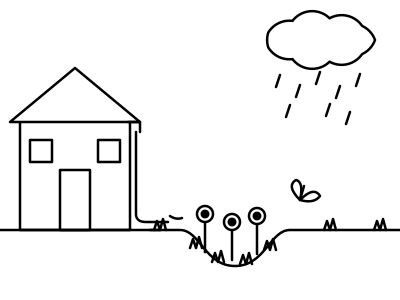
    A house with a small flower garden planted in a low dip in the front yard while rain falls from a cloud.
    A rain garden sits lower than the yard around it.

    Use the article.

    1. 1.

      Circle the clue words because, so and when.

    2. 2.

      Cause: the soil and plant roots soak up the water. Effect: ____

    3. 3.

      Cause: the flowers bloom. Effect: ____

    4. 4.

      Put the steps in order: plant tough plants, dig a shallow bowl, the garden drinks the rain.

    5. 5.

      Opinion: Every street should have a rain garden. Write an evidence sentence that names the source.

    Add -ment to make a noun.

    1. 6.

      agree + ment = ____

    2. 7.

      Circle the noun: move or movement.

      ○ move○ movement

    Challenge: Find one more fact in the article that could support the opinion.

    Science

    Objective: I can use a table of monthly averages to describe the climate pattern where I live.

    Standards: 3-ESS2-2, 3-ESS2-1

    Builds on: Needs Day 1: climate is the usual weather over many years. Also needs bar graphs and subtraction within 100 from math. One-minute check: your child solves 85 − 35 (50).

    New words:
    • average – the usual, middle amount you get when you even out many numbers

    Materials: Graph paper or ruled notebook paper, Ruler, Red and blue colored pencils, Science notebook with the Weather Log, Pencil, Optional: monthly average temperatures for your own town from a library almanac

    1. Day 97 — Climate Patterns Over Time — Wonder Warm-Up · 5 min

      Spaced review from Week 11. Ask: "What does it mean when an animal migrates?" (It travels to another place each year for food or better weather.) Then the wonder. Ask: "Next July has not happened yet. How could we know what it will probably be like?" (We can look at what July is usually like.)

    2. Mini-Lesson · 10–15 min

      Say: "An average is the usual, middle amount. You get it by evening out many numbers." Say: "A monthly average high tells how warm the afternoons of that month usually get. It comes from many years of records." Show this table for Sample City. January 30°F, April 52°F, July 77°F, October 56°F. Ask: "What happens from January to July?" (It gets warmer.) Ask: "By how many degrees?" (47 degrees.) Ask: "What happens from July to October?" (It cools by 21 degrees.) Say: "The same pattern comes back every year. So people there can expect warm summers and cold winters." Say: "Seasons group the months. In the United States, winter is December to February. Summer is June to August." Point to one row of the Weather Log. Say: "One day can sit above or below the average. The average is the middle." Ask: "Sample City has a 40°F day in January. Is that above or below the usual?" (Above, by 10 degrees.) If stuck, say: "Find the month's average. Is the day's number bigger or smaller?"

    3. Investigation / Hands-On · 15–20 min

      Graph a Climate. 1) Read these average highs for Maple Town aloud while your child copies them into a table. January 35°F, February 40°F, March 50°F, April 62°F. May 72°F, June 80°F, July 85°F, August 83°F. September 76°F, October 64°F, November 52°F, December 40°F. 2) Your child draws a bar graph. Months go along the bottom. The side is numbered by 10s from 0 to 90. 3) They draw each bar with the ruler. A value such as 62 sits just above the 60 line. 4) They color the three warmest months red and the three coolest blue. 5) They add a title and label both sides. 6) Ask: "What pattern do you see?" (It warms from January to July, then cools.) 7) Ask: "Which season is best for a lake swim in Maple Town? Use the data." (Summer. Its averages are 80°F or more.) Expect red on June, July and August, and blue on December, January and February. If you have your own town's numbers, graph them another day and compare.

    4. Science Notebook Entry · 10 min

      Your child glues or copies the graph and finishes this frame. "The warmest month is ___ at ___°F. The coldest month is ___ at ___°F. The pattern is ___." Sample: "The warmest month is July at 85°F. The coldest month is January at 35°F. The pattern is warming until July, then cooling until January."

    5. Wrap-Up & Exit Ticket · 5 min

      Ask the three exit questions with the graph in view. Praise any answer that uses a number from the graph.

    Watch for: Treating the monthly average as the exact temperature on every day of that month.

    Try: Point to January on the graph. Say: "Some January days are above 35 and some are below. The average is the middle."

    Exit ticket:
    1. Use your Maple Town graph. What is the difference between the June bar and the March bar?
    2. A July day in Maple Town reaches only 70°F. Is that above or below the usual, and by how much?
    3. Why do scientists use many years of records, not one year, to find a monthly average?
    Show answers
    1. 30 degrees (80 − 50 = 30).
    2. Below the usual, by 15 degrees (85 − 70 = 15).
    3. One year can be unusual. Many years evened out show what is usual.

    Support: Your child graphs only four months: January, April, July and October. They still describe the pattern.

    Extend: Your child graphs a second place and compares. Use almanac numbers for your own town. Or use Island City: 86°F, 89°F, 88°F and 88°F for January, April, July and October.

    Homework: Compare today's noon reading with Maple Town's average for the same month. Look for: "above" or "below" and the difference in degrees.

    Practice page · Week 20, Day 2

    Science

    I can use a table of monthly averages to describe a climate pattern.

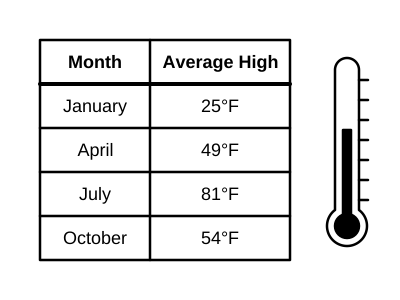
    Average Highs in Maple Falls

    January: 25°F. April: 49°F. July: 81°F. October: 54°F.

    A table of average high temperatures in Maple Falls: January 25°F, April 49°F, July 81°F and October 54°F, next to a thermometer.
    Each number is an average of many years of weather.

    Use the table in the box to answer.

    1. 1.

      Which month in the table is warmest?

    2. 2.

      How many degrees warmer is July than January?

    3. 3.

      How many degrees does it cool from July to October?

    4. 4.

      Describe the pattern in one sentence.

    Graph Our Climate. Make a bar graph of your town's 12 monthly average highs. Count by 10s up the side.

    MonthAverage high (°F)


    1. 5.

      Our town's warmest month:

    2. 6.

      Our town's coldest month:

    Challenge: Why do scientists use many years of weather to describe a climate?

    Materials: your town's monthly averages · graph paper · a ruler · red and blue colored pencils

    Standards-matched clips that reinforce today's objectives.

    Mathematics
    3:21

    Fractions on a Number Line Song | 3rd Grade & 4th Grade

    NUMBEROCK Math Songs

    Supports: I can place any fraction between 0 and 1 on a number line.

    3.NF.A.2.A
    3.NF.A.2.B
    Watch on YouTube